
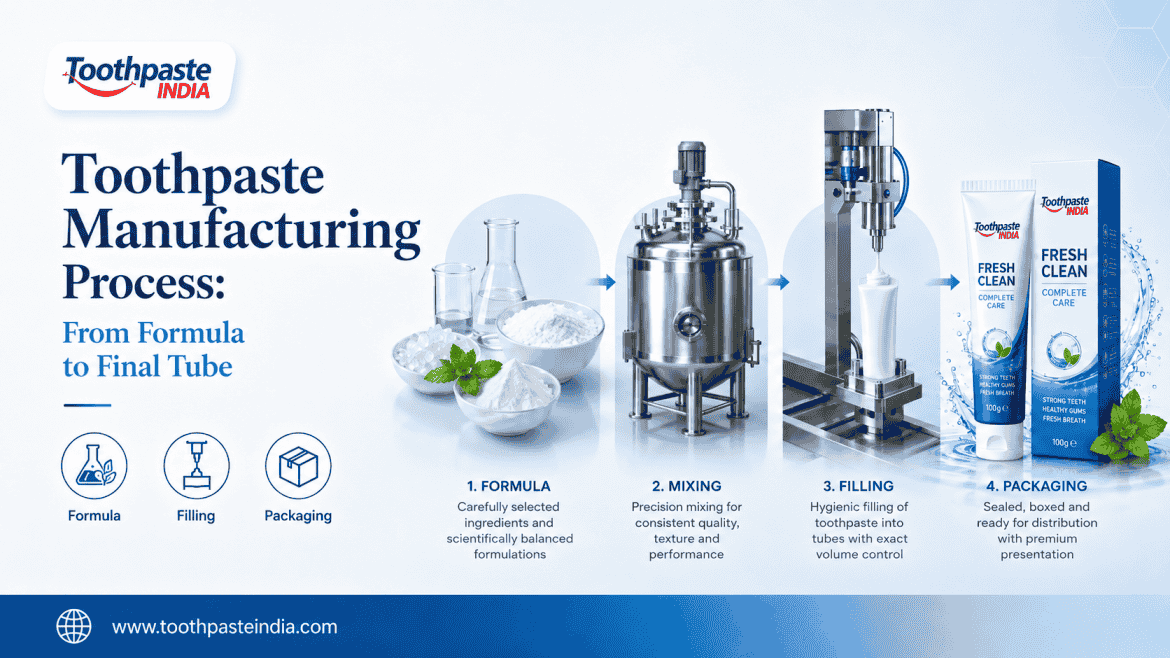

Launching or scaling an oral care brand requires more than just marketing; it demands a deep understanding of how commercial toothpaste manufacturing works at scale. For B2B brand owners, distributors, D2C startups, and pharmaceutical companies, understanding the toothpaste manufacturing process is critical to ensuring product quality, regulatory compliance, and market success. Developing a product from formula to final tube involves precise chemistry and high-speed automation. At Toothpaste India a leading oral care manufacturer in India based in Ahmedabad, Gujarat. We operate a state-of-the-art facility specializing in private label and contract manufacturing to turn your product vision into a market-ready reality.
What is the Toothpaste Formulation Process in Commercial R&D?
Toothpaste formula development is the systematic phase where scientists select and balance active and inactive components to achieve specific therapeutic and cosmetic benefits. The toothpaste formulation process is the foundation of any successful oral care product, determining the paste’s stability, flavor release, and shelf life long before bulk mixing begins.
During R&D, chemical compatibility is paramount. A toothpaste formulation manufacturer must balance humectants, binders, and abrasives to ensure the active ingredients (such as fluoride or herbal extracts) remain stable and biologically active. In our Ahmedabad R&D laboratory, our chemists analyze physical parameters using accelerated stability chambers to simulate a two-year shelf life under varying climatic conditions (such as Zone IV climates).
Understanding the role of essential toothpaste ingredients is critical during formulation:
Humectants: A humectant is a liquid ingredient that retains moisture to prevent the paste from drying out when the tube is opened. Sorbitol (70% solution) and glycerin are the most widely used humectants, which also provide a subtle sweetness and smooth texture.
Abrasives: An abrasive is an insoluble polishing agent that mechanically removes dental plaque, debris, and surface stains. Hydrated silica and precipitated calcium carbonate are the industry standards, selected based on their particle size to maintain a safe Relative Dentin Abrasivity (RDA) value below 250.
Binders (Thickeners): A binder is a hydrophilic polymer that increases viscosity and prevents liquid-solid phase separation. We utilize sodium carboxymethyl cellulose (CMC), xanthan gum, or carrageenan to create a stable network that suspends abrasive particles.
Surfactants (Foaming Agents): A surfactant is a foaming agent that reduces surface tension to help disperse the toothpaste throughout the mouth. Sodium Lauryl Sulfate (SLS) is standard, though we offer SLS-free formulations using sodium lauroyl sarcosinate for sensitive or natural oral care lines.
Active Agents: These ingredients deliver clinical benefits. Examples include sodium fluoride for cavity protection, potassium nitrate for desensitization, and zinc citrate for tartar control.
How is Toothpaste Made? The Phase-by-Phase Toothpaste Mixing Process
If you have ever wondered how toothpaste is made, the secret lies in high-shear blending under strict environmental controls. In a commercial facility, the toothpaste production process is conducted in a Class 100,000 cleanroom (ISO 8 environment) to prevent microbial contamination.
The toothpaste mixing process is executed in large-scale vacuum emulsifier mixers. Performing this step under a vacuum is crucial because it prevents air entrapment. Eliminating air bubbles ensures a smooth, glossy paste, prevents the oxidation of active ingredients, and guarantees accurate volumetric dosing during the filling stage.
The toothpaste batch manufacturing sequence follows these precise steps:
Binder Hydration: Binders are pre-dispersed in humectants to prevent clumping. This mixture is then combined with water in the vessel and stirred until a uniform, hydrated gel is formed.
Abrasive Incorporation: Dry powders, including calcium carbonate or hydrated silica, are introduced into the mixer under vacuum. The high-shear homogenizer runs at speeds up to 3,000 RPM to break down agglomerates and create a smooth dispersion.
Active Phase Addition: Soluble active ingredients, sweeteners (such as sodium saccharin), and preservatives are dissolved separately and drawn into the main mixture.
Flavor and Surfactant Blending: Flavors and foaming agents are added during the final stages of mixing. Because surfactants are prone to excessive foaming, they are mixed at lower speeds and under high vacuum to maintain the paste’s density.
Once the batch meets our viscosity and density parameters, it is transferred to hygienic stainless-steel holding tanks for filling.
How Does the Toothpaste Tube Filling Process Work?
Once bulk blending is complete, the paste is pumped to the packaging lines. The toothpaste tube filling process utilizes high-speed, automated machinery to convert empty laminates into sealed, retail-ready products.
The paste is transferred into the hopper of an automatic toothpaste filling machine. This machine utilizes volumetric dosing pumps to inject a precise weight of paste into the open bottom of each tube.
The primary steps in the filling and packaging line include:
Tube Feeding and Orientation: Empty tubes made of ABL (Aluminum Barrier Laminate) or PBL (Plastic Barrier Laminate) are loaded into a rotary cassette. Photocell sensors scan the registration mark on each tube, rotating it to align the artwork correctly.
Bottom-Up Filling: The filling nozzle descends deep into the tube. As the paste is injected, the nozzle retracts slowly. This bottom-up method prevents air pockets from forming inside the tube.
Toothpaste Tube Sealing: After filling, the open tail is sealed. For laminate tubes, we use hot-air sealing, where hot air is blown inside the tube tail before high-pressure jaws compress and weld the plastic layers. For plastic tubes, ultrasonic sealing is utilized.
Coding and Trimming: The sealing jaws emboss the batch number, manufacturing date, and expiry date onto the sealed tail. A cutting blade then trims the excess laminate to create a clean, rounded finish.
Toothpaste Packaging Process: Sealed tubes are automatically discharged from the rotary dial and pushed into individual cartons. These cartons pass through a checkweigher, are collated into shrink-wrapped bundles, and are finally packed into corrugated shipper boxes.
What are the Toothpaste Quality Control Standards for B2B Export?
Operating a commercial toothpaste manufacturing facility requires strict adherence to international safety and quality standards. In India, oral care products are regulated under the Drugs and Cosmetics Act, 1940, and must comply with the Bureau of Indian Standards (BIS IS 6356) specifications.
Our comprehensive toothpaste quality control protocol is structured across three stages:
Raw Material Testing: We verify the purity and microbiological status of every inbound raw material. Active ingredients like sodium fluoride are assayed to confirm chemical potency.
In-Process Quality Assurance: During mixing, every batch is checked for pH balance, viscosity (measured using a Brookfield viscometer), and density. A batch is only released for filling once it passes these checks.
Finished Goods Testing: We test final packaged tubes for seal strength, leaks, weight accuracy, and microbiological cleanliness. Finished goods undergo stability testing under different temperature profiles to ensure no separation occurs.
Which Toothpaste Contract Manufacturing Process is Best for Your Brand?
Selecting the right partner and business model is key to optimizing your supply chain. As an established toothpaste manufacturer in India, we offer several flexible manufacturing models to suit your business scale:
Private Label Toothpaste Manufacturing Process: Ideal for brands wanting a fast market launch. You select from our library of clinically validated, pre-developed formulations, and we package them with your brand design.
White Label Toothpaste Manufacturing Process: Perfect for bulk distributors or promotional campaigns. This model uses standard formulas and generic packaging options for maximum cost efficiency.
OEM Toothpaste Manufacturing Process (Original Equipment Manufacturer): Best for brands with proprietary formulas. You supply the exact chemical specifications, and we serve as the manufacturing facility that processes and packs the product.
Third Party Toothpaste Manufacturing Process / Contract Manufacturing: A full-service partnership. We manage the entire lifecycle, including formula optimization, raw material sourcing, regulatory compliance (FDCA/Ayush licensing), batch production, and custom packaging.
Why Choose an Ahmedabad-Based Toothpaste Manufacturer in India?
Partnering with an oral care manufacturer in India offers significant competitive advantages, particularly when located in Gujarat. Ahmedabad is a major industrial hub with excellent logistics connectivity, proximity to container ports (like Mundra and Kandla), and access to high-quality raw materials.
Toothpaste India combines local cost efficiencies with world-class quality systems. Whether you require a private label toothpaste manufacturer to launch an organic neem gel or a third party toothpaste manufacturer to scale a pharmaceutical desensitizing paste, our facility provides the scalability and regulatory expertise you need.
Contact our B2B team today to discuss your project, request custom formulation samples, or arrange a physical audit of our Ahmedabad manufacturing plant.
Frequently Asked Questions
Commercial toothpaste is made by hydrating polymeric binders in a liquid phase of water and humectants, dispersing solid abrasives and active ingredients in a high-shear vacuum mixer to prevent air bubbles, transferring the batch to holding tanks, and using automated rotary machines to fill and seal the paste into laminate tubes.
Vacuum mixing is essential because it prevents air entrapment within the dense paste. Air bubbles can oxidize active ingredients like fluoride, cause product spoilage, alter the viscosity, and lead to inaccurate volumetric filling or aesthetic defects in the final packaged tubes.
ABL (Aluminum Barrier Laminate) tubes contain a thin layer of aluminum sandwiched between plastic layers, providing excellent barrier protection against oxygen and moisture. PBL (Plastic Barrier Laminate) tubes are entirely plastic, offering superior aesthetic options like clear designs and better shape retention when squeezed.
In India, toothpaste is categorized as a cosmetic or drug under the Drugs and Cosmetics Act, 1940. Manufacturing facilities must secure licenses from state Food and Drug Control Administrations (FDCA) and comply with specifications set by the Bureau of Indian Standards (BIS IS 6356).
We control abrasiveness by selecting specific grades of abrasives (like hydrated silica or precipitated calcium carbonate) with precise size distributions. Formulations are tested using the Relative Dentin Abrasivity (RDA) index to ensure they clean teeth effectively without scratching enamel.
Yes, a private label toothpaste manufacturer like Toothpaste India can formulate both types. We develop fluoridated toothpastes for cavity protection under regulatory limits, and fluoride-free versions using natural ingredients, calcium hydroxyapatite, or herbal extracts to meet clean-label consumer demand.
Commercially manufactured toothpaste typically has a shelf-life of 2 to 3 years from the date of manufacture. This is validated through accelerated stability testing, where the product is exposed to high temperatures and humidity to monitor physical and chemical changes over time.
Look for a manufacturer with ISO 22716 (GMP for Cosmetics), WHO-GMP, FDA or state FDCA manufacturing licenses, Halal, Cruelty-Free, and organic certifications (if formulating natural pastes). These certifications demonstrate compliance with global safety, hygiene, and ethical standards.
The Ayurvedic toothpaste manufacturing process requires a dedicated manufacturing license under the Ayush department of India. The formulation uses specific herbal extracts (like neem, clove, and babool) and requires careful temperature control during mixing to preserve the therapeutic properties of the botanical ingredients.