
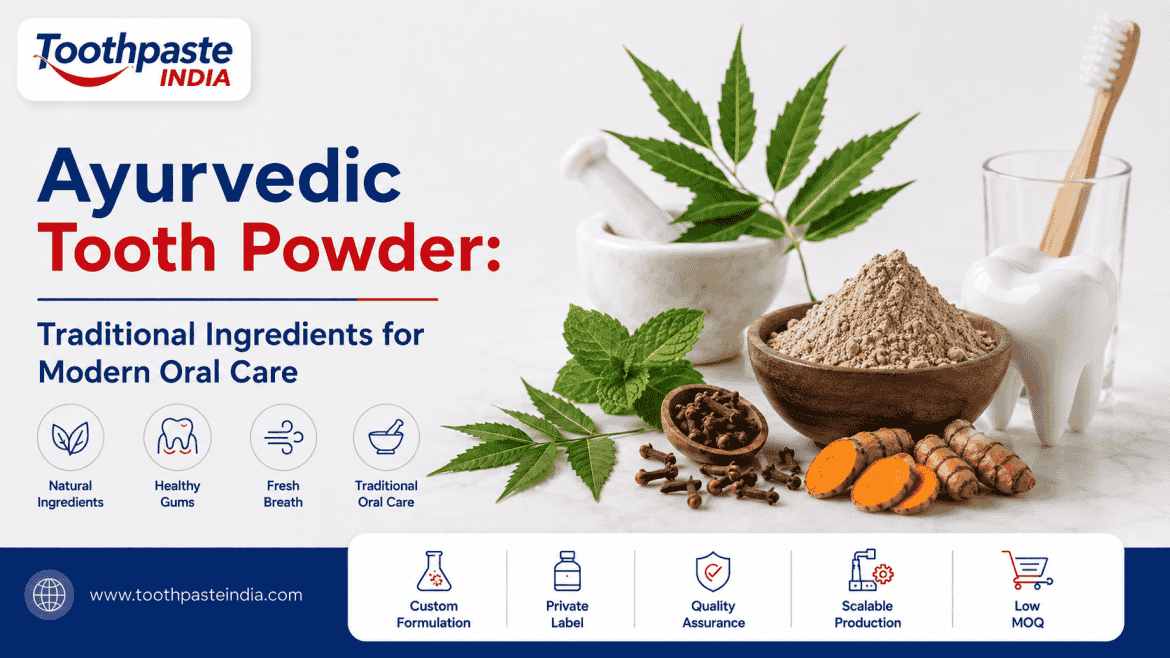

Ayurvedic tooth powder combines India’s traditional oral care practices with the quality, safety and formulation controls of modern dental products. Ayurvedic dant manjan or ayurvedic manjan, also called ayurvedic dental powder, is the form that is getting a renewed interest among natural oral-care brands, D2C startups, distributors and exporters.
But commercially successful powder is not just a matter of mixing herbs. Ingredient particle size, abrasivity, flavor balance, moisture control, microbial quality, packaging and regulatory compliance all have an impact on the finished product.
The opportunity for brands entering the category is to update a familiar format without making unsupported medicinal claims.
Ayurvedic Tooth Powder and How it Works
Ayurvedic tooth powder is a dry preparation for oral cleaning prepared with herbal ingredients and appropriate cleaning, polishing, flavoring or functional ingredients.
Compared to toothpaste, which usually has a semi-solid base with components like humectants and water, an ayurvedic teeth cleaning powder is mostly dry. For mechanical cleaning of the teeth. Apply to toothbrush or use as directed on its label.
Indian consumers are used to traditional terms like dant manjan. Depending upon the formula and branding strategy, modern products may therefore be positioned as ayurvedic herbal tooth powder, natural ayurvedic tooth powder, ayurvedic tooth care powder or ayurvedic dental care powder.
One major difference is that “natural” or “Ayurvedic” doesn’t necessarily mean a product is gentle. Still needs careful formulation: Particle size, abrasives, essential oils, botanical concentrations.
Common Ingredients In Ayurvedic Tooth Powder?
The choice of the best ingredients for an ayurvedic tooth powder depends on the product concept, the target consumer, the regulatory category and the claims you want to make.
Some common traditional and modern ingredient options are:
- Neem: Traditionally used as a part of oral-care routines in India, and commonly used in herbal dental products.
- Clove: Has a warm recognizable flavor and naturally occurring eugenol. It calls for careful control of its concentration.
- Triphala A traditional Ayurvedic blend of amla, haritaki and bibhitaki.
- Babool: Well-known for use in traditional gum-care products.
- Miswak: Used in a number of traditional oral hygiene systems.
- Licorice or mulethi: Can add to herbal positioning and flavor complexity.
- Mint and menthol: To impart freshness and increase acceptance by consumers.
- Salt: Sometimes used in traditional style cleansing formulations, if the overall abrasive system is appropriate.
- Calcium-based polishing materials: May be used for effective mechanical cleaning.
- Xylitol: a modern formulation option for brands developing a xylitol tooth powder Xylitol is not a classical Ayurvedic ingredient. It is better suited as part of a modern herbal-plus-science concept.
The dant manjan ingredients should not be included just because they sound traditional. A manufacturer has to look at ingredient specifications, compatibility, particle size, sensory profile, permitted use and performance of the end product.
Some research suggests that individual herbs used in the formula merit further study. For example, a small randomized double-blind clinical trial with 30 participants demonstrated improvements in plaque and gingival measures with a neem-containing toothpaste. Importantly, this evidence relates to the toothpaste tested and should not be taken as evidence that all neem tooth powders will produce similar results.
Triphala has been investigated in mouth rinses. A systematic review in 2020 evaluated seven randomized controlled trials of Triphala mouthrinse for the treatment of plaque-induced gingivitis. This gives useful ingredient level evidence but does not replace testing of the final tooth-powder formulation.
What Are The Benefits Of Ayurvedic Tooth Powder?
The main practical benefits of the ayurvedic tooth powder lie in the effective mechanical cleaning, freshening and the sensory or functional contribution of the selected ingredients.
A properly formulated ayurvedic tooth and gum powder can help:
- Scrub for food debris and surface deposits
- Support regular oral hygiene
- Leaves the mouth feeling cleaner and fresher.
- Offer a traditional herbal oral care experience
- Give a powder option for people that like powders
- Support no fluoride, no SLS or other specialized positioning if the formulation actually meets those criteria
An ayurvedic gum powder should still be promoted cautiously. Claims like “supports everyday gum care” are very different from claims that a product cures gum disease.
This is the same with an ayurvedic teeth whitening powder. Brushing with a cleaning powder may remove some surface staining but brands should not suggest professional bleaching or guarantyd whitening without adequate evidence.
How to Use Ayurvedic Tooth Powder?
Ayurvedic powder for teeth should be used as directed by the manufacturer, typically in a small quantity with a soft toothbrush and gentle brushing.
A workable routine might be:
- If the label says so, wet the toothbrush.
- Sprinkle a bit of powder on the brush.
- Don’t scrub hard, brush gently.
- Clean all accessible surfaces of the teeth.
- Spit the product out and rinse as directed.
Those looking for “ayurvedic teeth whitening powder how to use” should be warned against over-brushing or using large amounts in an attempt to get results faster. More abrasion does not mean better cleaning.
How is Ayurvedic Tooth Powder Manufactured on Commercial Scale?
Commercial manufacturing of ayurvedic tooth powder requires controlled raw materials, uniform mixing and quality checks, not a simple household-type mixing.
Here’s a typical private-label manufacturing workflow:
1. Formulation of the Formula
First the manufacturer defines the product positioning – herbal, fluoride-free, fresh-breath, gum-care, traditional dant manjan, premium botanical or some other concept.
Botanical ingredients, polishing agents, flavors and functional components are then chosen to meet the formulation brief and relevant requirements.
2. Qualification of raw material
Incoming herbs, minerals, flavors and other ingredients must be checked against approved specifications. Botanical raw materials have particular requirements for identity, quality, contamination risk and supplier documentation.
3. Milling, Sieving and Particle Size Control
The fineness of the powder is important since coarse particles can result in an unpleasant mouthfeel and may lead to increased unwanted abrasion. Hence, ingredients need to be controlled in particle size prior to final blending.
4. Blending under control
Add the measured ingredients and blend until they are well combined. For flavors and potent ingredients, it is important to accurately dose so that one portion of the batch is not significantly stronger than another.
5. Evaluation of Quality
Finished-product testing can include physical characteristics; microbiological quality; contaminants and other specification parameters, depending on the formulation and applicable standard.
The BIS standard IS 5383:2021 lays down the requirements of tooth powder along with sampling and test methods.
6. Filling and Packing
Low-moisture protection is especially important for powders. Jars, bottles, dispensers or other packs should minimize contamination and moisture ingress but allow for easy daily dispensing.
The compatibility of the packaging should be evaluated before commercial production for private label projects or bulk ayurvedic tooth powder.
What Regulations Apply to Ayurvedic Tooth Powder in India?
For an oral-cleansing powder that is marketed under cosmetics regulatory route, India’s Cosmetics Rules, 2020 is highly relevant.
The Cosmetics Rules explicitly mention “Tooth cleansing powder / salt” in the category of oral-care cosmetic. The rules also bring the manufacture for sale or distribution of cosmetics under the competent State Licensing Authority.
The Ninth Schedule also states that finished tooth powder shall conform to the Indian Standard specified by the Bureau of Indian Standards (BIS) and the Indian Standard for tooth powder shall be IS 5383. Present BIS specification is IS 5383 : 2021.
For brand owners, this is an important distinction. If a product is making therapeutic claims as an Ayurvedic medicine rather than normal cosmetic claims of oral-cleansing, then its regulatory pathway may be different. The formulation, intended use, label and claims should therefore be reviewed with the appropriate regulatory professional or authority prior to launch.
Further, brands should also avoid false or misleading cosmetic claims as CDSCO has clearly mentioned that cosmetics should not make false or misleading claims to the users.
How Can Brands Select the Top Ayurvedic Tooth Powder Manufacturer in India?
The best manufacturing partner is one that can blend traditional ingredient knowledge with controlled formulation, testing, compliance and scalable production.
Brand owners should assess before choosing an ayurvedic tooth powder manufacturer:
- Formulation and R&D Capacity
- Experience with tooth powder and toothpaste
- Raw material records
- Batch consistency controls
- Product testing ability
- Support with labeling and regulatory
- Custom choices of flavor and ingredients
- Support for packaging
- MOQ requirements
- Production capability at scale
- Export documentation if required
A private label ayurvedic tooth powder maker should also explain what claims can realistically be supported rather than just adding every marketing claim requested to the label.
If the future product line has pastes and powders, then working with an experienced ayurvedic toothpaste manufacturer or private label ayurvedic toothpaste manufacturer can make range extension easier.
Toothpaste India, an Ahmedabad-based B2B oral care manufacturer, partners with brand owners, distributors, D2C businesses and other companies seeking private-label and contract manufacturing solutions.
Commercial searches such as “best ayurvedic tooth powder in India” refer to a completed product, while searches like “ayurvedic powder near me” often indicate a local buying intent. B2B buyers, however, should put more emphasis on formulation quality, compliance, testing, scalability and manufacturer reliability.
Why Traditional Oral Care Requires Modern Formulation Criteria
Traditional ingredients can offer powerful product differentiation, but the consistency and safety of the product determine whether the concept works as a modern consumer product.
This is very important with ayurvedic tooth powder for teeth because all the ingredients come into contact with the teeth, gums and oral tissues during use. The right balance of cleansing performance, powder fineness, flavor, botanical identity and consumer comfort is needed for a successful formula.
Research on herbal ingredients can guide formulation decisions but claims should be based on the finished product and associated evidence and not automatically transferred from an individual ingredient.
Conclusion
Ayurvedic tooth powder represents a strong connection between traditional Indian oral care and contemporary private-label product development. Carefully designed botanicals, flavors, fluoride or fluoride-free concepts, contemporary packaging and dant manjan positioning can help brands differentiate.
For commercial success, however, quality of the formula, controlled abrasivity, ingredient documentation, compliance and credible claims matter more than just adding more herbs.
If you are planning to launch an ayurvedic tooth powder, ayurvedic dant manjan or complete herbal oral-care range, get in touch with Toothpaste India to discuss custom formulation, private-label manufacturing, packaging and bulk production requirements.
Frequently Asked Questions
Ayurvedic tooth powder is a dry oral-care product that combines traditional botanical ingredients with cleansing and polishing components. It is generally used with a toothbrush for routine oral hygiene and may be marketed as ayurvedic dental powder, ayurvedic manjan or herbal dant manjan depending on the product concept.
Common options include neem, clove, babool, triphala, miswak, mulethi, mint and suitable cleansing or polishing ingredients. The exact ayurvedic tooth powder ingredients should be selected according to safety, sensory performance, intended claims and applicable regulatory standards rather than simply maximizing the number of herbs.
The best dant manjan powder should have a controlled particle size, balanced cleaning action, acceptable flavour, consistent botanical quality, microbiological control and compliant labelling. The best dant manjan is not necessarily the formula containing the highest number of herbs or the strongest abrasive ingredients.
The best ayurvedic powder for teeth depends on the user’s oral-care needs and the formula’s quality. Consumers should prefer products with clear ingredient information, appropriate usage directions and credible manufacturing standards. People with existing dental problems should seek professional dental advice rather than relying on a powder as treatment.
An ayurvedic teeth whitening powder may help clean some external surface staining through brushing, depending on its formulation. It should not automatically be considered equivalent to professional tooth whitening or bleaching. Brands should use whitening claims only when they can substantiate the expected effect of the finished product.
Persistent toothache needs dental evaluation. Searches such as “ayurvedic tooth pain” may reflect interest in traditional remedies, but tooth pain can result from decay, infection, fractures, gum problems or other causes that a tooth powder cannot reliably diagnose or treat.
A properly formulated ayurvedic tooth care powder can be designed for routine use, but suitability depends on abrasivity, ingredients, particle size and individual oral condition. Users should follow the label directions and avoid forceful brushing. Anyone with persistent sensitivity or gum irritation should consult a dental professional.
Tooth powder is a dry cleansing format, while toothpaste is normally a semi-solid formulation containing a liquid phase, humectants and other ingredients. Both can incorporate herbal ingredients. The better format depends on consumer preference, formulation objectives, active ingredients and desired market positioning.
Yes. A private label ayurvedic tooth powder manufacturer can develop the formula, flavour profile, packaging and production specifications for a brand. Before launch, the product’s regulatory category, ingredient compliance, test requirements and marketing claims should be reviewed according to current Indian regulations and target export-market requirements.
Yes. A qualified manufacturer can produce bulk ayurvedic tooth powder for distributors, private-label brands, exporters and D2C companies. Scaling requires controlled raw materials, validated batch quantities, uniform powder blending, suitable testing and moisture-resistant packaging so that product quality remains consistent across commercial batches.