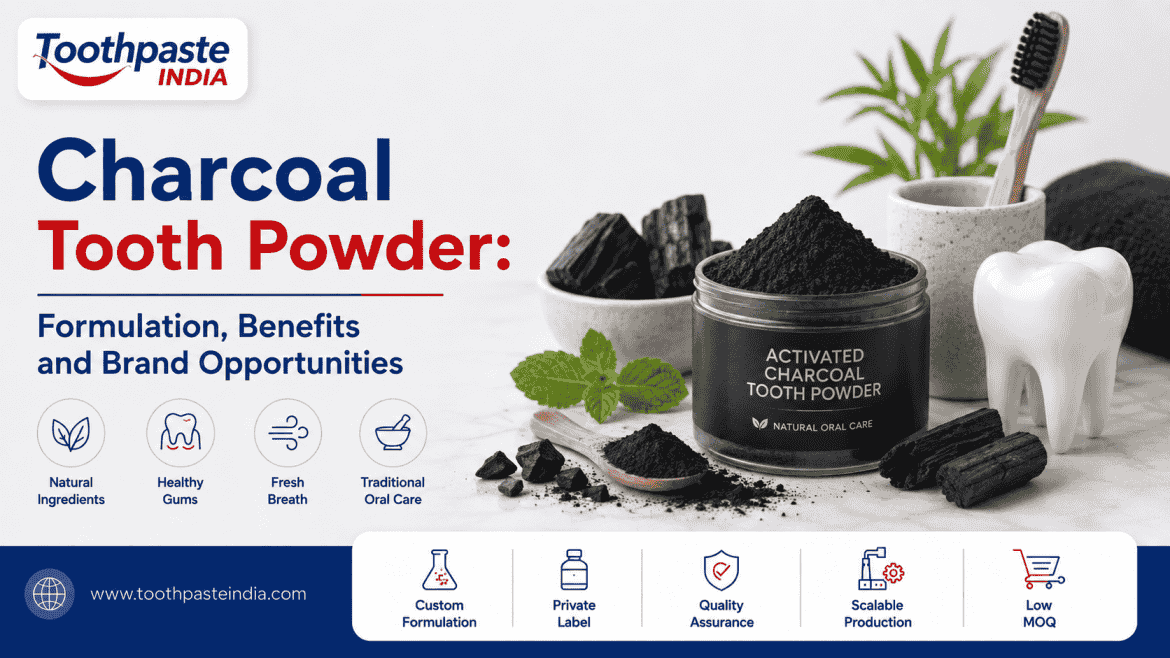

Charcoal Tooth Powder has become one of the most visually distinctive products in natural and whitening-focused oral care. Consumers searching for charcoal teeth whitening, activated charcoal for teeth and natural teeth whitening powder are attracted by its black appearance and its promise of cleaner-looking teeth.
For brands, however, developing a credible charcoal product requires more than adding black powder to a dental formula. Activated charcoal grade, particle size, cleaning system, abrasivity, flavour, microbiological quality, heavy-metal control and regulatory positioning all need careful consideration. Brands may also extend the same ingredient story into charcoal toothpaste, creating a broader charcoal-based oral-care portfolio.
Scientific evidence also requires balanced communication. Current research suggests charcoal products may help with external stain removal in some conditions, but they should not be promoted as equivalent to professional bleaching treatments.
What Is Charcoal Tooth Powder and How Does It Work?
Charcoal Tooth Powder is a dry dentifrice that uses activated charcoal or activated carbon as a distinctive ingredient within a tooth-cleaning formulation.
Activated charcoal is a highly porous carbon material processed to create a large surface area. This structure gives it adsorption properties, meaning substances can attach to its surface.
In oral-care products, the visible cleaning effect may come from a combination of:
- Physical brushing action
- Abrasive or polishing ingredients
- Activated charcoal particles
- Removal of some external surface deposits
- Supporting ingredients within the complete formulation
It is important to distinguish surface-stain removal from true tooth bleaching. Teeth whitening using charcoal generally does not work through the same chemical mechanism as peroxide-based professional whitening.
A 2023 laboratory study found that activated charcoal dentifrices did not provide superior stain-minimizing results compared with conventional toothpaste, while pure activated charcoal powder produced greater surface alteration and enamel wear in that experimental model.
Does Charcoal Teeth Whitening Really Work?
Charcoal teeth whitening may produce limited improvement in the appearance of external staining, but evidence for significant intrinsic tooth whitening remains weak.
A systematic review examining 11 eligible studies found mixed whitening results and concluded that activated-charcoal toothpastes generally demonstrated lower whitening effectiveness than alternative whitening approaches, while abrasivity remained an important concern.
More importantly, a randomized controlled clinical trial published in 2024 evaluated activated charcoal powder and toothpaste and reported only a minor, unsatisfactory whitening effect compared with carbamide peroxide treatment.
Therefore, brands developing a charcoal teeth whitening powder should avoid claims such as:
- “Instantly whitens teeth”
- “Bleaches teeth naturally”
- “Removes all stains”
- “Professional whitening at home”
A more defensible positioning is focused on cleansing, polishing and helping remove external surface stains when supported by the finished formulation.
Consumers looking for the best teeth whitening powder or best whitening powder for teeth should also understand that cosmetic surface cleaning and professional bleaching are not interchangeable.
What Ingredients Can Be Used in a Charcoal Dental Powder?
A well-designed charcoal dental powder combines activated charcoal with ingredients selected for cleaning performance, sensory quality and product stability.
Bamboo-derived activated charcoal is another option for brands interested in developing bamboo charcoal toothpaste with a distinctive natural oral-care positioning. Regardless of the charcoal source, manufacturers should carefully evaluate purity, particle characteristics, ingredient compatibility and finished-product performance before commercialization.
Activated Charcoal or Activated Carbon
Activated charcoal is usually the hero ingredient. Raw-material specifications should consider source, purity, particle characteristics and contaminants.
Activated carbon for teeth should not be selected solely because it is commercially available. Oral-care manufacturers need a suitable grade supported by appropriate supplier specifications and quality documentation.
Cleaning and Polishing Ingredients
The formula may include carefully selected mineral-based polishing materials. Their concentration and particle characteristics should be controlled because excessive mechanical abrasion can damage tooth surfaces over time.
Flavouring Ingredients
Mint, peppermint, spearmint, menthol or other compatible flavours help overcome the earthy sensory character of charcoal.
Functional Ingredients
Depending on the intended formulation, products may incorporate additional oral-care ingredients. Any fluoride, fluoride-free, herbal, vegan or natural positioning must reflect the actual formulation and comply with applicable regulatory and labelling requirements.
The formula should never be created simply by combining activated carbon tooth powder with aggressive abrasives to create a stronger “scrubbing” sensation.
Is Brushing Teeth With Charcoal Safe?
Brushing teeth with charcoal can be acceptable only when the finished product is professionally formulated and its cleaning system is appropriately controlled.
Safety cannot be judged from the word “charcoal” alone.
Research in this area is not completely uniform. A 2023 systematic review highlighted elevated abrasive potential in many charcoal formulations, while a 2024 laboratory study comparing six charcoal-containing and three non-charcoal fluoride dentifrices found no statistically significant difference in abrasivity between the groups tested.
This difference illustrates an important formulation lesson: the complete product matters more than the marketing ingredient alone.
Consumers attempting to brush teeth with activated charcoal directly or using loose, unformulated black powder for teeth whitening may not know the particle size, purity, contamination profile or abrasive behaviour of the material.
For this reason, brands should formulate and test a finished product rather than encouraging DIY use of raw charcoal.
How Is Charcoal Tooth Powder Manufactured Commercially?
Commercial charcoal tooth powder manufacturing requires controlled weighing, powder processing, uniform blending and quality assurance.
Brands looking to expand from powder into paste-based oral care can also work with experienced charcoal toothpaste manufacturers that have formulation and manufacturing capabilities across multiple dental-care formats.
A qualified bamboo charcoal toothpaste manufacturer can additionally help brands develop bamboo-charcoal-based products while controlling raw-material specifications, abrasive systems, flavour profile, texture and overall product consistency.
A typical manufacturing workflow includes:
1. Product Brief and Formula Development
The manufacturer first defines the positioning. Examples include:
- Charcoal cleaning powder
- Natural teeth whitening powder
- Herbal-charcoal tooth powder
- Mint charcoal powder
- Fluoride-free charcoal powder
- Premium activated charcoal teeth whitening powder
The formula is then developed around the intended consumer, target price, market and claims.
2. Raw Material Qualification
Activated charcoal and other ingredients should be sourced against defined specifications.
For charcoal in particular, attention should be given to purity, source, particle characteristics and relevant contaminant testing.
3. Sieving and Particle-Size Control
Uniform powder size improves sensory quality and helps manage cleaning performance. Extremely coarse particles should not be treated as a benefit.
4. Controlled Blending
Charcoal is intensely pigmented, so homogeneous distribution is important. Flavours and other lower-dose ingredients must also be distributed evenly throughout the batch.
5. Finished-Product Quality Control
Testing should be designed according to the applicable specification, formula and regulatory requirements.
For Indian tooth powder, BIS IS 5383:2021 is the current tooth-powder specification listed by BIS. It prescribes requirements and methods of sampling and testing, with referenced methods covering areas including cosmetic safety, microbiology and heavy metals.
6. Moisture-Protective Filling
Charcoal powder should be packed in a format that limits moisture ingress and contamination while allowing convenient dispensing.
Jars, shaker packs and custom containers can be considered depending on the brand concept.
What Regulations Apply to Charcoal Tooth Powder in India?
A charcoal tooth powder marketed as a cosmetic tooth-cleansing product in India must be evaluated under the Cosmetics Rules, 2020 and applicable BIS requirements.
The Ninth Schedule of the Cosmetics Rules lists Tooth Powder under IS 5383.
The Cosmetics Rules also make the State Licensing Authority responsible for the manufacture for sale or distribution of cosmetics. Manufacturing premises are required to comply with Good Manufacturing Practices and premises, plant and equipment requirements specified in the Seventh Schedule.
CDSCO further states that cosmetics covered by the Ninth Schedule must comply with the applicable standards and that cosmetic claims must not be false or misleading.
For this product category, FSSAI should not automatically be treated as the primary regulatory authority simply because ingredients may be natural. Product classification, claims and labelling should be checked against current cosmetics requirements and, where necessary, confirmed with the appropriate regulatory authority.
What Are the Main Benefits of Charcoal Tooth Powder for Brands?
The strongest brand opportunity comes from differentiation rather than exaggerated whitening promises.
Potential commercial advantages include:
- Highly recognizable black product appearance
- Strong natural and modern-cleaning positioning
- Excellent visual content potential for D2C marketing
- Premium and minimalist packaging possibilities
- Compatibility with herbal oral-care concepts
- Opportunities for fluoride-free or other targeted formulas where appropriate
- Expansion into charcoal toothpaste and other oral-care formats
Search phrases such as whiten teeth with charcoal powder, whitening teeth charcoal powder, charcoal for teeth cleaning and activated carbon tooth powder show that consumers associate the ingredient primarily with cleansing and cosmetic whitening.
Some consumers also search for teeth charcoal foam wash. For brands, this signals potential range-extension opportunities into visually distinctive charcoal oral-care formats, although each format requires its own formulation and regulatory assessment.
How Can Brands Build a Better Charcoal Whitening Product?
The best charcoal product should prioritize controlled cleaning performance, consumer comfort and credible claims rather than maximum abrasiveness.
For brand owners, five formulation decisions matter most:
- Select an appropriate activated-charcoal grade.
- Control the complete abrasive system.
- Develop a pleasant flavour and mouthfeel.
- Validate finished-product quality and relevant claims.
- Use packaging that protects the powder from moisture and contamination.
This is particularly important for products marketed around activated charcoal teeth whitening powder, teeth whitening activated organic charcoal or natural whitening concepts. Working with a private label charcoal toothpaste manufacturer can help brands customize the formula, flavour profile, charcoal concentration, packaging and positioning without investing in their own manufacturing infrastructure.
The term “organic charcoal” should also not be used loosely. If a brand intends to make certified-organic claims, those claims and certification requirements should be separately verified.
Why Is Private Label Charcoal Tooth Powder a B2B Opportunity?
Private-label manufacturing allows brands to enter the charcoal oral-care category without building their own formulation and production infrastructure.
For D2C startups, distributors, exporters and established oral-care businesses, customization may include:
- Charcoal concentration
- Herbal ingredient combinations
- Mint or other flavour systems
- Fluoride or fluoride-free positioning where applicable
- Packaging size
- Jar and shaker formats
- Label and carton development
- Bulk supply requirements
Toothpaste India an Ahmedabad-based B2B oral-care manufacturer specializes in private label and contract manufacturing solutions for companies developing oral-care products.
Brands specifically interested in plant-derived charcoal concepts may partner with a private label bamboo charcoal toothpaste manufacturer for custom formulation, manufacturing, packaging and scalable production under their own label.
Conclusion
Charcoal Tooth Powder can be a commercially attractive oral-care product when it combines distinctive branding with responsible formulation and evidence-based claims.
Activated charcoal provides strong visual identity and consumer recognition, but current evidence does not justify treating it as a substitute for professional tooth bleaching. The better opportunity lies in controlled cleaning, surface-stain management, premium natural positioning and modern private-label product development.
If you are planning to launch charcoal dental powder, activated carbon tooth powder or a complete charcoal oral-care range, contact Toothpaste India to discuss custom formulation, private label manufacturing, packaging, quality requirements and bulk production.
Frequently Asked Questions
Charcoal tooth powder is a dry oral-care product containing activated charcoal or activated carbon along with cleaning, polishing, flavouring and other formulation ingredients. It is intended for tooth cleaning and may help manage some external surface stains, depending on the complete formula.
Charcoal may help remove some external staining, but clinical evidence does not support dramatic bleaching effects. A randomized clinical trial found activated-charcoal products produced only minor whitening compared with carbamide peroxide. Professional bleaching and charcoal surface cleaning work through different mechanisms.
Safety depends on the complete formulation, charcoal grade, particle size, abrasive system and frequency of use. Research findings on abrasivity vary across formulations, so professionally formulated products are preferable to brushing with loose or unknown-grade charcoal powder.
Using raw activated charcoal directly is not advisable because its purity, particle size and abrasive characteristics may be unknown. A professionally formulated dentifrice provides better control over ingredient specifications, cleaning action, flavour, quality and labelled directions for use.
Activated charcoal has a porous surface with adsorption properties, while brushing and the overall abrasive system provide mechanical cleaning. Evidence suggests any visible improvement is mainly associated with external stain management rather than chemical bleaching of the natural tooth structure.
The best whitening powder for teeth should balance effective surface cleaning with controlled abrasivity, pleasant flavour, ingredient quality, regulatory compliance and realistic claims. A product should not be judged simply by how gritty it feels or how much activated charcoal it contains.
Charcoal dental powder is a dry formulation, while charcoal toothpaste is usually a semi-solid product containing a liquid phase, humectants and other ingredients. Both can contain activated charcoal, but their formulation systems, sensory profiles, processing methods and testing requirements differ.
They serve different purposes. A natural teeth whitening powder may help clean some surface staining, while peroxide-based whitening chemically changes tooth colour and can deliver stronger bleaching results. Consumers seeking significant whitening should discuss appropriate options with a dental professional.
Yes. Brand owners can work with a private-label oral-care manufacturer to customize charcoal type, flavour, supporting ingredients, packaging and positioning. Before commercialization, the finished product should meet applicable Cosmetics Rules, BIS standards and current labelling and claims requirements.
Yes. Commercial manufacturers can produce bulk charcoal tooth powder for brands, distributors and exporters. Reliable scale-up requires documented raw materials, controlled particle size, accurate weighing, uniform blending, relevant finished-product testing and packaging designed to minimize moisture and contamination.