
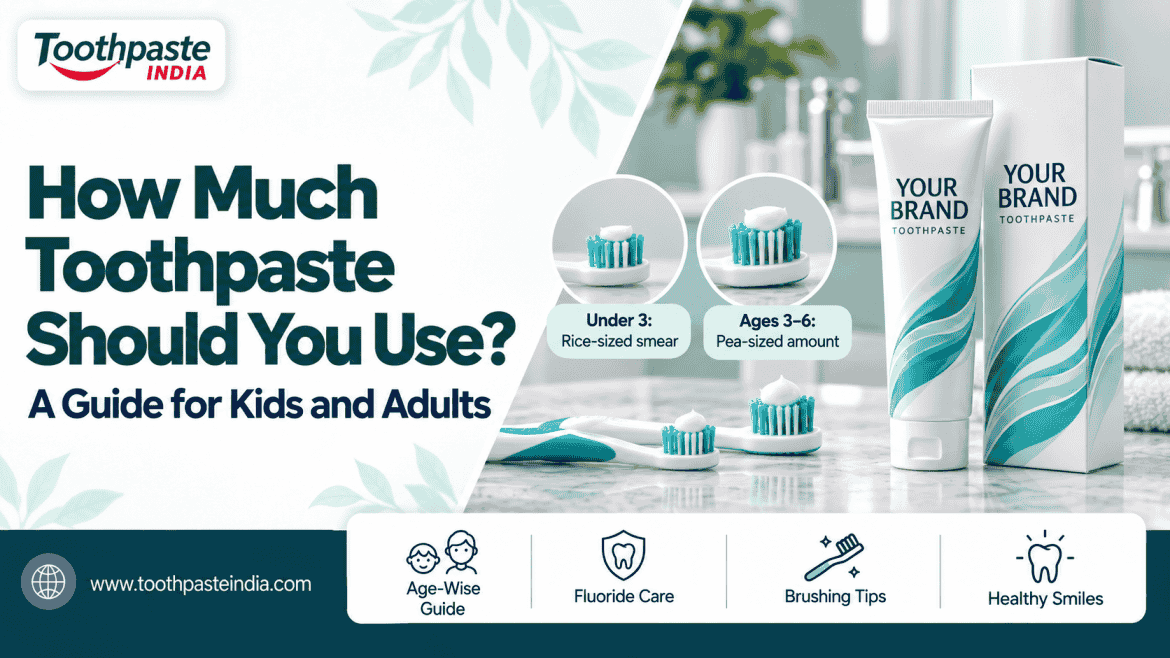

How much toothpaste should you use? For children under three, use a rice-grain-sized smear from the first tooth; for ages three to six, use a pea-sized amount. Adults can generally start with a pea-sized amount, while following their toothpaste’s directions and their dentist’s advice.
The long ribbon shown in toothpaste advertisements is not a useful measuring guide. Your age, fluoride concentration, brushing technique and ability to spit out toothpaste matter more than covering every bristle.
This guide explains the correct amount of toothpaste, how fluoride strength differs from quantity, and what to do if someone accidentally swallows it.
How Much Toothpaste Should You Use by Age?
Use this toothpaste amount by age guide as a starting point. Special products, including prescription toothpaste, may have different directions.
| Age or stage | Suggested amount | Practical guidance |
|---|---|---|
| Babies, from the first tooth | Rice-grain-sized smear | A parent or caregiver brushes |
| Toddlers under three | Rice-grain-sized smear | An adult dispenses the toothpaste |
| Children aged three to six | Pea-sized amount | Supervise brushing and encourage spitting |
| Older children | Follow age-appropriate product directions | Continue helping until brushing is reliable |
| Adults | Generally a pea-sized amount | Follow the label and individual dental advice |
How Much Toothpaste for Babies and Toddlers?
Parents asking how much toothpaste for babies should begin with the first tooth not wait until the child can brush independently. Apply a thin smear using a soft, age-appropriate toothbrush.
For how much toothpaste for toddlers, the same rice-grain guide applies until the third birthday. The adult should control dispensing because young children often swallow toothpaste rather than spit it out.
How Much Toothpaste Should Kids Use?
From ages three to six, use a pea-sized amount and supervise. Teach children to spit out the excess and keep the tube away from them between brushing sessions.
Do not increase the quantity simply because the child has a larger toothbrush. Ask their dentist to demonstrate the amount if the difference between a smear and a pea-sized portion is unclear.
How Much Toothpaste Should Adults Use?
A pea-sized amount is a practical starting point for ordinary adult toothpaste, rather than a strip covering the entire brush. ARM & HAMMER’s guidance and the Acorn Dental reference both support this approach.
However, it is not a universal maximum for every formulation. Follow the product label, especially for prescription or specialist products.
What Does a Pea-Sized Amount Actually Look Like?
A pea sized amount of toothpaste means a small, rounded portion not a thick ribbon stretched along the brush. Rice grain sized toothpaste is smaller: a thin smear rather than a rounded blob.
The distinction is easy to underestimate. A study involving parents in Germany, the United States and the United Kingdom found that most dispensed substantially more than the study’s recommended 0.25-gram amount for their three- to six-year-old children.
That study examined dispensing behaviour, not whether a particular quantity prevented cavities in those children. Its practical lesson is that a visual demonstration can make instructions easier to follow.
Whether you search “how much toothpaste should i use,” “how much toothpaste do you need” or “how much toothpaste to put on toothbrush,” start with age-appropriate guidance rather than the size of the brush head.
How Much Fluoride Should Be in Toothpaste?
Fluoride concentration and toothpaste quantity are different measurements. Concentration tells you how much fluoride is present in the product; quantity describes how much you apply.
For context, NHS guidance recommends adult toothpaste containing at least 1,350 parts per million fluoride. Its children’s guidance allows family toothpaste containing 1,350–1,500 ppm, with certain younger children able to use a lower-strength product containing at least 1,000 ppm. These are UK recommendations, not universal formulation requirements.
How Much Fluoride Toothpaste Should You Use?
Use the amount recommended for the user’s age and the particular product. A larger blob of low-fluoride toothpaste should not be treated as an equivalent replacement for an appropriately selected fluoride formula.
If you are wondering how much fluoride is too much in toothpaste, distinguish product strength from swallowed exposure. A dentist may recommend a higher-strength product for specific needs; it should be used according to its directions rather than shared as ordinary family toothpaste.
Can You Use Too Much Toothpaste?
Yes. Using more than directed can waste product and increase the amount available to swallow, particularly in young children.
Repeated excessive fluoride ingestion while teeth are developing can cause dental fluorosis, which changes the appearance of enamel. This differs from acute poisoning after a large ingestion.
For adults, “how much toothpaste is too much” is better answered by checking the label than by assuming one fixed quantity suits every product. More paste also cannot compensate for missed surfaces or rushed brushing.
What Happens If You Swallow Toothpaste?
A small accidental swallow of ordinary over-the-counter toothpaste is unlikely to cause serious toxicity, although stomach upset can occur. Larger amounts or prescription-strength products require more careful assessment.
There is no single household answer to how much toothpaste is toxic. Risk depends on the formulation, fluoride concentration, amount swallowed and the person’s body weight.
If someone swallows a substantial or uncertain amount, contact a poison-information service or medical professional promptly. Keep the tube available and do not induce vomiting; severe symptoms such as breathing difficulty require emergency help.
Should You Rinse After Brushing?
After brushing with fluoride toothpaste, spit out the excess without immediately rinsing with water. Rinsing washes away some of the concentrated fluoride left behind.
The NHS also recommends using mouthwash at a separate time, such as after lunch, instead of immediately after brushing.
Brush twice daily for about two minutes, reaching the inner, outer and chewing surfaces. Toothpaste quantity is one part of the routine; careful coverage matters too.
What Should Oral-Care Brands Put on Their Labels?
Clear dispensing instructions help consumers use a product as intended. An age-specific illustration is often more useful than a large decorative toothpaste ribbon.
Toothpaste India presents itself as an oral care manufacturer offering toothpaste and private-label manufacturing services. Businesses evaluating a toothpaste manufacturer or toothpaste supplier can discuss their product brief and request supporting documentation.
When choosing a third party toothpaste manufacturer, private label toothpaste manufacturer or white label toothpaste manufacturer, ask who verifies fluoride content, stability, packaging compatibility and usage instructions.
For buyers searching “third party toothpaste manufacturer India” or “GMP certified toothpaste manufacturer in India,” check current certification documents and their scope. Manufacturing certification should not be presented as proof of a finished product’s clinical effectiveness.
Conclusion
The answer to how much toothpaste should you use starts with age: a rice-grain smear for children under three and a pea-sized portion for ages three to six. Adults should follow their product’s directions, with a pea-sized amount serving as a common practical guide.
Use the appropriate fluoride strength, brush thoroughly and supervise children. If you are unsure, take your toothpaste to a dental appointment and ask for a quick demonstration.
Frequently Asked Questions
Use an age-appropriate amount rather than covering the bristles. Young children need a smear or pea-sized portion depending on age, while adults should check their product directions.
It is the recommended amount for children aged three to six and a common guide for adults. Specialist products may have different instructions, so check the label.
Use the recommended amount for each brushing session, rather than splitting one portion across the day. Consistent, thorough brushing matters alongside the amount.
This question usually refers to price, which varies by brand, formulation and pack size. Compare cost per 100 grams when assessing value, while checking whether the product suits your needs.
Follow the sensitivity toothpaste’s label rather than increasing the quantity yourself. Some formulas have specific application instructions, and persistent sensitivity needs dental assessment.
Do not automatically replace fluoride toothpaste solely because a young child cannot spit reliably. Dental guidance recommends carefully controlled fluoride amounts from the first tooth, with adult supervision.
Foam alone does not measure cleaning quality. Focus on reaching every tooth surface rather than adding paste to produce more bubbles.
A rice-sized smear is guidance for very young children, rather than the usual adult recommendation. Adults should follow their product’s directions or ask their dentist about an appropriate amount.
No; brushing and cleaning between teeth address different areas. Use floss or an appropriate interdental cleaner alongside brushing, according to your dental professional’s advice.