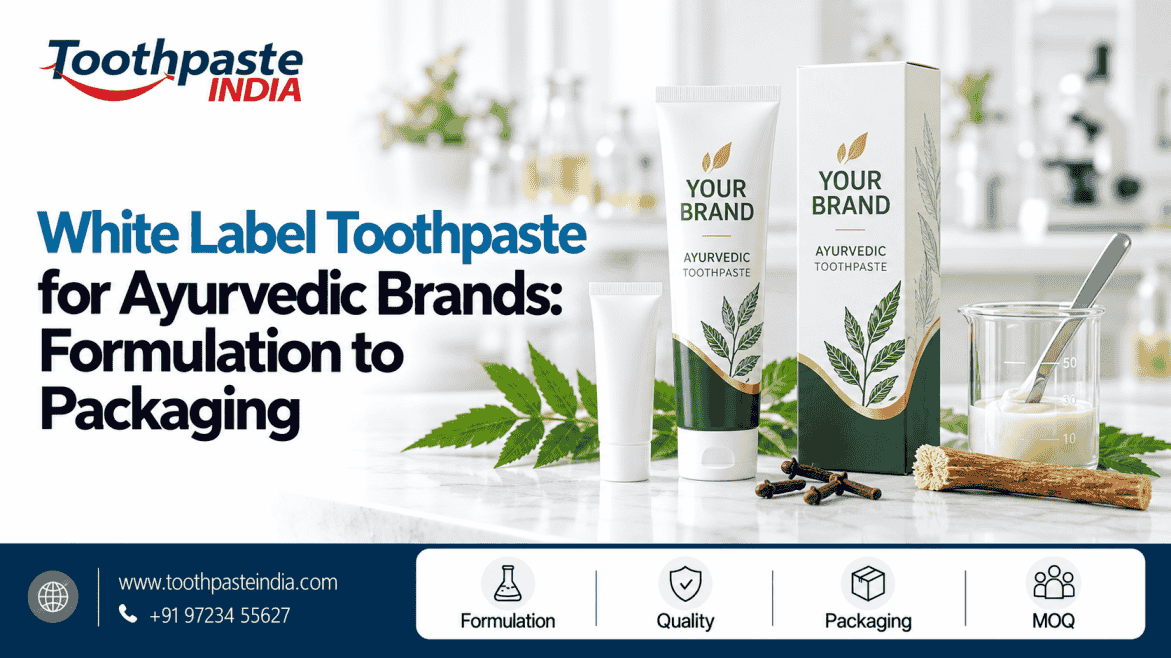

White label toothpaste for Ayurvedic brands is an existing toothpaste formula manufactured and packaged under your brand name. It allows wellness businesses to introduce an oral-care product without setting up their own production facility.
The process usually involves selecting a formula, evaluating samples, approving packaging and agreeing on production requirements. However, an existing formula still needs suitable documentation, finished-product testing and support for its proposed claims.
For established Ayurvedic businesses and new herbal brands, the starting point is a clear product brief: who will use the toothpaste, what it should offer and how it will fit the existing range.
What Is White Label Ayurvedic Toothpaste?
White label Ayurvedic toothpaste uses an existing formulation supplied under a buyer’s branding. Available changes may include packaging, pack size and flavour selection, depending on the manufacturer’s programme.
The terms “herbal” and “Ayurvedic” should not be treated as interchangeable regulatory descriptions. Before approving artwork, establish the product’s classification, applicable licence and permitted claims with a qualified regulatory professional.
A botanical ingredient list alone does not establish clinical effectiveness or justify an Ayurvedic medicine claim.
White Label vs Private Label Ayurvedic Toothpaste
White label generally starts with an existing formula. Private label Ayurvedic toothpaste may involve additional development or customisation, although manufacturers use these terms differently.
| Factor | White Label | Private Label |
|---|---|---|
| Formula | Existing formulation | Existing, modified or newly developed formulation |
| Customisation | Usually branding and selected options | Potentially ingredients, texture, flavour and packaging |
| Development work | Often less extensive | Depends on the requested changes |
| Exclusivity | Must be negotiated | Must also be negotiated |
| Testing | Request evidence for the supplied product | Changes may require additional testing |
A private label toothpaste manufacturer should explain exactly what is included. Formula ownership, exclusivity, testing responsibilities and access to specifications belong in the agreement.
Choose the manufacturing model according to your product requirements rather than the service name alone.
Why Ayurvedic Brands May Add Toothpaste to Their Range
An oral-care product can complement an existing wellness portfolio when it fits the brand’s customers and distribution channels.
For example, a business selling herbal personal-care products may consider private label herbal toothpaste for customers who already recognise its ingredient approach. The commercial opportunity still depends on pricing, product acceptance, retailer interest and repeat purchases.
Potential Business Benefits
- Extend an existing brand into daily oral care.
- Offer complementary products through established channels.
- Develop coordinated personal-care bundles.
- Control branding, pack size and product positioning.
- Expand gradually after testing demand.
Custom branded Ayurvedic toothpaste should offer a clear reason to buy, such as a preferred flavour, a well-documented formulation or a convenient pack format. Ingredient imagery alone is unlikely to create lasting differentiation.
Choosing Ayurvedic Toothpaste Ingredients
Evaluate ingredients as part of the complete formula. Cleaning performance, flavour, abrasivity, preservation and stability all affect the finished product.
Neem, Clove and Miswak Formulations
When comparing a neem toothpaste manufacturer, ask which botanical material or extract is used, how it is identified and what quality specifications apply.
A clove toothpaste manufacturer should explain the ingredient’s concentration, purpose and effect on flavour. A strong taste does not establish stronger oral-care performance.
Similarly, a miswak toothpaste manufacturer should provide ingredient traceability and evidence relevant to the finished product’s claims. Research about a traditional chewing stick cannot automatically establish the performance of a toothpaste containing its extract.
Herbal Toothpaste With Fluoride
If you are considering herbal toothpaste with fluoride, ask the supplier to verify ingredient compatibility and the available fluoride in the finished formulation throughout its intended shelf life.
For fluoride free herbal toothpaste, define the intended positioning clearly. Removing fluoride does not, by itself, establish equivalent cavity-prevention performance.
SLS Free Herbal Toothpaste
SLS free herbal toothpaste excludes sodium lauryl sulfate, a commonly used foaming ingredient. Review the alternative cleansing system, flavour and overall tolerability rather than assuming every SLS-free formula performs identically.
For private label natural toothpaste, also define what “natural” means for your product and how that description will be supported.
How White Label Toothpaste Manufacturing Works
Start by asking an Ayurvedic toothpaste manufacturer for its available formulations, specifications and commercial terms.
- Define the customer, target price and intended sales market.
- Review ready made herbal toothpaste formulas.
- Request samples and supporting documentation.
- Evaluate flavour, texture, foam and packaging suitability.
- Approve the formulation and proposed claims.
- Finalise tube, carton and label artwork.
- Confirm MOQ, testing, production and delivery terms.
- Approve the finished batch before dispatch.
Ready to brand Ayurvedic toothpaste can reduce development work when an existing formula matches your brief. A custom Ayurvedic toothpaste formulation requires a separate development plan, with time allowed for sampling, assessment and testing.
How to Choose an Ayurvedic Toothpaste Supplier
Choose a partner that can explain both the product and the production responsibilities.
A herbal toothpaste manufacturer should provide clear answers about botanical sourcing, formula consistency, testing and packaging compatibility. Request documents for the actual manufacturing site and proposed product.
Review Quality and Ingredient Traceability
Ask for:
- Ingredient specifications and botanical identification.
- Relevant supplier and raw-material records.
- Finished-product specifications.
- Microbiological and stability testing information.
- Packaging compatibility results.
- Batch release documentation.
- Procedures for complaints and product recalls.
“Tested” is incomplete without knowing what was tested, when, by whom and against which specification.
Clarify Manufacturing Responsibilities
An OEM toothpaste manufacturer may offer development and production services, but the scope varies. Confirm who sources ingredients, purchases packaging, reviews artwork and authorises product release.
When assessing third party Ayurvedic toothpaste manufacturing, establish whether any work is subcontracted. Your third party manufacturer should identify the responsible production site and explain how quality is controlled.
Ayurvedic toothpaste contract manufacturing agreements should also address specification changes, rejected batches, lead times and repeat-order consistency.
Check Certification Scope and Claims
A manufacturing certificate does not independently prove a product’s clinical benefits. Check its validity, site address, scope and relevance to the proposed product.
Avoid unsupported approval language. The Ministry of Ayush has clarified that it does not itself grant manufacturing licences or certify or approve individual ASU&H companies and medicines; relevant manufacturing licences are issued by State or Union Territory licensing authorities.
Ayurvedic Toothpaste Packaging and Branding
Ayurvedic toothpaste packaging needs to communicate the product clearly while protecting it during storage and transport.
Custom Printed Toothpaste Tubes
Evaluate custom printed toothpaste tubes at actual size. Check that the product name, directions, ingredient information, batch details and applicable declarations remain readable.
Review:
- Cap fit and opening convenience.
- Seal integrity and leakage resistance.
- Print durability.
- Compatibility between formula and tube.
- Carton strength during shipping.
- Space for coding and market-specific information.
Packaging changes can affect costs and minimum orders. Approve physical components before committing to a large print run.
Costs, MOQ and Production Timelines
There is no universal price or minimum order for white label herbal toothpaste. Formula choice, tube size, printing, cartons, testing and order quantity all influence the quotation.
Request MOQ separately for each formula, flavour, pack size and artwork version. A total order may still contain several individual minimums.
For bulk Ayurvedic toothpaste, compare the delivered cost with expected sales and remaining shelf life. A lower unit price can become expensive if stock moves slowly.
Ask for a written timeline covering sample approval, artwork, packaging procurement, production, testing and dispatch. Avoid planning a launch around an unconfirmed standard lead time.
Common Mistakes to Avoid
- Assuming “herbal” means suitable for every user.
- Treating ingredient research as finished-product proof.
- Launching several variants before understanding demand.
- Approving flavour changes without checking testing requirements.
- Selecting a supplier solely on price.
- Printing exaggerated treatment or whitening claims.
- Leaving formula ownership and exclusivity undefined.
- Ordering more stock than the business can realistically sell.
For cosmetics, CDSCO states that claims must not be false or misleading. Product positioning should therefore follow the evidence and applicable classification.
Buyer Checklist Before Placing an Order
Before approving production, confirm:
- Target customer, market and product positioning.
- Formula specifications and sample approval.
- Ingredient sourcing and traceability.
- Appropriate classification, documentation and claims.
- Testing responsibilities and acceptance criteria.
- Packaging compatibility.
- MOQ and complete project cost.
- Formula ownership and exclusivity terms.
- Delivery schedule and reorder arrangements.
Conclusion
White label toothpaste for Ayurvedic brands can provide a practical route into oral care when the formula, documentation and packaging match the business’s needs.
Start with a focused product brief, compare samples and evaluate the finished product’s evidence. Contact Toothpaste India with your preferred ingredients, target market, pack size and expected volume to discuss suitable manufacturing options and confirm project-specific capabilities.
Frequently Asked Questions
It is an existing toothpaste formulation supplied under an Ayurvedic brand’s name. Buyers should verify the formulation, product classification, testing and branding options before ordering.
Compare sample quality, ingredient traceability, manufacturing documentation and testing support. Also review MOQ, packaging capability and written production terms.
Some suppliers allow selected changes, while others offer only existing formulations. Changes to ingredients or flavour may require additional assessment and testing.
“Herbal” generally describes botanical ingredients, while Ayurvedic positioning requires closer examination of the formulation and applicable regulatory framework. Confirm the correct classification before using the description on packaging.
Herbal ingredients and fluoride can be considered within the same product brief. The finished formulation must meet applicable requirements and be assessed for compatibility and fluoride availability.
Request relevant manufacturing credentials, product specifications and testing documentation. Ingredient traceability, batch release records and packaging specifications are also useful.
MOQ depends on the formula, pack size, packaging components and printing method. Ask for minimums per SKU and the conditions for repeat orders.
Define your customer and product brief, compare manufacturers, approve samples and finalise compliant packaging. Confirm costs, testing and delivery terms before placing the production order.