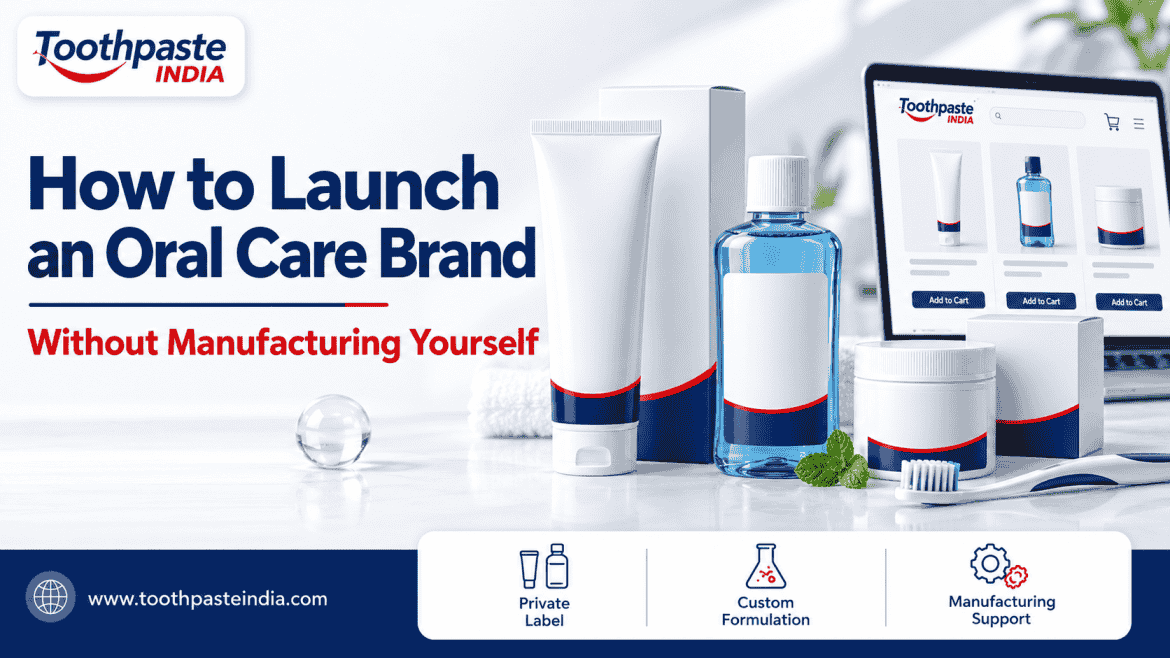

You can launch an oral care brand without owning a factory by working with a private label or contract manufacturer. Your partner produces the products, while you manage brand positioning, sales, distribution and customer relationships.
The key is choosing a suitable product, validating its formulation and agreeing on clear manufacturing responsibilities before placing your first order. This guide explains how to start an oral care brand, from selecting your manufacturing model to planning packaging and launch costs.
What Should You Decide Before Choosing a Manufacturer?
Start with a defined customer and one clear product need. A focused brief makes manufacturer selection, formulation development and pricing easier.
For example, your brand might offer everyday fluoride toothpaste, alcohol-free mouthwash or herbal tooth powder. Each concept requires different ingredients, packaging and evidence to support its claims.
Write down your target audience, sales channels, intended retail price, preferred pack size and product positioning. Launching one carefully developed product can help you understand demand before investing in multiple variants.
How Can You Launch an Oral Care Brand Without a Factory?
An outsourced manufacturing partner can develop, manufacture and pack products under your brand name. The exact services depend on your agreement.
A practical launch process includes:
- Define your customer and product brief.
- Shortlist suitable oral care manufacturers.
- Compare samples, documentation and quotations.
- Approve the formulation and packaging.
- Complete applicable regulatory and label reviews.
- Place the production order.
- Inspect finished goods and prepare distribution.
- Launch, collect feedback and plan replenishment.
Avoid committing to printed packaging before the formula, claims and label information are approved.
Private Label vs Third Party vs Contract Manufacturing
These terms often overlap, so compare the actual scope of work rather than relying on the service name.
| Manufacturing model | Typical arrangement | What to clarify |
|---|---|---|
| Private label | An existing formulation is offered under your brand | Customization options and formula exclusivity |
| Third-party manufacturing | Another company manufactures your branded products | Who handles formulation, testing and packaging |
| Contract manufacturing | Production follows an agreed specification and contract | Formula ownership, responsibilities and change control |
Private label oral care products may suit a straightforward launch. Custom oral care formulations can offer greater differentiation but may require additional development and testing.
Which Oral Care Products Can You Launch?
Choose products that match your customer’s needs and your available budget.
Toothpaste and Tooth Powder
A private label toothpaste manufacturer can help evaluate flavour, texture, ingredients and tube options. A private label tooth powder manufacturer should also address powder consistency, moisture protection and dispensing.
Mouthwash and Oral Rinses
A private label mouthwash manufacturer can help assess active ingredients, flavour, bottle compatibility and suitable directions. Alcohol-free positioning alone does not establish a product’s effectiveness.
Products With Specialized Claims
Sensitivity, whitening and gum-care products need appropriate evidence for their proposed benefits. Do not assume that including a recognized ingredient automatically proves the finished product performs as advertised.
How Do You Choose an Oral Care Manufacturer?
Choose a manufacturer whose documented capabilities match your product requirements.
Ask for relevant manufacturing licences, current certification documents, sample specifications and an explanation of their quality-control process. Confirm whether certificates cover the actual facility and product category involved.
Discuss:
– Sample approval and production specifications.
– Ingredient sourcing and batch traceability.
– Stability, microbiological and packaging testing.
– Formula ownership and confidentiality.
– Defect handling and complaint investigation.
– Lead times, payment terms and repeat-order capacity.
Compare quotations using the same formula, pack size, packaging specification and testing scope. A lower price may reflect a different service package.
What Should You Know About MOQ and Packaging?
Minimum order quantity depends on the formula, production equipment and packaging components. There is no single oral care manufacturing MOQ that applies to every project.
Ask separately about manufacturing MOQ and packaging MOQ. Custom-printed tubes, bottles or cartons may require larger purchases than the initial production batch.
Check closure quality, leakage resistance, dispensing and transport protection. For tooth powders, moisture resistance is especially relevant. Confirm responsibility for unused packaging and storage charges before ordering.
How Much Does It Cost to Start an Oral Care Brand?
Your launch budget should cover development, inventory and selling costs not just manufacturing.
Include sample development, testing, artwork, packaging, production, freight, warehousing, marketplace fees, marketing and customer support. Keep funds available for replenishment before your first batch sells out.
Calculate your expected margin after discounts, shipping, commissions and returns. Oral care brand startup costs vary substantially, so request an itemized quotation instead of relying on a generic investment estimate.
What About Licences, Labelling and Product Claims?
Regulatory requirements depend on the product’s classification, ingredients, claims and target market. In India, products classified as cosmetics fall under the applicable Cosmetics Rules, 2020, including relevant manufacturing and labelling requirements. Confirm current requirements before launch.
Outsourcing production does not remove the need to clarify your business’s responsibilities. Have a qualified regulatory professional review the arrangement, label and proposed claims.
Export products also require destination-market review. Packaging approved for India should not automatically be treated as suitable for another country.
Why Work With an Indian Oral Care Manufacturer?
An Indian manufacturing partner may make sampling, factory discussions and domestic logistics easier for India-focused brands. Evaluate these practical advantages alongside quality, documentation and commercial terms.
Toothpaste India, based in Ahmedabad, describes outsourced manufacturing services covering toothpaste, mouthwash, tooth powder and whitening products, along with custom formulation and private label support. Discuss your specific requirements to confirm feasibility, MOQ and available services.
Conclusion
Launching an oral care brand without manufacturing yourself begins with a focused product concept and a well-defined manufacturing agreement. Approve samples, verify documentation and establish realistic costs before committing to production.
Contact Toothpaste India with your product category, target market, pack size and expected quantity to discuss development and manufacturing options.
Frequently Asked Questions
Yes, an outsourced manufacturer can produce toothpaste under your brand. Confirm the applicable regulatory requirements and each party’s responsibilities before selling.
No, private label and contract manufacturing allow you to outsource production. You still need to manage branding, commercial decisions and agreed compliance responsibilities.
Private label may suit a simpler launch using an existing formula. Custom formulation offers more development flexibility but can require additional time and investment.
MOQ varies by product, formulation and packaging. Request separate quantities for production and custom packaging components.
Yes, provided your budget supports both products. Starting with one product can simplify inventory and demand planning.
Timing depends on development, testing, packaging availability and approvals. Obtain a written schedule with clear milestones.
Ownership depends on the contract. Clarify exclusivity, usage rights and transfer rights before development begins.
Some manufacturers offer filling and packaging support. Confirm artwork responsibilities, component sourcing and approval procedures.
Testing should reflect the formula, packaging and claims. Discuss stability, microbiological quality, compatibility and relevant performance testing.
Compare equivalent specifications, documentation, testing and service scope. Evaluate reliability and total project cost alongside the quoted unit price.