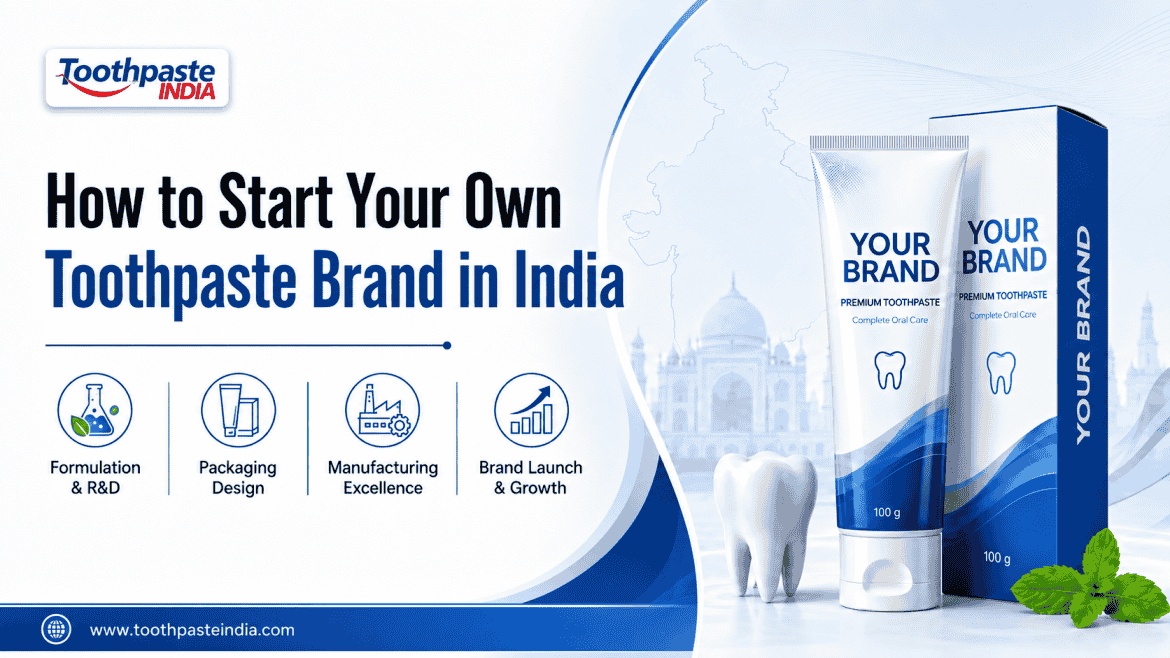

How to Start Your Own Toothpaste Brand in India is a practical question for D2C startups, pharma companies, exporters, distributors, dental clinics, and oral care entrepreneurs. Toothpaste is a daily-use product, but launching a successful brand needs more than just a good tube design. You need the right formulation, taste, packaging, compliance review, manufacturing partner, MOQ planning, and clear market positioning.
In India, oral care products such as toothpaste are generally handled under cosmetics or related regulatory frameworks depending on formulation and claims. The Drugs and Cosmetics Act, 1940 regulates the import, manufacture, distribution, and sale of drugs and cosmetics in India, and startups should verify current requirements with the state FDA, CDSCO guidance, and a regulatory consultant before launch.
What Does It Mean to Start Your Own Toothpaste Brand in India?
Starting your own toothpaste brand means selling toothpaste under your own brand name, packaging, formula positioning, and market identity.
You do not always need to build a factory. Many startups begin with a private label toothpaste manufacturer or contract toothpaste manufacturer who already has manufacturing setup, formulation support, tube filling machinery, quality testing systems, and packaging guidance.
This model is useful for:
- D2C oral care brands
- Pharma companies
- Dental clinic brands
- Exporters
- E-commerce sellers
- Distributors
- Ayurveda and herbal product brands
- Personal care startups
A toothpaste brand launch India plan should focus on product idea, audience, manufacturing model, pricing, and distribution before ordering bulk stock.
Can You Start a Toothpaste Brand Without a Factory?
Yes, you can start toothpaste brand in India without a factory by working with a private label, OEM, white label, or third party toothpaste manufacturer.
This is the easiest route for new businesses because the manufacturer handles production while you focus on branding, marketing, sales, and distribution. You can launch your own toothpaste brand in India with custom packaging and selected formulation without investing in a full toothpaste manufacturing plant.
Common manufacturing options include:
1. Private Label Toothpaste Manufacturing
Private label toothpaste manufacturing means the product is made by a manufacturer and sold under your brand name.
2. White Label Toothpaste Manufacturing
White label toothpaste is usually a ready formula that can be packed with your branding.
3. OEM Toothpaste Manufacturing
OEM toothpaste manufacturing allows more customization in formula, packaging, flavor, tube size, and product concept.
4. Third Party Toothpaste Manufacturing
Third party toothpaste manufacturing is when an experienced manufacturer produces toothpaste for your brand on a contract basis.
For startups, low MOQ toothpaste manufacturer support is important because it reduces initial investment and helps test the market.
How Do You Choose the Right Toothpaste Product Concept?
Choose your toothpaste product concept based on customer need, market gap, price range, and brand positioning.
A toothpaste brand should not start with “any toothpaste.” It should have a clear reason to exist. The product concept decides ingredients, flavor, packaging, claims, pricing, and buyer segment.
Popular toothpaste brand ideas include:
- Herbal toothpaste brand
- Ayurvedic toothpaste brand
- Natural toothpaste brand
- Fluoride toothpaste brand
- Fluoride free toothpaste brand
- Charcoal toothpaste brand
- Neem toothpaste brand
- Kids toothpaste brand
- Whitening toothpaste brand
- Sensitive toothpaste brand
- SLS free toothpaste brand
- Vegan toothpaste brand
- Sugar free toothpaste brand
For example, a neem toothpaste brand can target herbal oral care users, while a sensitive toothpaste brand needs careful ingredient selection and claim review. A whitening toothpaste brand may need surface stain cleaning positioning and stronger product testing support.
What Is the Best Toothpaste Business Plan India Startups Should Follow?
A toothpaste business plan India startups should follow includes product strategy, manufacturing model, investment planning, compliance, packaging, sales channels, and marketing.
Before you begin, answer these questions:
- Who is your target customer?
- Are you selling online, offline, export, dental clinic, pharmacy, or distributor channel?
- What problem does your toothpaste solve?
- Will you use ready formulation or custom toothpaste formulation?
- What is your preferred MOQ?
- What tube size will you launch first?
- What price range will your brand target?
- What claims will appear on packaging?
- Who will handle label and regulatory review?
- What is your first 3-month sales plan?
This planning helps avoid common mistakes like wrong packaging size, weak positioning, high MOQ, poor flavor, or unsupported product claims.
What Is the Cost to Launch a Toothpaste Brand in India?
The toothpaste business cost in India depends on formula type, tube size, packaging quality, MOQ, testing, branding, and marketing.
The biggest cost difference comes from whether you build your own factory or use a private label toothpaste manufacturer in India. A factory setup needs machinery, space, license, workers, utilities, raw material storage, quality control, and production management. Private label manufacturing reduces this burden because the manufacturer already has the production setup.
Startup cost usually includes:
- Product sampling
- Formula development
- Toothpaste tube packaging
- Carton design and printing
- MOQ production
- Label and regulatory review
- Barcode and artwork
- Website or marketplace listing
- Photography and marketing
- Logistics and distribution
Toothpaste private label cost also depends on whether you choose herbal, ayurvedic, fluoride, fluoride-free, charcoal, whitening, SLS-free, or premium active-based formulation.
What License Is Required for Toothpaste Business in India?
The license required for toothpaste business depends on product category, claims, formulation, manufacturing model, and state-level requirements.
The Drugs and Cosmetics Act defines cosmetics broadly as products intended to be applied to the human body for cleansing or beautifying, excluding soaps, and toothpaste is commonly treated within cosmetic-style compliance when marketed for oral cleansing.
If you manufacture yourself, you may need manufacturing-related approvals from the relevant state authority along with GST, business registration, factory-related approvals, and other local compliances. If you use a third party toothpaste manufacturer, the manufacturer’s license and documentation support become very important.
For ayurvedic toothpaste, therapeutic claims, medicated positioning, export, or special ingredients, verify with current regulatory guidelines before finalizing label and marketing content.
Important compliance tips:
- Avoid disease-treatment claims without legal and technical support.
- Check ingredient acceptability before launch.
- Review label copy before printing.
- Maintain batch records and COA where applicable.
- Verify cosmetic, ayurvedic, export, and marketplace requirements separately.
- Confirm current rules with regulatory professionals.
How Is Toothpaste Formulation Developed?
Toothpaste formulation is the technical process of selecting ingredients that create taste, texture, cleaning performance, stability, foam, freshness, and product positioning.
A basic toothpaste formula may include abrasives, humectants, binders, surfactants, sweeteners, flavors, preservatives, actives, water, and herbal extracts. Each ingredient has a role.
Abrasives help clean tooth surfaces. Humectants keep toothpaste moist. Binders maintain thickness. Surfactants create foam. Flavors improve brushing experience. Actives support the product concept.
Common formulation options include:
- Neem and herbal toothpaste
- Charcoal toothpaste
- Fluoride toothpaste
- Fluoride free toothpaste
- Kids toothpaste
- Whitening toothpaste
- Sensitive toothpaste
- SLS free toothpaste
- Vegan toothpaste
- Sugar free toothpaste
- Custom toothpaste formulation
In our facility, taste, viscosity, foam level, tube filling behavior, pH balance, and stability are checked before moving from sample to production. A good toothpaste should not only look good, but also feel good during brushing.
What Is the Toothpaste Manufacturing Process?
The toothpaste manufacturing process includes formulation finalization, raw material weighing, mixing, homogenization, deaeration, tube filling, sealing, coding, packing, and quality testing.
A typical process follows these steps:
1. Concept and formula discussion
The brand shares product type, audience, claims, flavor, tube size, and packaging need.
2. Sample development
The manufacturer prepares sample batches for approval.
3. Formula approval
The brand checks taste, texture, foam, color, and mouthfeel.
4. Packaging artwork
Tube and carton design are finalized with label information.
5. Raw material planning
Toothpaste ingredients and toothpaste raw materials are arranged as per batch size.
6. Bulk manufacturing
The toothpaste batch is mixed and processed under controlled conditions.
7. Tube filling and sealing
The product is filled into tubes using toothpaste tube filling machinery.
8. Quality testing
The batch is checked for appearance, weight, leakage, pH, texture, and packaging quality.
9. Final dispatch
Finished goods are packed and dispatched as per order plan.
This process helps maintain consistency from sample to final market product.
How Do You Choose Toothpaste Packaging?
Choose toothpaste packaging based on product type, target price, shelf appeal, tube size, and distribution channel.
Toothpaste packaging is not only design. It affects cost, customer trust, shelf visibility, and logistics. Poor packaging can make a good product look weak.
Packaging decisions include:
- Tube size
- Tube material
- Cap style
- Carton or no carton
- Label design
- Brand color
- Claims and icons
- Barcode
- Batch details
- MRP and mandatory declarations
- Export label requirements where applicable
For e-commerce, packaging should look clean in product photos. For retail, it should stand out on shelves. For export, it should meet buyer and country-specific label requirements.
How Do You Find a Toothpaste Manufacturer in India?
Find a toothpaste manufacturer in India by checking their experience, formulation capability, MOQ flexibility, packaging support, quality process, and communication.
A good manufacturer should understand toothpaste brand manufacturing, not only production. They should guide you on formula type, sample approval, tube filling, packaging, MOQ, quality testing, and scale-up.
Before selecting a manufacturer, ask:
- Do you support private label toothpaste brands?
- Can you create custom toothpaste formulation?
- What is your MOQ?
- Do you support startups?
- What tube sizes are available?
- Can you help with packaging design guidance?
- Do you offer herbal, ayurvedic, fluoride, and fluoride-free options?
- What quality checks are performed?
- Can you scale from small batch to bulk order?
- Do you support export documentation if needed?
How Toothpaste India Helps Brands Launch Toothpaste Products
Toothpaste India is an Ahmedabad-based toothpaste manufacturer in India that helps startups, D2C brands, pharma companies, exporters, distributors, and dental brands launch private label toothpaste products.
We support toothpaste sample development, custom toothpaste formulation, toothpaste packaging, tube filling, third party toothpaste manufacturing, OEM toothpaste manufacturing, white label toothpaste manufacturing, and low MOQ toothpaste manufacturing.
Brands can develop herbal toothpaste, ayurvedic toothpaste, natural toothpaste, fluoride toothpaste, fluoride-free toothpaste, neem toothpaste, charcoal toothpaste, kids toothpaste, whitening toothpaste, sensitive toothpaste, SLS-free toothpaste, vegan toothpaste, and sugar-free toothpaste.
Our role is to make the launch process practical, structured, and scalable.
How Long Does It Take to Launch a Toothpaste Brand?
The time to launch a toothpaste brand depends on sample approval, packaging design, raw material availability, tube printing, compliance review, and production schedule.
A simple private label toothpaste brand can launch faster than a fully customized formula. Custom flavor, special active ingredients, premium packaging, export requirements, or complex claims can take more time.
To avoid delays:
- Finalize formula early.
- Approve sample quickly.
- Keep packaging content ready.
- Check label before printing.
- Confirm MOQ and payment terms.
- Avoid last-minute claim changes.
- Plan production before stock deadline.
What Mistakes Should Toothpaste Startups Avoid?
Toothpaste startups should avoid launching without clear positioning, proper compliance review, tested formulation, and realistic MOQ planning.
Common mistakes include:
- Choosing packaging before formula approval
- Using unsupported whitening or medical claims
- Ignoring taste and mouthfeel
- Selecting very high MOQ in the first batch
- Copying competitor packaging too closely
- Not checking label requirements
- Selling without proper documentation
- Not planning repeat production
- Focusing only on low cost instead of quality
A toothpaste brand should be built for repeat purchase. Customers may try a product once because of packaging, but they repeat only if taste, freshness, texture, and trust are strong.
Conclusion
How to Start Your Own Toothpaste Brand in India becomes easier when you follow a clear process: choose your product idea, select the right manufacturer, approve formulation, create compliant packaging, start with practical MOQ, and build your sales channel.
Toothpaste India helps brands launch toothpaste products through private label, OEM, white label, and third party manufacturing support. For D2C startups, exporters, pharma companies, dental clinics, and distributors, this is a practical way to enter the oral care market without building a factory from day one.
Frequently Asked Questions
You can start your own toothpaste brand in India by choosing a product concept, selecting a private label toothpaste manufacturer, approving formulation, designing packaging, checking compliance, starting MOQ production, and planning sales channels.
Yes, you can start toothpaste brand without a factory through private label, OEM, white label, or third party toothpaste manufacturing. The manufacturer produces the toothpaste, while you sell it under your own brand name.
The cost depends on formula type, tube size, packaging, MOQ, testing, design, and marketing. Private label toothpaste manufacturing usually needs lower investment than setting up your own manufacturing plant.
License requirements depend on product category, claims, ingredients, and manufacturing model. If you use a licensed manufacturer, they may support production compliance. Always verify current regulatory guidelines before launch.
Find a toothpaste manufacturer in India by checking experience, formulation capability, MOQ, quality systems, packaging support, sample development, and ability to support private label or third party manufacturing.
Private label toothpaste manufacturing is a model where a manufacturer produces toothpaste and the product is sold under your brand name. It is useful for startups that want to launch without owning a factory.
MOQ for toothpaste manufacturing depends on formula type, tube size, packaging material, printing requirement, and manufacturer policy. Low MOQ toothpaste manufacturing is better for startups testing a new brand.
Choose toothpaste packaging based on tube size, product type, target market, price point, branding, mandatory label details, and sales channel. Packaging should be attractive, compliant, and practical for production.
Yes, toothpaste business can be profitable when the brand has clear positioning, good formulation, attractive packaging, repeat purchase demand, and strong distribution. Profit depends on cost, pricing, sales channel, and marketing.
Launch time depends on sample development, formula approval, packaging design, tube printing, compliance review, and production schedule. Ready private label formulas usually launch faster than fully customized products.