
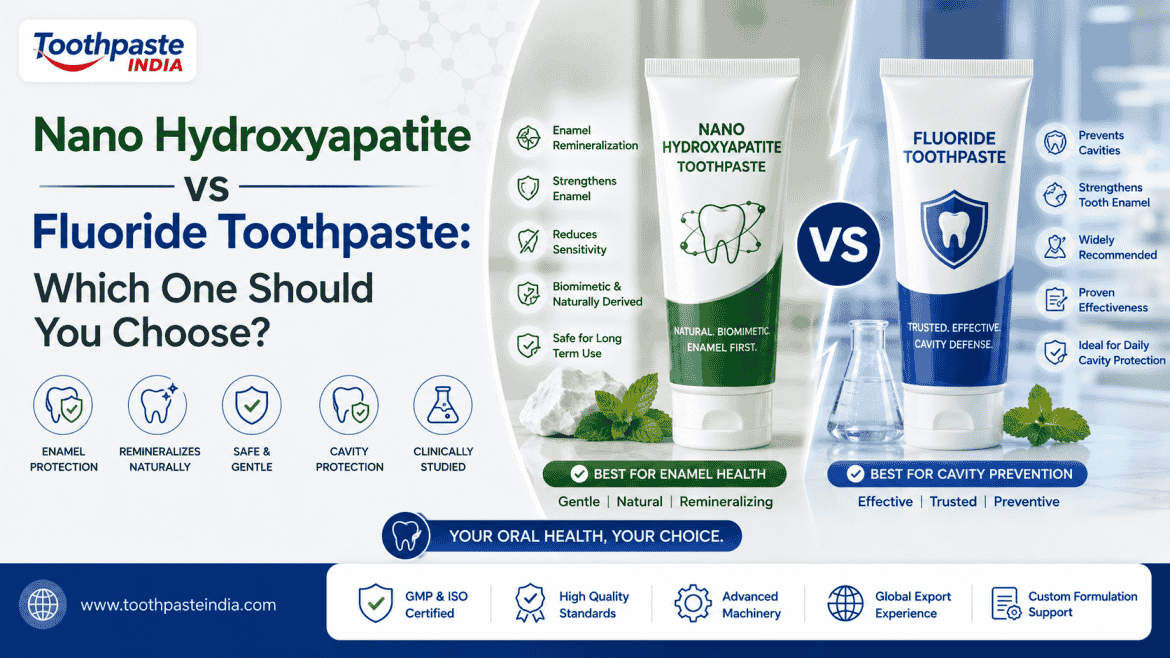

Choosing the right toothpaste has become more complicated than ever. Consumers are no longer looking only for cavity protection they also want stronger enamel, healthier gums, reduced tooth sensitivity, and cleaner ingredient lists.
This has led to one of the biggest debates in modern oral care: nano hydroxyapatite vs fluoride toothpaste.
While fluoride toothpaste has remained the global standard for decades, nano hydroxyapatite toothpaste has rapidly gained attention as an innovative alternative for enamel repair and sensitivity relief. Today, many premium oral care brands are launching fluoride free toothpaste formulated with nano hydroxyapatite to meet growing consumer demand.
If you’re wondering which is better nano hydroxyapatite or fluoride toothpaste, this guide explains how both ingredients work, their benefits, limitations, and which one may be the better choice for different users.
What Is Nano Hydroxyapatite Toothpaste?
Nano hydroxyapatite toothpaste is a biomimetic toothpaste that helps rebuild and remineralize tooth enamel by replacing lost minerals.
Hydroxyapatite is the primary mineral naturally found in human teeth and bones. Nano hydroxyapatite uses microscopic particles that closely resemble natural enamel crystals, allowing them to bond with damaged enamel surfaces.
Instead of only protecting teeth, nano hydroxyapatite actively helps repair microscopic enamel defects.
Some of the most recognized nano hydroxyapatite toothpaste benefits include:
- Supports enamel remineralization
- Helps reduce tooth sensitivity
- Smooths microscopic enamel imperfections
- Improves tooth surface strength
- May reduce plaque attachment
- Provides a fluoride-free alternative
- Suitable for daily oral care routines
Because it closely mimics natural tooth minerals, nano hydroxyapatite is often described as a biomimetic toothpaste.
What Is Fluoride Toothpaste?
Fluoride toothpaste is an oral care product formulated to strengthen enamel and reduce the risk of tooth decay by increasing enamel resistance to acid attacks.
For decades, fluoride has been one of the most researched ingredients in preventive dentistry.
When teeth are exposed to acids produced by bacteria and sugary foods, minerals are gradually lost from enamel. Fluoride promotes enamel remineralization by encouraging the formation of stronger mineral structures that are more resistant to future acid damage.
Major fluoride toothpaste benefits include:
- Proven cavity prevention
- Strong scientific evidence
- Widely recommended by dental professionals
- Helps strengthen developing enamel
- Supports long-term oral health
- Cost-effective daily protection
Because of its extensive research history, fluoride toothpaste for cavity prevention remains the standard recommendation in many countries.
How Does Nano Hydroxyapatite Work?
Nano hydroxyapatite works by physically integrating with the enamel surface.
Its nano-sized particles enter microscopic cracks and weak areas, where they deposit calcium and phosphate minerals that resemble natural tooth enamel.
The process generally includes:
- Filling tiny enamel defects
- Rebuilding weakened enamel
- Reducing exposed dentin tubules responsible for sensitivity
- Creating a smoother tooth surface
- Improving resistance against future wear
Unlike traditional whitening ingredients, nano hydroxyapatite focuses primarily on restoring tooth structure rather than bleaching enamel.
This makes it especially attractive for consumers searching for enamel repair toothpaste, remineralizing toothpaste, or nano hydroxyapatite for sensitive teeth.
How Does Fluoride Protect Teeth?
Fluoride works differently from nano hydroxyapatite.
Instead of filling enamel defects directly, fluoride chemically reacts with minerals already present in teeth to form fluorapatite a stronger mineral that is more resistant to acid attacks.
The fluoride protection cycle includes:
- Early enamel remineralization
- Reduced mineral loss
- Increased acid resistance
- Lower cavity risk
- Long-term protection against tooth decay
Because of this mechanism, fluoride remains highly effective in populations with a higher risk of cavities.
Nano Hydroxyapatite vs Fluoride Toothpaste: What’s the Real Difference?
The biggest difference is that nano hydroxyapatite focuses on rebuilding enamel, while fluoride primarily strengthens existing enamel against acid damage.
Although both ingredients contribute to healthier teeth, they achieve their results through different mechanisms.
Many modern dental professionals now recognize that the discussion is no longer simply hydroxyapatite toothpaste vs fluoride, but rather identifying which ingredient better matches a person’s oral health needs.
Consumers increasingly choose products based on:
- Tooth sensitivity
- Enamel erosion
- Cavity history
- Ingredient preferences
- Age
- Professional dental advice
As a result, both fluoride and nano hydroxyapatite continue to play important roles in modern oral health.
Is Nano Hydroxyapatite Better Than Fluoride?
The answer depends on your oral condition.
If your primary concern is tooth sensitivity relief or repairing early enamel wear, nano hydroxyapatite may offer additional advantages because it physically restores weakened enamel surfaces.
If your main concern is preventing cavities particularly if you’re at high risk of tooth decay fluoride continues to have decades of strong clinical evidence supporting its effectiveness.
Rather than asking “Is nano hydroxyapatite better than fluoride?”, it is more accurate to ask:
Which ingredient best addresses my current dental needs?
Many consumers are now switching between formulations depending on their dentist’s recommendation or specific oral health goals.
Nano Hydroxyapatite vs Fluoride Toothpaste for Sensitive Teeth
Sensitivity usually occurs when enamel becomes thinner or dentin tubules become exposed.
Nano hydroxyapatite helps by sealing these microscopic tubules while also repairing weakened enamel. This dual action makes it one of the fastest-growing ingredients in toothpaste for sensitive teeth.
Fluoride can also reduce sensitivity over time by strengthening enamel, but it generally works through a different biological process.
For consumers looking for:
- Best toothpaste for sensitive teeth
- Nano hydroxyapatite vs fluoride toothpaste for sensitive teeth
- Best toothpaste for enamel repair
Nano hydroxyapatite is increasingly becoming a preferred option, especially in premium oral care formulations.
Why Are More Toothpaste Brands Launching Nano Hydroxyapatite Products?
The global oral care market is shifting toward science-backed, premium formulations with multifunctional benefits.
Brands are responding to consumer demand for:
- Fluoride-free alternatives
- Advanced enamel repair
- Sensitive teeth solutions
- Clean-label formulations
- Premium oral care products
- Innovative ingredients
At Toothpaste India, we have observed increasing inquiries from private label brands, exporters, pharmacies, and D2C startups looking to develop nano hydroxyapatite oral care products. As an Ahmedabad-based toothpaste manufacturer, we support custom formulation, private label, and contract manufacturing for brands seeking to launch next-generation oral care products while following applicable GMP and quality manufacturing practices.
Does Nano Hydroxyapatite Help Prevent Cavities?
Yes, nano hydroxyapatite may help reduce the risk of cavities by strengthening enamel and repairing microscopic damage, but fluoride still has the strongest long-term clinical evidence for cavity prevention.
Nano hydroxyapatite creates a protective mineral layer on the tooth surface and supports enamel remineralization. By repairing early enamel defects, it may reduce the likelihood of bacterial penetration and decay.
People searching for nano hydroxyapatite toothpaste for cavities often want a fluoride-free option that still supports strong, healthy teeth. While research on nano hydroxyapatite continues to grow, fluoride remains the benchmark ingredient for high-risk cavity prevention.
If cavity prevention is your primary concern, consult your dentist before switching products.
Can Nano Hydroxyapatite Replace Fluoride?
It depends on your oral health needs and your dentist’s recommendation.
One of the most common questions today is, “Can nano hydroxyapatite replace fluoride?”
The answer isn’t universal because both ingredients offer different advantages.
Nano hydroxyapatite may be an excellent option for individuals who:
- Experience tooth sensitivity
- Want a fluoride-free toothpaste
- Have early enamel wear
- Prefer biomimetic oral care products
Fluoride may remain the preferred choice for people who:
- Have a history of frequent cavities
- Are at higher risk of tooth decay
- Need clinically established cavity protection
- Follow a dentist-prescribed fluoride regimen
Rather than replacing fluoride completely, many consumers choose products based on their current dental needs.
Is Nano Hydroxyapatite Toothpaste Safe?
Current research suggests that nano hydroxyapatite toothpaste is considered safe for daily oral care when formulated according to applicable quality and regulatory standards.
Because hydroxyapatite is naturally found in human teeth and bones, it is widely recognized as a biocompatible material.
Many premium brands now formulate fluoride free toothpaste with nano hydroxyapatite for consumers seeking an alternative oral care solution.
However, ingredient quality, particle technology, and manufacturing standards vary between manufacturers. Brands should always work with experienced partners that follow GMP, ISO, and other relevant quality systems.
Always verify the latest regulatory requirements for your target export market before commercial production.
Nano Hydroxyapatite Toothpaste for Adults vs Kids
Both adults and children have different oral care needs.
For adults, nano hydroxyapatite formulations are commonly developed for:
- Tooth sensitivity relief
- Enamel repair
- Whitening support
- Daily enamel strengthening
- Long-term oral health
For children, toothpaste formulations should always be selected according to age and a dental professional’s advice.
Interest in nano hydroxyapatite toothpaste for kids has increased because parents are looking for gentle yet effective oral care products. However, every children’s formulation should comply with applicable safety and regulatory guidelines.
Fluoride Toothpaste vs Non-Fluoride Toothpaste
The comparison between fluoride toothpaste vs non fluoride toothpaste has become increasingly relevant as consumers seek more personalized oral care solutions.
Fluoride toothpaste is ideal for:
- Proven cavity prevention
- High-risk dental patients
- Long-established preventive care
Non-fluoride toothpaste containing nano hydroxyapatite may be suitable for:
- Sensitive teeth
- Enamel repair
- Consumers seeking a natural toothpaste alternative
- Premium oral care products
- Daily remineralizing toothpaste
The best choice depends on oral health history, diet, and professional dental advice rather than marketing claims alone.
How Toothpaste Manufacturers Develop Both Formulations
As consumer preferences evolve, manufacturers increasingly produce both fluoride and nano hydroxyapatite formulations.
At Toothpaste India, our formulation team works with brands to develop customized products based on target markets, consumer preferences, and regulatory requirements.
Depending on project goals, manufacturers may customize:
- Nano hydroxyapatite concentration
- Fluoride level (where permitted)
- SLS-free formulations
- Herbal or Ayurvedic ingredients
- Whitening systems
- Activated charcoal variants
- Natural flavors
- Vegan-friendly formulations
- Sugar-free formulations
- Premium packaging options
Working with an experienced hydroxyapatite toothpaste manufacturer helps brands create differentiated products that align with current market trends while maintaining product quality and consistency.
How to Choose the Right Toothpaste
Choosing the right toothpaste starts with identifying your primary oral health concern.
Consider nano hydroxyapatite if you want:
- Enamel repair
- Tooth sensitivity relief
- Fluoride-free oral care
- Daily remineralization
- Premium biomimetic toothpaste
Consider fluoride toothpaste if you need:
- Strong cavity prevention
- Proven anti-caries protection
- Dentist-recommended preventive care
- Long-term enamel strengthening
The best toothpaste is one that matches your oral condition and is used consistently as part of a complete dental care routine that includes brushing, flossing, tongue cleaning, and regular dental check-ups.
Conclusion
The discussion around nano hydroxyapatite vs fluoride toothpaste isn’t about identifying a universal winner it’s about understanding which ingredient best supports your oral health goals.
Fluoride continues to be the gold standard for cavity prevention, backed by decades of scientific research. Nano hydroxyapatite, meanwhile, has emerged as a promising innovation for enamel remineralization, sensitivity relief, and premium fluoride-free formulations.
As consumer demand continues to shift toward specialized oral care products, both ingredients are expected to play an important role in the future of toothpaste manufacturing.
If you’re planning to launch your own toothpaste brand, choosing the right formulation is just as important as choosing the right manufacturing partner.
Frequently Asked Questions
Neither is universally better. Fluoride is best known for cavity prevention, while nano hydroxyapatite is widely recognized for enamel repair and reducing tooth sensitivity. The right choice depends on your oral health needs.
Yes. Current research indicates that nano hydroxyapatite toothpaste is generally considered safe for daily use when manufactured according to applicable quality standards.
It may be suitable for some individuals, but it is not a universal replacement. People with a high risk of cavities should consult their dentist before switching.
Nano hydroxyapatite supports enamel remineralization by depositing minerals onto weakened enamel surfaces, helping restore early microscopic damage.
Yes. Fluoride toothpaste remains one of the most widely recommended options for preventing cavities and strengthening enamel.
Yes. It can help reduce tooth sensitivity by sealing exposed dentin tubules while supporting enamel repair.
Children’s toothpaste should always be selected based on age and a dentist’s recommendation. Parents should verify product suitability before use.
Growing consumer demand for premium, fluoride-free, enamel-repair, and sensitivity-focused oral care products has increased interest in nano hydroxyapatite formulations.
Yes. Experienced manufacturers offer private label and contract manufacturing services with customized formulations, packaging, flavors, and ingredient combinations.
Look for a manufacturer with GMP-compliant facilities, strong R&D capabilities, custom formulation expertise, quality certifications, scalable production, and experience in private label and contract manufacturing.