
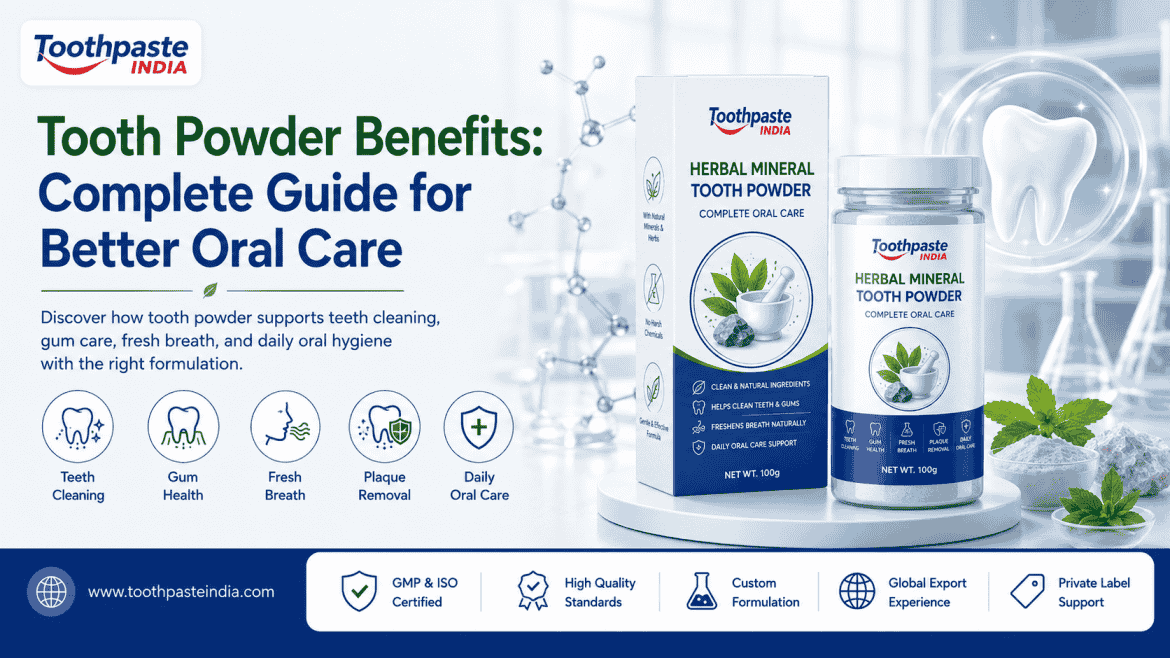

Tooth powder is one of the oldest formats used for teeth cleaning, but modern formulations are becoming increasingly relevant to both consumers and oral care brands. The main tooth powder benefits include mechanical cleaning, plaque-removal support, surface-stain removal and the ability to create herbal, Ayurvedic and natural oral care concepts.
However, a good tooth cleaning powder is not simply a mixture of herbs and abrasive ingredients. Its effectiveness and safety depend on the complete formula, including abrasive particle size, ingredient quality, flavor, moisture control and how the consumer uses it.
For brand owners, distributors, D2C startups and exporters, tooth powder also creates opportunities for differentiated private label oral care products in India and international markets.
What Is Tooth Powder and How Does It Work?
Tooth powder is a dry dentifrice formulated to clean teeth when used with a toothbrush.
Unlike conventional toothpaste, it does not require the same paste structure created by water, humectants and thickening systems. A tooth powder formulation generally relies on carefully blended dry ingredients that provide cleaning, flavor and other intended oral care functions.
Common tooth powder ingredients may include:
- Calcium carbonate or another suitable cleaning agent
- Sodium bicarbonate in selected formulations
- Herbal or botanical powders
- Flavoring ingredients
- Sweetening agents
- Mineral ingredients
- Functional ingredients based on the intended product concept
A natural tooth powder may additionally include botanical ingredients such as neem, clove, babool or other herbs, subject to formulation suitability and regulatory review.
What Are the Main Tooth Powder Benefits for Oral Care?
The main tooth powder benefits come from effective mechanical cleaning and the flexibility to create different oral care formulations.
A randomized controlled trial involving 154 participants, with 137 completing the study, evaluated a tooth powder against toothpaste over 24 weeks. The tested tooth powder produced statistically significant improvements in plaque and gingival index scores compared with the control product. This result applies to the formulation studied and should not be interpreted to mean that every tooth powder is superior to toothpaste.
For consumers and brands, potential dental powder benefits include:
- Supporting regular teeth cleaning
- Helping mechanically remove plaque
- Removing some external surface stains
- Supporting fresh-breath positioning
- Providing a dry alternative to conventional paste
- Allowing herbal and Ayurvedic ingredient concepts
- Supporting differentiated natural oral care products
The benefits always depend on the finished formulation rather than the product format alone.
What Are Tooth Powder Benefits for Teeth?
Tooth powder benefits for teeth primarily relate to mechanical removal of plaque, food debris and external stains during brushing.
Abrasive ingredients help clean tooth surfaces. The American Dental Association notes that abrasives in dentifrices can physically clean teeth and remove surface stains. However, abrasivity must be controlled because stronger abrasion does not automatically mean better cleaning.
A properly developed tooth powder for teeth cleaning should therefore balance cleaning performance with protection of enamel and exposed dentin.
For brands targeting tooth powder for healthy teeth, claims should remain realistic. A powder can support daily oral hygiene, but it should not be presented as curing cavities or dental disease without appropriate evidence and regulatory authorization.
What Are Tooth Powder Benefits for Gums?
Tooth powder may support gum health indirectly by helping remove plaque from teeth and around the gumline when used correctly.
Plaque control is an important component of oral hygiene, and the clinical tooth-powder study mentioned above reported reductions in both plaque and gingival scores for the tested formulation.
However, tooth powder benefits for gums should not be exaggerated. A tooth powder for gum health is not automatically a treatment for gingivitis or periodontal disease.
Brands developing gum-focused products should evaluate the complete formula and substantiate any specific gum-related claims.
Can Tooth Powder Help With Plaque, Bad Breath and Whitening?
Yes, tooth powder can be formulated for plaque removal, fresh breath and surface-stain cleaning, but each benefit works differently.
Tooth Powder for Plaque Removal
Mechanical brushing combined with suitable cleaning particles helps remove plaque and deposits from tooth surfaces.
Tooth Powder for Fresh Breath
A tooth powder for fresh breath may include flavor systems such as mint or other suitable ingredients that improve the immediate sensory experience after brushing.
A tooth powder for bad breath should not be positioned as treating persistent halitosis unless supported by appropriate evidence. Persistent bad breath can have dental or medical causes that require professional evaluation.
Tooth Powder for Teeth Whitening
A tooth powder for teeth whitening can help remove certain external stains through physical cleaning.
This is different from chemically changing the intrinsic color of teeth. Whitening claims should therefore distinguish surface-stain removal from bleaching.
Can Tooth Powder Be Too Abrasive?
Yes. Excessive abrasivity is one of the most important formulation risks in tooth powder.
An Indian study from researchers including AIIMS New Delhi evaluated tooth-substance loss associated with different dentifrices and specifically noted concerns about low-quality abrasives in some tooth powders. Abrasive composition, particle size and particle shape can influence wear.
This is why tooth powder ingredients for manufacturing should be selected based on technical specifications rather than simply cost or traditional familiarity.
During custom tooth powder formulation, manufacturers should evaluate factors such as:
- Type of abrasive
- Particle size distribution
- Particle shape
- Powder fineness
- Cleaning performance
- Finished-product consistency
For international formulation benchmarking, RDA is one established method used to evaluate dentifrice abrasivity, although brands should follow the standards applicable to their target market.
What Are Herbal Tooth Powder Benefits?
Herbal tooth powder benefits depend on the botanical ingredients selected and the evidence supporting the final formula.
A herbal dental powder may use ingredients such as neem, clove, mint or other botanicals to create a traditional or naturally positioned oral care product.
The benefits of herbal tooth powder should not be assumed simply because an ingredient is natural. Botanical raw materials still require evaluation for:
- Identity and purity
- Microbiological quality
- Contaminants
- Particle characteristics
- Stability
- Sensory performance
- Regulatory suitability
For brands seeking a herbal tooth powder manufacturer, formulation quality and testing should therefore carry as much weight as the ingredient story.
What Are Ayurvedic Tooth Powder Benefits?
Ayurvedic tooth powder offers a traditional Indian oral care format that can be developed around suitable Ayurvedic ingredients and consumer preferences.
An Ayurvedic dental powder may appeal to customers interested in traditional tooth powder concepts, herbal ingredients and familiar Indian oral care practices.
However, product classification can depend on composition, claims and the regulatory pathway chosen. Brands working with an Ayurvedic tooth powder manufacturer should verify whether the planned product falls under cosmetic requirements or another applicable regulatory framework before manufacturing or marketing it.
Tooth Powder vs Toothpaste: Which Is Better?
Neither tooth powder nor toothpaste is automatically better for every consumer; the formulation and intended use matter more than the physical format.
Tooth powder offers benefits such as:
- Dry-format formulation
- Herbal and traditional positioning
- Flexible packaging concepts
- Simple ingredient stories
Toothpaste offers advantages such as:
- Controlled paste dispensing
- Familiar consumer experience
- Easy incorporation of humectants and functional ingredients
- Strong evidence base for fluoride toothpaste in cavity prevention
The ADA states that fluoride helps prevent tooth decay and that toothpastes making cavity-protection claims under its Seal program must contain fluoride.
Therefore, brands comparing tooth powder vs toothpaste should avoid presenting a non-fluoride powder as automatically superior for cavity prevention.
How to Use Tooth Powder Correctly
Tooth powder should be used in a small quantity with gentle brushing rather than aggressive scrubbing.
A simple method is:
- Lightly wet a soft-bristled toothbrush.
- Apply a small quantity of tooth powder.
- Brush gently across all tooth surfaces.
- Clean along the gumline without excessive pressure.
- Follow the directions provided on the product label.
How to use tooth powder can vary by formulation, so manufacturers should include clear usage instructions on the final pack.
A tooth powder for daily use should be specifically developed and tested for that intended frequency.
What Makes the Best Tooth Powder for Oral Care?
The best tooth powder for oral care is a balanced formulation that delivers the intended cleaning experience without relying on unnecessarily aggressive abrasives or exaggerated claims.
From a product-development perspective, brands should evaluate:
- Cleaning performance
- Abrasivity
- Ingredient quality
- Flavor and aftertaste
- Powder flow
- Moisture resistance
- Microbiological quality
- Packaging compatibility
- Regulatory compliance
Whether developing a natural oral care powder, herbal formulation or premium tooth powder, the entire product system matters more than any single ingredient.
How Does the Tooth Powder Manufacturing Process Work?
Commercial tooth powder manufacturing involves controlled weighing, sieving, blending, quality checks, filling and packaging. Brands working with a third party toothpaste manufacturer can also use this manufacturing infrastructure to develop and scale customized oral care products.
India’s Cosmetics Rules, 2020 specifically identify equipment for general tooth-powder production, including weighing and measuring devices, a dry mixer or powder blender, stainless-steel sieves, and powder filling and sealing equipment. The Rules also recommend separate manufacturing areas for black and white tooth powders.
A typical tooth powder manufacturing process includes:
- Raw-material receipt and inspection
- Accurate weighing
- Sieving to achieve suitable particle consistency
- Controlled dry blending
- Addition of flavors and functional ingredients
- Homogeneity checks
- Finished-product quality testing
- Filling into suitable containers
- Sealing, coding and packaging
- Final release inspection
Moisture control is particularly important because humidity can affect powder flow, texture and stability.
What Regulations Apply to Tooth Powder Manufacturing in India?
Tooth powder sold as a cosmetic oral care product in India must be developed with the Cosmetics Rules, 2020 and applicable BIS requirements in mind.
The Ninth Schedule of the Cosmetics Rules states that finished tooth powder must conform to the BIS specification identified as IS 5383.
The Rules also prohibit cosmetics from making false or misleading claims.
A tooth powder manufacturer in India should therefore review:
- Raw-material suitability
- Applicable manufacturing licence
- BIS requirements
- Finished-product specifications
- Label declarations
- Product claims
- Batch testing
- Packaging
- Export-country requirements
Regulations can change, so always verify with current regulatory guidelines and the relevant licensing authority before commercial launch.
Why Are Brands Choosing Private Label Tooth Powder?
Private label tooth powder allows a company to launch a differentiated oral care product without building its own manufacturing infrastructure.
A private label tooth powder manufacturer can assist with:
- Product concept development
- Custom tooth powder formulation
- Herbal or Ayurvedic variants
- Ingredient selection
- Sample development
- Tooth powder manufacturing
- Packaging selection
- Private labeling
- Bulk production
- Export support
Toothpaste India, an Ahmedabad-based oral care manufacturer, currently lists tooth powder among its product categories and offers private label tooth powder, custom branding, OEM/contract manufacturing and third-party production for domestic and export markets.
Its broader private-label services also include formulation development and oral care product customization.
For a D2C startup, distributor, pharmaceutical company or oral care brand, working with an experienced tooth powder supplier can reduce the complexity of moving from product concept to commercial production.
Conclusion
Tooth powder benefits can include effective teeth cleaning, plaque-removal support, surface-stain cleaning, fresh-breath positioning and flexibility for herbal, Ayurvedic and natural formulations. At the same time, abrasivity, ingredient quality, manufacturing controls and evidence-based claims are critical to developing a safe and commercially credible product.
For brands planning a private label tooth powder, private label toothpaste manufacturer or custom oral care range, product development should begin with a clear consumer need and continue through formulation, testing, compliance and packaging.
Frequently Asked Questions
Tooth powder benefits may include mechanical teeth cleaning, plaque-removal support, surface-stain removal and fresh-breath support. Herbal, Ayurvedic and natural formulations also allow brands to create differentiated oral care products. Actual performance depends on the ingredients, abrasive characteristics, finished formulation and correct brushing technique.
Yes, tooth powder can be suitable for teeth when it is properly formulated and used gently. The main concern is abrasivity. Powders containing unsuitable or overly coarse abrasive particles may increase tooth wear, so ingredient specifications, particle size and brushing pressure should be carefully controlled.
Tooth powder can support oral hygiene around the gumline by helping remove plaque during brushing. However, it should not automatically be described as treating gum disease. A product making specific gum-health claims should have an appropriate formulation, supporting evidence and compliant marketing language.
Benefits of herbal tooth powder depend on the botanical ingredients and complete formulation. Herbal tooth powders can combine mechanical cleaning with natural or traditional positioning and fresh-flavor concepts. Botanical raw materials should still be evaluated for purity, microbial quality, safety and regulatory suitability.
Ayurvedic tooth powder benefits may include traditional oral-care positioning and the ability to incorporate suitable Ayurvedic ingredients. Actual performance depends on the final product rather than the word “Ayurvedic” alone. Brands should also verify the correct regulatory classification based on ingredients and intended claims.
Yes, brushing with a properly formulated tooth powder can mechanically help remove plaque. One 24-week randomized clinical study reported significant improvements in plaque and gingival scores with the tested tooth powder, although results from one formulation should not be generalized to every tooth powder.
Tooth powder may help remove external surface stains through abrasive cleaning, which can make teeth appear cleaner or brighter. This should not be confused with bleaching or changing intrinsic tooth color. Whitening formulations should balance stain removal with controlled abrasivity.
Lightly wet a soft toothbrush, apply a small quantity of powder and brush gently across the teeth and gumline according to the product directions. Avoid aggressive scrubbing. Brands developing tooth powder for daily use should provide clear instructions and ensure the formulation is appropriate for its intended frequency.
Tooth powder ingredients may include calcium carbonate or other cleaning materials, flavoring agents, sweeteners, botanical ingredients and functional ingredients selected for the product concept. Each raw material should be evaluated for purity, particle characteristics, stability, safety and regulatory compliance before commercial manufacturing.
Start by defining the target consumer, desired benefits, ingredient preferences, packaging, target market and pricing. Then work with a qualified private label tooth powder manufacturer for custom formulation, samples, quality testing, manufacturing and packaging. Indian and export-market regulatory requirements should be verified before launch.