
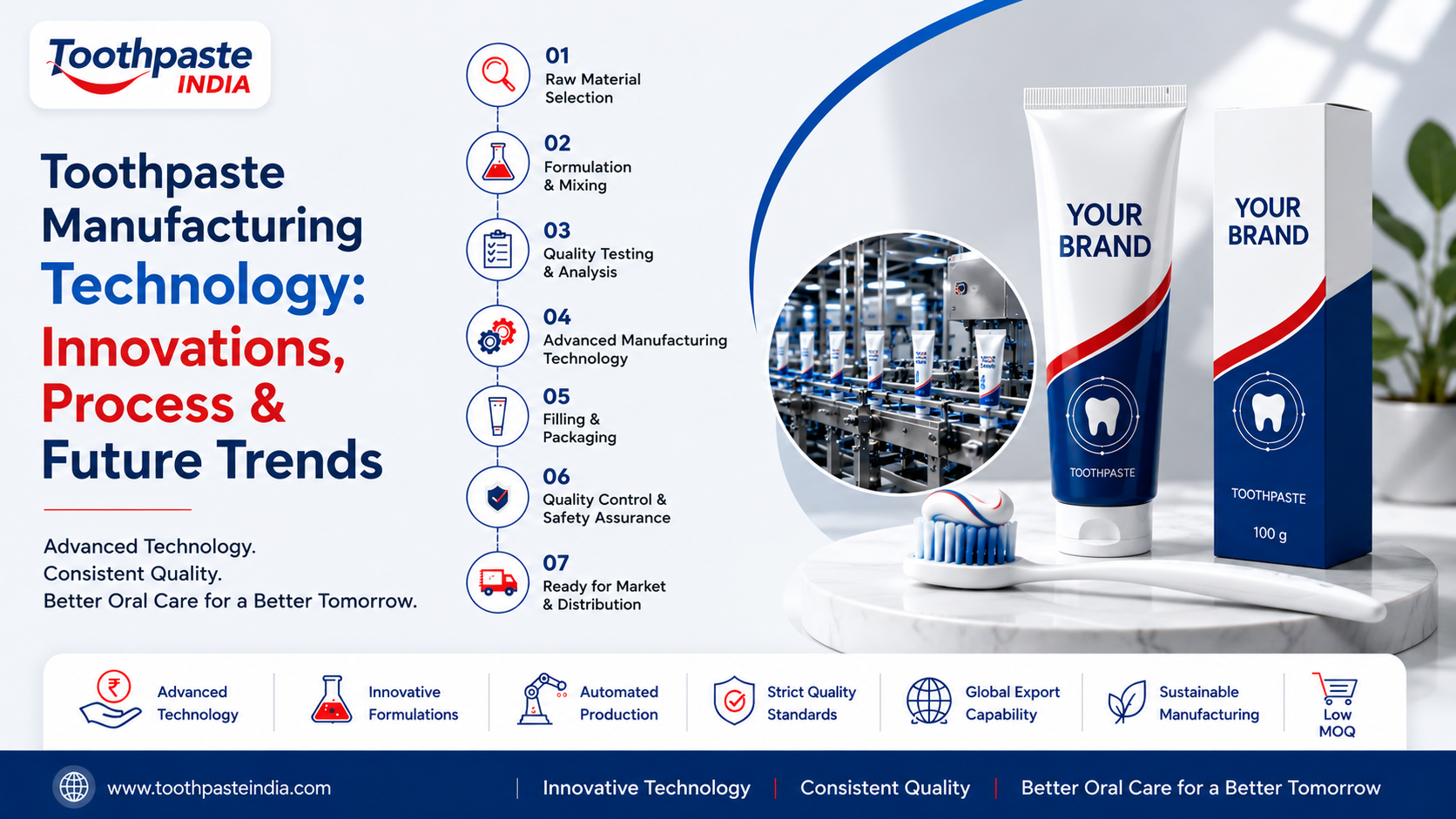

Modern toothpaste manufacturing technology has transformed how oral care products are produced. Today’s manufacturing plants combine automation, intelligent machinery, advanced quality testing, and digital monitoring to manufacture safe, consistent, and high-quality toothpaste at scale.
Whether you’re launching a private label toothpaste brand, expanding an oral care business, or looking for a reliable private label toothpaste manufacturer, understanding modern manufacturing technology helps you make better business decisions.
This guide explains how toothpaste is manufactured, the machinery involved, quality standards, and how technologies like Artificial Intelligence (AI), Industry 4.0, IoT, and industrial automation are shaping the future of toothpaste production.
What Is Toothpaste Manufacturing Technology?
Toothpaste manufacturing technology refers to the equipment, production methods, automation systems, and quality control processes used to manufacture toothpaste efficiently while maintaining consistent product quality.
Modern manufacturing technology combines:
- Automated ingredient handling
- Precision mixing systems
- Vacuum homogenization
- Intelligent production monitoring
- Automated filling and packaging
- Digital quality control
- Sustainable production practices
These technologies help manufacturers improve productivity while reducing waste and ensuring product consistency.
Why Modern Toothpaste Manufacturing Technology Matters
Advanced manufacturing technology benefits both manufacturers and brand owners.
Key advantages include:
- Consistent toothpaste quality
- Faster production cycles
- Reduced human error
- Better ingredient accuracy
- Improved hygiene standards
- Lower production waste
- Higher manufacturing efficiency
- Easier compliance with international quality standards
For brands, this means receiving products with consistent texture, flavor, color, stability, and performance across every production batch.
How Toothpaste Is Manufactured
The modern toothpaste manufacturing process follows several carefully controlled stages.
1. Ingredient Selection
Manufacturers first select high-quality toothpaste ingredients such as:
- Abrasives
- Humectants
- Fluoride or fluoride-free alternatives
- Herbal extracts
- Sweeteners
- Flavoring agents
- Binders
- Preservatives
- Active natural oral care ingredients
Each ingredient is tested before entering production.
2. Automated Weighing and Dispensing
Modern manufacturing plants use automated weighing systems that accurately measure raw materials.
Automation minimizes manual errors while ensuring every batch follows the approved formulation.
3. Vacuum Mixing and Homogenization
Ingredients are transferred into vacuum mixers where they are blended into a smooth paste.
Vacuum technology removes trapped air bubbles, resulting in:
- Better texture
- Longer shelf life
- Improved stability
- Consistent appearance
This stage is one of the most important parts of toothpaste production.
4. Quality Testing During Production
Modern plants perform continuous quality control throughout production.
Common tests include:
- pH testing
- Viscosity measurement
- Microbiological testing
- Stability testing
- Density checks
- Appearance inspection
- Flavor consistency
- Active ingredient verification
Continuous monitoring ensures every production batch meets predefined specifications.
5. Filling and Tube Packaging
Once approved, toothpaste is transferred to automated toothpaste filling machines.
The production line performs:
- Tube filling
- Tube sealing
- Batch coding
- Date printing
- Carton packing
- Final inspection
Automated toothpaste tube packaging significantly improves production speed while maintaining hygiene.
Machinery Used in Modern Toothpaste Manufacturing Plants
A modern toothpaste manufacturing facility typically includes:
Raw Material Storage Systems
Safe storage maintains ingredient quality before production.
Vacuum Emulsifier Mixer
Creates a smooth, homogeneous toothpaste formulation.
Homogenizer
Improves texture and ingredient dispersion.
Transfer Pumps
Move product efficiently between production stages.
Automatic Toothpaste Filling Machine
Accurately fills toothpaste tubes with minimal product waste.
Tube Sealing Machine
Provides secure and leak-proof packaging.
Cartoning Machine
Automates secondary packaging for retail distribution.
Quality Control Laboratory
Equipped with instruments for microbiological, chemical, and physical testing.
The Role of Automation in Manufacturing
Automation has become essential in toothpaste production.
Modern automated systems help manufacturers:
- Reduce production downtime
- Improve production speed
- Increase batch consistency
- Lower labor-intensive operations
- Enhance workplace safety
- Improve production planning
Industrial automation also allows manufacturers to produce large volumes while maintaining strict quality standards.
Industry 4.0 and Smart Manufacturing
Industry 4.0 connects production equipment using digital technologies.
Features include:
- Real-time production monitoring
- Connected machinery
- Automated reporting
- Production analytics
- Machine learning insights
- Cloud-based production management
Smart manufacturing enables manufacturers to identify production issues before they affect product quality.
Artificial Intelligence in Toothpaste Manufacturing
Artificial Intelligence is increasingly being integrated into manufacturing technology.
AI helps manufacturers by:
- Predicting equipment failures
- Monitoring production efficiency
- Detecting quality deviations
- Optimizing production schedules
- Improving inventory management
- Supporting preventive maintenance
AI in toothpaste manufacturing improves productivity while reducing operational costs.
Internet of Things (IoT) in Manufacturing
IoT devices collect real-time production data from manufacturing equipment.
Benefits include:
- Equipment monitoring
- Temperature tracking
- Energy monitoring
- Production analytics
- Predictive maintenance
- Remote equipment diagnostics
IoT allows manufacturers to make faster, data-driven production decisions.
Sustainable Manufacturing Practices
Modern toothpaste manufacturing plants are increasingly adopting sustainable manufacturing practices.
Examples include:
- Energy-efficient equipment
- Water conservation systems
- Eco-friendly manufacturing processes
- Recyclable toothpaste tube packaging
- Reduced production waste
- Responsible raw material sourcing
Sustainability benefits both manufacturers and environmentally conscious consumers.
How Technology Improves Toothpaste Quality
Advanced toothpaste manufacturing technology improves quality by:
- Maintaining ingredient accuracy
- Eliminating batch inconsistencies
- Improving product stability
- Enhancing hygiene
- Preventing contamination
- Increasing packaging precision
- Supporting continuous quality testing
The result is a safer, more consistent oral care product.
How to Choose the Right Toothpaste Manufacturer
When selecting a manufacturing partner, consider:
- Modern manufacturing technology
- GMP-compliant production
- ISO-certified quality systems
- Strong research and development capabilities
- Product customization options
- Quality testing procedures
- Export experience
- Flexible private label services
- Scalable production capacity
- Transparent communication
A manufacturer investing in advanced technology is better equipped to deliver reliable, high-quality products.
Expert Buyer Checklist
Before choosing a toothpaste manufacturing partner, verify:
- Modern automated production facility
- Advanced toothpaste manufacturing technology
- Comprehensive quality testing
- Industry certifications
- Private label expertise
- Contract manufacturing capabilities
- Sustainable manufacturing practices
- Export compliance
- Product development support
- Experienced technical team
Conclusion
Modern toothpaste manufacturing technology has transformed the oral care industry through automation, AI, Industry 4.0, IoT, and advanced quality control systems. These innovations help manufacturers improve production efficiency, ensure consistent product quality, reduce waste, and support sustainable manufacturing.
For businesses looking to launch or expand an oral care brand, partnering with an experienced third party toothpaste manufacturer that invests in advanced manufacturing technology is essential. Companies like Toothpaste India combine modern production processes, stringent quality standards, customization capabilities, and industry expertise to help brands develop reliable, high-quality toothpaste products for domestic and international markets.
Frequently Asked Questions
Toothpaste is manufactured by blending carefully measured ingredients in vacuum mixers, followed by homogenization, quality testing, tube filling, sealing, and packaging using automated production systems.
Modern toothpaste manufacturing technology includes vacuum mixers, automated filling machines, industrial automation, IoT, AI-based monitoring, robotics, and digital quality control systems.
AI improves toothpaste manufacturing by predicting equipment maintenance, monitoring production quality, optimizing production schedules, and reducing manufacturing errors.
The process includes ingredient selection, automated weighing, vacuum mixing, homogenization, quality testing, filling, sealing, packaging, and final inspection.
Common machines include vacuum emulsifier mixers, homogenizers, transfer pumps, toothpaste filling machines, tube sealing machines, cartoning machines, and quality testing equipment.
Automation increases production speed, improves accuracy, reduces human error, enhances hygiene, and ensures consistent product quality.
Industry 4.0 integrates digital manufacturing, IoT, AI, automation, and real-time data analytics to create smarter, more efficient production facilities.
Manufacturers perform raw material inspection, in-process testing, microbiological analysis, stability testing, viscosity checks, pH measurement, and final product inspection before packaging.
Sustainable manufacturing reduces environmental impact through energy-efficient equipment, recyclable packaging, waste reduction, and responsible sourcing while meeting growing consumer expectations.
Manufacturers using modern toothpaste manufacturing technology provide better consistency, faster production, stronger quality assurance, customization options, and greater scalability for growing oral care brands.