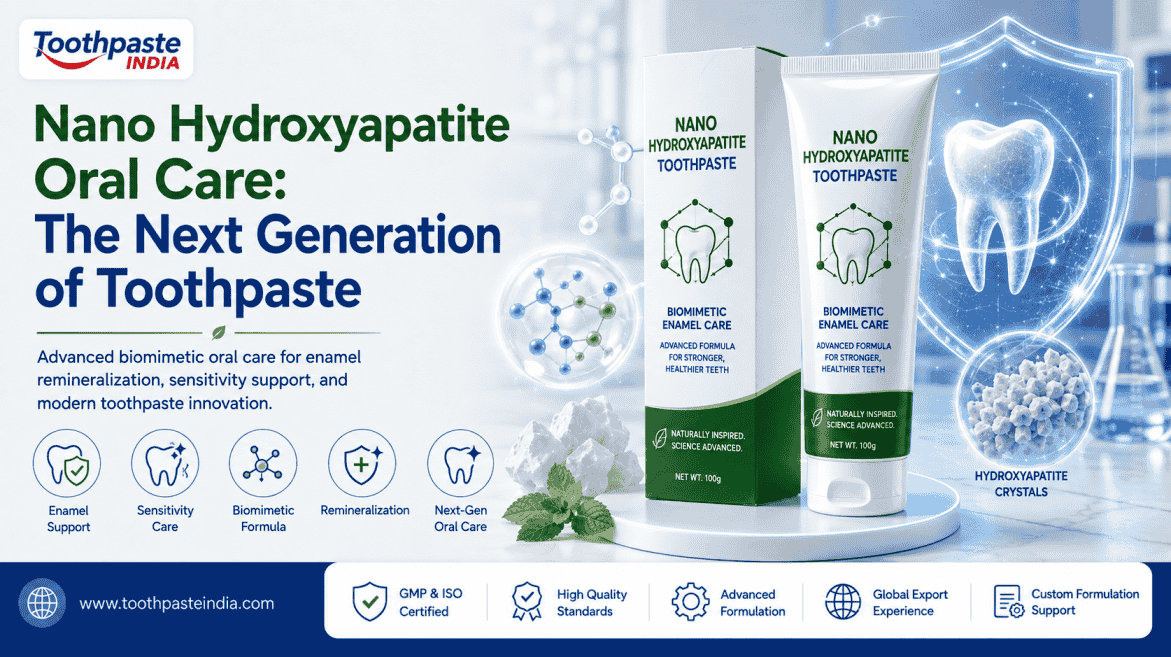

Consumer expectations around toothpaste are changing. Buyers increasingly look beyond basic cleaning and fresh breath toward products designed for sensitivity, enamel support, remineralization and ingredient-led oral care.
Nano Hydroxyapatite Oral Care is emerging within this shift because hydroxyapatite is a calcium-phosphate mineral closely related to the mineral phase of human teeth. When incorporated correctly into toothpaste, nano hydroxyapatite can interact with enamel and exposed dentin surfaces, making it particularly relevant for modern remineralizing toothpaste and sensitivity-care formulations.
For toothpaste brand owners, distributors, D2C startups, exporters and pharmaceutical companies, however, the opportunity is not simply to add a trending ingredient. Successful products require appropriate particle specifications, compatible supporting ingredients, controlled processing, stability testing, compliant claims and a clearly defined consumer benefit.
What Is Nano Hydroxyapatite Oral Care?
Nano Hydroxyapatite Oral Care refers to toothpaste and other oral care formulations containing very small hydroxyapatite particles designed to mimic the mineral characteristics of teeth.
Hydroxyapatite is commonly represented chemically as Ca10(PO4)6(OH)2. Its biomimetic nature is the reason hydroxyapatite toothpaste has attracted attention as an ingredient for enamel-supporting and sensitivity-focused formulations.
The nano form provides very small particles with a high surface area. Depending on particle characteristics and formulation design, these particles can interact with microscopic irregularities on the tooth surface and exposed dentinal tubules.
This has led to product categories such as:
- Nano hydroxyapatite toothpaste
- Biomimetic toothpaste
- Remineralizing toothpaste
- Enamel repair toothpaste
- Hydroxyapatite toothpaste for sensitive teeth
- Fluoride free hydroxyapatite toothpaste
- Enamel strengthening toothpaste
- Toothpaste for enamel protection
The term “enamel repair” should still be used carefully. Toothpaste cannot regenerate severely lost enamel. A scientifically responsible interpretation of nano hydroxyapatite enamel repair is support for mineral deposition and remineralization of early or superficially demineralized areas.
How Does Nano Hydroxyapatite for Teeth Work?
Nano hydroxyapatite for teeth works primarily by interacting with mineralized tooth surfaces and supplying calcium-phosphate-rich material where early mineral loss or surface irregularities are present.
This is why it is frequently described as a biomimetic oral care ingredient.
Three mechanisms are particularly relevant.
1. Surface mineral deposition
Hydroxyapatite particles can deposit on enamel surfaces and contribute to a mineral-rich layer over microscopic defects.
This process is central to the concept of nano hydroxyapatite remineralization.
Research continues to evaluate how effectively different particle sizes, concentrations and formulations influence early enamel lesions. A 2025 Journal of Dentistry systematic review specifically assessed fluoride-free hydroxyapatite toothpastes for remineralization and prevention of initial caries lesions, reflecting the growing clinical research around this ingredient class.
2. Dentinal tubule occlusion
Tooth sensitivity often occurs when dentin becomes exposed and microscopic dentinal tubules allow external stimuli to trigger discomfort.
Nano hydroxyapatite for sensitive teeth is used because particles can help occlude these tubules.
A systematic review and meta-analysis of randomized clinical trials found nano-hydroxyapatite-containing treatments effective for reducing dentin hypersensitivity, although the authors also emphasized the need for longer-term trials.
An updated 2023 review identified 44 clinical trials involving hydroxyapatite oral care products and found significant sensitivity reduction in its quantitative analyses. The publication also disclosed that some authors were employees of an oral care manufacturer, an important consideration when interpreting the evidence.
3. Biomimetic interaction with enamel
Traditional toothpaste often focuses on removing plaque and surface debris. Biomimetic toothpaste adds another formulation objective: interacting with the mineral structure of teeth.
That positioning makes nano hydroxyapatite oral care particularly attractive for premium products focused on enamel, sensitivity and preventive oral care.
What Are the Main Nano Hydroxyapatite Toothpaste Benefits?
The most defensible nano hydroxyapatite toothpaste benefits relate to remineralization support and dentin sensitivity rather than exaggerated claims of rebuilding damaged teeth.
Potential formulation benefits include:
- Supporting tooth enamel remineralization
- Helping fill microscopic surface irregularities
- Helping occlude exposed dentinal tubules
- Supporting sensitivity-focused toothpaste positioning
- Enabling biomimetic oral care concepts
- Supporting fluoride-free product development when appropriate
- Creating differentiation in premium oral care
- Pairing well with enamel-protection positioning
Clinical evidence for sensitivity is particularly notable. In one randomized trial involving 105 participants, a nano-hydroxyapatite toothpaste group showed significant improvements in sensitivity measurements after two and four weeks compared with control groups.
Brands should nevertheless avoid converting research findings into absolute consumer promises. Product-specific performance depends on formulation, active concentration, particle characteristics, usage pattern and clinical substantiation.
Nano Hydroxyapatite vs Fluoride: Which Is Better?
Nano hydroxyapatite vs fluoride should be presented as a formulation decision rather than a simplistic winner-versus-loser comparison.
Fluoride has decades of established use for caries prevention. Hydroxyapatite is receiving increasing research attention for remineralization, sensitivity management and fluoride-free oral care.
Hydroxyapatite toothpaste has also been tested directly against fluoride toothpaste.
For example, an 18-month randomized clinical trial in 189 adults compared a hydroxyapatite toothpaste with fluoride toothpaste. In the per-protocol analysis, 89.3% of subjects using hydroxyapatite and 87.4% using fluoride showed no increase in the study’s DMFS caries measure, and hydroxyapatite met the predefined non-inferiority criterion. This study evaluated hydroxyapatite toothpaste broadly and should not automatically be interpreted as evidence for every nano-hydroxyapatite formula.
Other reviews have reported more mixed evidence, particularly because formulations, particle characteristics and study designs differ. A 2022 systematic review concluded that nano-hydroxyapatite showed similar remineralizing potential to fluoride under some remineralizing conditions but rated the overall evidence as very low and noted substantial study heterogeneity.
Therefore, hydroxyapatite vs fluoride toothpaste is best discussed according to product objective.
Fluoride may remain appropriate for conventional anticaries positioning, while hydroxyapatite can be especially relevant for biomimetic, enamel-support, sensitivity and fluoride-free concepts.
Combination strategies involving hydroxyapatite and fluoride are also being studied.
Why Is Nano Hydroxyapatite Becoming Important for Oral Care Brands?
Nano hydroxyapatite is commercially attractive because it connects scientific oral care with several growing product-positioning opportunities.
Brand owners can potentially develop concepts around:
- Enamel protection
- Sensitive teeth
- Remineralization
- Premium oral care
- Biomimetic science
- Fluoride-free oral care
- Gentle daily care
- Dentist-inspired positioning
For a D2C startup, this provides a clearer differentiation story than launching another generic mint toothpaste.
For distributors and exporters, a hydroxyapatite range can create additional premium SKUs alongside herbal, whitening, sensitivity and conventional fluoride toothpaste.
For established brands, it offers an opportunity to build a science-led subcategory without replacing the entire oral care portfolio.
What Goes Into a Well-Designed Nano Hydroxyapatite Toothpaste?
A successful nano hydroxyapatite toothpaste requires more than adding the active ingredient to a standard toothpaste base.
A toothpaste development team must balance the active with the complete formulation system.
Typical formulation components may include:
- Hydroxyapatite as the functional mineral ingredient
- Humectants such as glycerin or sorbitol to retain moisture
- Appropriate abrasives for controlled cleaning
- Binding or thickening agents for stable texture
- Surfactants for cleaning and foaming
- Flavors and sweetening systems
- Preservative systems where required
- Water and other formulation carriers
Brands may also request SLS-free formulation when targeting consumers seeking lower-foaming or gentler oral care.
The interaction between abrasives and nano hydroxyapatite deserves particular attention. An overly abrasive base may undermine an enamel-care positioning, while poor viscosity can cause settling, separation or inconsistent active distribution.
The formulation should therefore be evaluated as a complete system rather than as a list of marketable ingredients.
What Should Manufacturers Check During Custom Toothpaste Formulation?
A nano hydroxyapatite toothpaste manufacturer should evaluate raw-material specifications, formulation compatibility, processing conditions and finished-product stability before commercial production.
Important development checks include:
- Hydroxyapatite particle specification and supplier documentation
- Intended active concentration
- Particle morphology
- Compatibility with abrasives and surfactants
- pH of the finished toothpaste
- Viscosity and dispensing performance
- Flavor compatibility
- Microbiological quality
- Packaging compatibility
- Accelerated and real-time stability where applicable
- Claim substantiation
- Applicable regulatory and labeling requirements
Particle morphology deserves special attention.
The European Commission’s Scientific Committee on Consumer Safety issued an updated opinion in 2025 concluding that nano hydroxyapatite meeting specific particle specifications was safe at concentrations up to 29.5% in toothpaste. That conclusion applied to specified uncoated, predominantly rod-shaped particles and explicitly did not extend to needle-shaped material. This is an EU scientific safety opinion, not an Indian product approval, but it illustrates why raw-material characterization is critical when sourcing nano hydroxyapatite.
What Regulations Apply to Nano Hydroxyapatite Toothpaste in India?
For conventional cosmetic toothpaste manufactured in India, the Cosmetics Rules, 2020 and applicable Indian Standards should be reviewed during product development and commercialization.
CDSCO states that cosmetic manufacture is regulated through licensing by State Licensing Authorities and that cosmetics must comply with applicable quality and safety standards. CDSCO also prohibits false or misleading cosmetic claims.
The Bureau of Indian Standards lists toothpaste under IS 6356 among Indian Standards referenced for finished cosmetics.
Therefore, a brand developing nano hydroxyapatite toothpaste in India should verify:
- Applicable Cosmetics Rules
- Current version and amendments of IS 6356
- Ingredient acceptability
- Label declarations
- Claims and supporting evidence
- Manufacturing licence requirements
- Quality-control specifications
- Export-country requirements when selling internationally
FSSAI should not automatically be treated as the primary regulatory framework for conventional toothpaste simply because ingredients may also occur in food or supplements.
Likewise, terms such as GMP, ISO, Halal, Vegan or Cruelty-Free should only appear on packaging or marketing when the relevant manufacturing system, certification or substantiation actually supports the claim.
Regulatory requirements can change, so formulations and labels should be verified against current Indian and destination-market requirements before launch.
Why Does the Manufacturing Partner Matter?
The manufacturing partner determines whether an innovative ingredient becomes a stable commercial product or simply a strong marketing concept.
A capable hydroxyapatite toothpaste manufacturer should understand formulation chemistry, raw-material qualification, production controls, packaging compatibility and regulatory documentation.
Depending on the business model, brands may work with:
- A private label toothpaste manufacturer
- A third party toothpaste manufacturer
- A contract toothpaste manufacturer
- A remineralizing toothpaste manufacturer
- A fluoride free toothpaste manufacturer
- An oral care manufacturer in India
A private label nano hydroxyapatite toothpaste project may begin with an existing formulation platform and then customize flavor, active positioning, packaging and branding.
A fully custom toothpaste formulation typically requires more development work because the base system, ingredient interactions, sensory profile and stability need to be optimized together.
Is Nano Hydroxyapatite Oral Care the Next Generation of Toothpaste?
Nano Hydroxyapatite Oral Care has strong potential to become an important next-generation toothpaste category because it combines biomimetic science with consumer demand for enamel-focused and sensitivity-focused products.
The evidence should still be communicated responsibly. Nano hydroxyapatite should not be marketed as magically rebuilding severely damaged enamel or as universally superior to fluoride.
Its strongest opportunity lies in scientifically designed products with appropriate particle specifications, a balanced formulation, defensible claims and clearly defined consumer use cases.
For B2B buyers, the commercial opportunity is equally important. A well-developed hydroxyapatite toothpaste can differentiate a new oral care brand across D2C, pharmacy, retail and export channels.
Toothpaste India, an Ahmedabad, Gujarat-based B2B toothpaste manufacturing company, works in the private label and contract manufacturing space. Brands exploring nano hydroxyapatite toothpaste, enamel-care toothpaste, sensitivity products or other private label oral care products can discuss their formulation, positioning and manufacturing requirements before moving toward commercial production.
Contact Toothpaste India to discuss your private label or contract toothpaste manufacturing project.
Frequently Asked Questions
Nano hydroxyapatite toothpaste is a dentifrice containing very small hydroxyapatite particles designed to interact with tooth mineral surfaces. It is commonly positioned for enamel remineralization, sensitivity support and biomimetic oral care. Product effectiveness depends on particle specifications, concentration, supporting ingredients and overall formulation quality.
Nano hydroxyapatite has promising evidence for enamel remineralization and management of dentin hypersensitivity. Clinical and laboratory studies have reported beneficial effects, although results vary by formulation. Consumers with active dental disease, severe sensitivity or high cavity risk should seek advice from a qualified dental professional.
Nano hydroxyapatite may support remineralization of early or superficially demineralized enamel, but “repair” should not imply regeneration of enamel that has been physically lost through advanced erosion, cavities or fracture. Enamel repair toothpaste claims therefore need careful scientific and regulatory substantiation.
The main potential nano hydroxyapatite toothpaste benefits include enamel remineralization support, mineral deposition on tooth surfaces and occlusion of exposed dentinal tubules associated with sensitivity. It also enables biomimetic, enamel-care and fluoride-free toothpaste positioning for oral care brands.
Yes, nano hydroxyapatite for sensitive teeth is supported by clinical research showing reductions in dentin hypersensitivity. Its proposed mechanism includes deposition over exposed dentin and occlusion of dentinal tubules, helping reduce the transmission of external stimuli that can trigger sensitivity.
Current evidence does not justify saying nano hydroxyapatite is universally better than fluoride. Fluoride has a long-established role in caries prevention, while hydroxyapatite shows promising evidence for remineralization and sensitivity. The appropriate ingredient strategy depends on target consumers, claims and formulation objectives.
Yes. A fluoride free hydroxyapatite toothpaste can be developed for brands targeting biomimetic, enamel-support or fluoride-free oral care segments. The manufacturer should still evaluate ingredient specifications, product stability, cleaning performance, microbiological quality, labeling and regulatory requirements before commercialization.
Look for experience in oral care formulation, raw-material qualification, quality control, manufacturing licensing, stability evaluation, packaging compatibility and regulatory documentation. A suitable nano hydroxyapatite toothpaste manufacturer in India should also be able to explain ingredient specifications rather than relying only on marketing claims.
Yes. Private label nano hydroxyapatite toothpaste can be developed by customizing a suitable toothpaste platform with the required flavor, packaging, positioning and branding. More distinctive concepts may require custom toothpaste formulation and additional development or stability work before commercial production.
Private label toothpaste manufacturing generally starts with an established formulation that can be branded or selectively customized. Contract toothpaste manufacturing may involve deeper product development based on a buyer’s formulation brief, ingredient requirements, packaging and target market. The best model depends on launch speed, budget and desired differentiation.