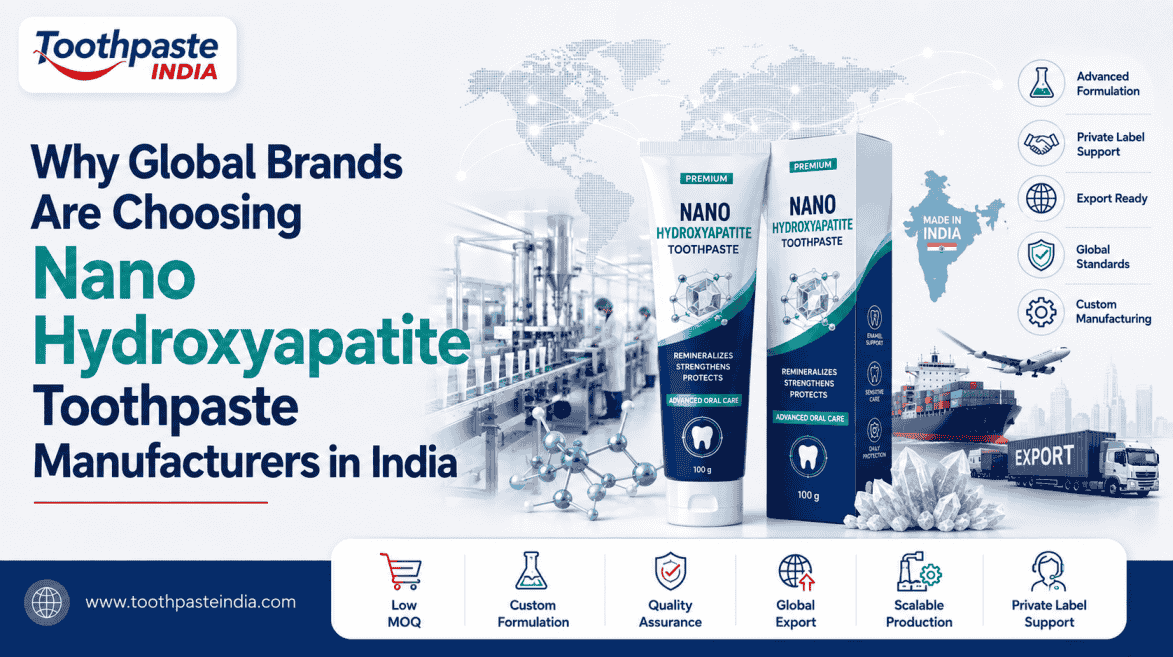

Nano hydroxyapatite is moving from a specialist oral care ingredient into a commercially important toothpaste category. For brand owners, D2C startups, distributors, pharmaceutical businesses and exporters, the opportunity is not only the ingredient itself but also the ability to manufacture a technically stable and market-ready formulation.
This is where Nano Hydroxyapatite Toothpaste Manufacturers in India play an important role. A capable manufacturing partner can combine toothpaste research and development, ingredient sourcing, formulation optimization, quality control, packaging and scalable production under one system.
Toothpaste India, based in Ahmedabad, Gujarat, works with private label and contract manufacturing customers and currently lists nano hydroxyapatite toothpaste among its oral care manufacturing capabilities. Its published manufacturing process includes raw-material inspection, precision weighing, vacuum mixing, homogenization, testing, filling, sealing and final packaging.
What Is Nano Hydroxyapatite Toothpaste and Why Are Brands Interested in It?
Nano hydroxyapatite toothpaste is an oral care formulation containing very small particles of hydroxyapatite, a calcium-phosphate mineral closely related to the mineral composition of tooth enamel.
The ingredient fits the growing biomimetic oral care category because its formulation strategy is designed to interact with mineralized tooth surfaces rather than simply clean them.
Brands commonly explore nano hydroxyapatite for:
- Enamel-focused toothpaste
- Remineralizing toothpaste
- Sensitive-teeth toothpaste
- Premium daily oral care
- Fluoride-free hydroxyapatite toothpaste
- Biomimetic toothpaste
- Enamel protection toothpaste
- Science-based oral care positioning
A 2025 systematic review and meta-analysis examined fluoride-free hydroxyapatite toothpastes for initial caries lesions and reported comparable outcomes with fluoride toothpaste for some assessed measures. The authors described hydroxyapatite as a promising fluoride-free option, although formulation-specific evidence still matters.
How Does Nano Hydroxyapatite Support Enamel and Sensitive Teeth?
Nano hydroxyapatite can support oral care formulations through mineral deposition on enamel surfaces and by helping occlude exposed dentinal tubules.
For nano hydroxyapatite enamel repair, the word “repair” needs responsible interpretation. Toothpaste cannot regenerate enamel that has been physically lost through advanced erosion, cavities or fracture. The stronger scientific positioning is support for tooth enamel remineralization and early mineral deposition.
Nano hydroxyapatite for sensitive teeth is also commercially relevant because hydroxyapatite particles may deposit over exposed dentin and help block microscopic tubules associated with sensitivity.
These characteristics create opportunities for hydroxyapatite toothpaste for sensitive teeth, enamel strengthening toothpaste and toothpaste for enamel protection.
Why Are Global Brands Looking at Nano Hydroxyapatite Toothpaste Manufacturers in India?
Global brands consider Indian manufacturers because India offers a combination of formulation capabilities, private label services, packaging flexibility and scalable production.
The commercial advantage is especially relevant for companies that do not want to build their own toothpaste manufacturing infrastructure.
A nano hydroxyapatite toothpaste manufacturer in India may support:
- Product concept development
- Custom toothpaste formulation
- Ingredient and flavor selection
- Sample development
- Private label manufacturing
- OEM toothpaste manufacturing
- Third party toothpaste manufacturing
- Contract manufacturing
- Custom tube and carton packaging
- Bulk toothpaste production
- Export-ready packaging
- Production scaling
Toothpaste India states that its private label and third party manufacturing workflow can include formulation, sample development, custom packaging, automated filling, batch coding, quality inspection and bulk production.
This makes Indian manufacturing particularly relevant for toothpaste manufacturers for global brands, D2C companies, importers, distributors and startups seeking a lower infrastructure burden.
What Happens During Nano Hydroxyapatite Toothpaste Manufacturing?
Nano hydroxyapatite toothpaste manufacturing requires control over both the functional ingredient and the complete toothpaste base.
At our manufacturing level, the process is not simply “add nano hydroxyapatite and mix.” Ingredient compatibility, viscosity, abrasivity, pH, flavor profile, particle characteristics and packaging performance must work together.
A typical nano hydroxyapatite toothpaste manufacturing process can involve:
- Raw-material verification and documentation
- Precision weighing of formulation ingredients
- Preparation of humectant and binder phases
- Controlled addition of abrasives and functional ingredients
- Incorporation of nano hydroxyapatite according to the formulation process
- Vacuum mixing and homogenization
- Flavor and surfactant integration
- pH and viscosity adjustment
- In-process quality testing
- Tube filling and sealing
- Coding and secondary packaging
- Final quality inspection
Toothpaste India publicly describes raw-material inspection, precision weighing, vacuum mixing, homogenization, pH testing, viscosity evaluation, stability assessment, microbiological checks and packaging inspection as part of its nano hydroxyapatite manufacturing controls.
Which Ingredients Matter in Custom Nano Hydroxyapatite Toothpaste Formulation?
A successful formula depends on the complete ingredient system, not only nano hydroxyapatite.
Common nano hydroxyapatite toothpaste ingredients may include:
- Nano hydroxyapatite as the functional mineral ingredient
- Humectants such as glycerin or sorbitol
- Appropriate abrasives
- Binders and thickeners
- Surfactants or mild cleansing systems
- Flavor systems
- Sweeteners
- Preservative systems where required
- Purified water
- Other compatible functional ingredients
An SLS free toothpaste manufacturer may use alternative surfactant systems for brands seeking gentler or low-foaming positioning. Toothpaste India also lists SLS-free, fluoride-free and customized toothpaste as part of its current manufacturing range.
Why Does Particle Specification Matter?
Particle specification matters because “nano hydroxyapatite” does not describe one universally identical raw material.
Particle size, morphology, coating, purity and supplier specifications can affect safety assessment and product behavior.
For useful international context, the EU Scientific Committee on Consumer Safety concluded in 2025 that nano hydroxyapatite meeting specific submitted specifications was safe at up to 29.5% in toothpaste. The opinion applied to specified uncoated, predominantly rod-shaped particles and specifically did not extend to needle-shaped hydroxyapatite.
This is an EU safety opinion, not an Indian approval or a recommended formulation concentration. Manufacturers should assess the actual raw material being used.
Should Brands Choose Fluoride-Free or Fluoride-Containing Hydroxyapatite Toothpaste?
The choice should depend on the target market, claims strategy and regulatory requirements rather than assuming one formula is universally superior.
A fluoride free toothpaste manufacturer may develop fluoride free hydroxyapatite toothpaste for consumers specifically seeking fluoride-free oral care.
Other brands may explore formulations combining hydroxyapatite with fluoride. Toothpaste India lists both fluoride-free nHAp toothpaste and nano hydroxyapatite toothpaste with fluoride among its customization options.
When discussing nano hydroxyapatite vs fluoride toothpaste, brands should avoid simplistic “better than fluoride” claims. Fluoride has an extensive history of caries-prevention evidence, while hydroxyapatite has growing clinical evidence around remineralization and biomimetic oral care.
What Quality Checks Should a Hydroxyapatite Toothpaste Manufacturer Perform?
A professional hydroxyapatite toothpaste manufacturer should evaluate the formula throughout development and commercial manufacturing.
Important checks can include:
- Raw-material identity and documentation
- Appearance and homogeneity
- pH
- Viscosity
- Flavor and sensory performance
- Microbiological quality
- Stability
- Tube compatibility
- Seal integrity
- Batch consistency
- Net content
- Final packaging inspection
A science based toothpaste manufacturer should also retain appropriate technical documentation and ensure claims correspond to available evidence.
For export projects, specifications and labeling may need to be adjusted according to destination-country regulations.
What Regulations Apply to Toothpaste Manufacturing in India?
Conventional cosmetic toothpaste manufactured in India falls under the Cosmetics Rules, 2020 and applicable standards referenced under those rules.
CDSCO states that cosmetic manufacturing is regulated through State Licensing Authorities and that cosmetics must comply with applicable quality and safety requirements. Rule 36 also prohibits false or misleading cosmetic claims.
The Ninth Schedule of the Cosmetics Rules identifies IS 6356 as the Indian Standard for toothpaste in finished form.
For this reason, brands should verify:
- Applicable manufacturing licence requirements
- Current IS 6356 requirements
- Ingredient compliance
- Permitted claims
- Label declarations
- Raw-material specifications
- Finished-product quality requirements
- Export-country regulations
FSSAI should not automatically be treated as the primary regulator for conventional cosmetic toothpaste. Product classification and regulatory requirements should always be verified against current guidelines before launch.
Likewise, GMP, ISO, Halal, Vegan, Cruelty-Free or similar claims should only be used when adequate certification or substantiation exists.
How Do Private Label and Contract Manufacturing Models Differ?
Private label toothpaste manufacturing generally allows a brand to launch using an established manufacturing platform with selected customization, while contract manufacturing can support deeper formulation development.
A private label nano hydroxyapatite toothpaste project may customize:
- Active strategy
- Flavor
- Sweetening system
- Texture
- Color
- SLS-free positioning
- Fluoride or fluoride-free positioning
- Tube size
- Carton design
- Branding
A custom toothpaste manufacturer may go further through new formulation development, ingredient compatibility work, pilot samples and stability evaluation.
Toothpaste India describes its manufacturing model as supporting customization from ingredients, color and flavor through tube and packaging specifications.
What Should Global Buyers Ask Before Selecting a Manufacturer?
Global buyers should evaluate technical capability before focusing only on toothpaste MOQ or price.
Ask a potential manufacturer:
- Can you provide the nano hydroxyapatite raw-material specification?
- What formulation concentrations are technically feasible?
- Can you develop fluoride-free and fluoride-containing versions?
- What stability testing is performed?
- How are pH and viscosity controlled?
- Can you develop SLS-free formulations?
- What toothpaste MOQ applies to my packaging format?
- Can you provide custom packaging?
- Can production scale after the initial launch?
- What export documentation support is available?
- Which certifications are currently valid?
- Can you support formulation and regulatory documentation?
These questions make it easier to distinguish a simple bulk supplier from a genuine oral care contract manufacturer with toothpaste research and development capabilities.
Why Is India Well Positioned for the Next Generation of Oral Care?
India is well positioned for advanced oral care manufacturing because buyers can combine custom formulation, private label production, multiple packaging formats and export-oriented manufacturing within one supply ecosystem.
For B2B buyers, the bigger opportunity is flexibility. A brand may start with private label hydroxyapatite toothpaste and later expand into sensitivity toothpaste, fluoride-free toothpaste, herbal variants, SLS-free formulations or broader private label oral care products.
Toothpaste India operates from Ahmedabad, Gujarat and presents itself as a toothpaste manufacturing partner providing R&D, custom formulation, contract manufacturing, private label production and export support.
Conclusion
Choosing the right nano hydroxyapatite toothpaste manufacturers in India requires more than comparing quotations. Brands should evaluate formulation expertise, nano hydroxyapatite specifications, quality systems, stability controls, regulatory understanding, packaging capability and long-term production scalability.
Nano hydroxyapatite oral care offers a strong opportunity for premium, biomimetic, remineralizing and sensitivity-focused product development when claims are evidence-based and formulations are technically sound.
If you are planning private label nano hydroxyapatite toothpaste, OEM production, third party manufacturing or custom toothpaste formulation, contact Toothpaste India to discuss formulation, sampling, packaging, MOQ and commercial manufacturing requirements.
Frequently Asked Questions
Nano hydroxyapatite toothpaste contains very small hydroxyapatite particles, a calcium-phosphate material related to the mineral phase of tooth enamel. It is commonly used in biomimetic oral care formulations targeting enamel remineralization, sensitivity management and premium oral care positioning.
Nano Hydroxyapatite Toothpaste Manufacturers in India may provide formulation development, private label manufacturing, third party production, OEM services, sampling, quality testing, filling, packaging and bulk production. Capabilities vary between manufacturers, so buyers should verify technical facilities and certifications before placing commercial orders.
Potential nano hydroxyapatite toothpaste benefits include support for enamel remineralization, mineral deposition and sensitivity-focused formulations. Evidence is promising, but brands should avoid claims that toothpaste can completely regenerate enamel that has been structurally lost.
Yes. Fluoride free hydroxyapatite toothpaste can be formulated for brands targeting fluoride-free oral care. Hydroxyapatite can also be used in some fluoride-containing formulas, depending on formulation objectives, compatibility, claims and applicable market regulations.
Current evidence does not establish nano hydroxyapatite as universally better than fluoride. Fluoride has long-established caries-prevention evidence, while hydroxyapatite has growing evidence for remineralization and sensitivity-related applications. Product selection should depend on the intended consumer and claims strategy.
Yes. Private label nano hydroxyapatite toothpaste can potentially be customized for flavor, texture, active strategy, SLS-free positioning, fluoride status, tube size, packaging and branding. Greater formulation changes may require additional development and stability testing.
Important checks can include raw-material verification, pH, viscosity, appearance, homogeneity, microbiological quality, stability and packaging integrity. Nano hydroxyapatite specifications should also be reviewed because particle characteristics may differ between raw-material suppliers.
Toothpaste MOQ varies by manufacturer, formulation, tube size, printed packaging and customization level. A stock private label formula may have different minimums from a fully custom product. Brands should request MOQ separately for formulation, tubes, cartons and final production.
Yes, some Indian manufacturers support export-oriented production and packaging. However, ingredients, labeling, claims and documentation must comply with the destination country. Export buyers should confirm current regulatory requirements before approving the final formulation and artwork.
Choose a manufacturer based on formulation expertise, ingredient documentation, R&D capability, quality testing, manufacturing licences, stability controls, packaging options, MOQ flexibility and export experience. Request current certificates and technical documentation rather than relying solely on marketing claims.