
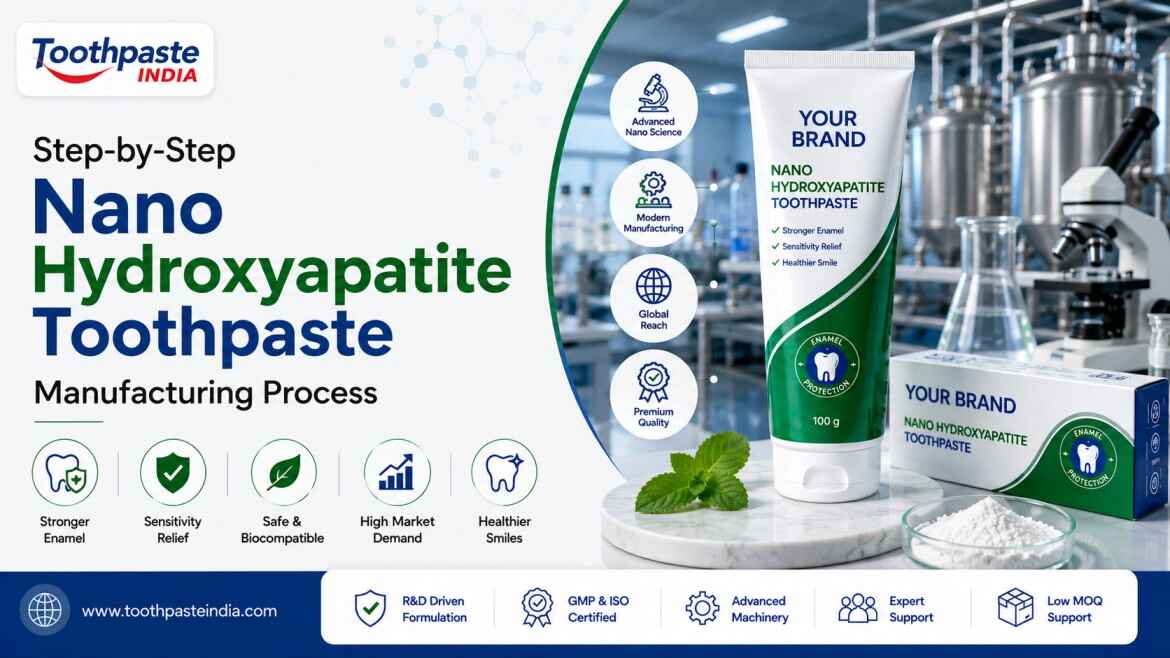

Nano hydroxyapatite toothpaste has become one of the fastest-growing categories in the global oral care industry. As more consumers look for fluoride alternatives and enamel-repair solutions, brands are increasingly investing in Nano Hydroxyapatite Toothpaste Manufacturing Process to launch innovative oral care products.
Unlike conventional toothpaste, nano hydroxyapatite toothpaste requires precise formulation, advanced processing technology, and strict quality control to maintain particle stability and product performance. Whether you’re a D2C startup, pharmaceutical company, distributor, or private label brand, understanding how this manufacturing process works can help you choose the right manufacturing partner.
In this guide, we’ll walk through every stage of the production process from selecting raw materials to final packaging—while highlighting the quality standards that ensure a premium toothpaste reaches the market.
What Is the Nano Hydroxyapatite Toothpaste Manufacturing Process?
The Nano Hydroxyapatite Toothpaste Manufacturing Process is a controlled production workflow that combines nano-sized hydroxyapatite particles with carefully selected oral care ingredients to produce a stable, safe, and effective toothpaste.
Nano hydroxyapatite is a biomimetic material, meaning it closely resembles the natural mineral found in human tooth enamel. Because of this similarity, it is widely used in enamel repair toothpaste and remineralizing toothpaste formulations designed to support enamel health and reduce tooth sensitivity.
A professional nano hydroxyapatite toothpaste manufacturer follows standardized manufacturing procedures to ensure:
- Uniform particle distribution
- Stable toothpaste consistency
- Optimal pH balance
- Safe ingredient compatibility
- High production efficiency
- Regulatory compliance
Every production batch undergoes multiple quality checks before it reaches consumers.
Why Is Nano Hydroxyapatite Becoming So Popular?
Consumer demand for science-backed oral care products has increased significantly over the past few years. Many brands are expanding beyond traditional fluoride formulations by introducing biomimetic toothpaste products that focus on enamel protection and sensitivity relief.
Several factors are driving this trend:
- Growing awareness of enamel remineralization
- Increasing demand for fluoride alternatives
- Rising popularity of premium oral care products
- Expansion of private label oral care brands
- Advances in toothpaste manufacturing technology
For manufacturers, this growing demand creates opportunities to develop customized formulations for different markets, including teeth whitening toothpaste, sensitive care toothpaste, children’s toothpaste, herbal toothpaste, and professional dental products.
Step 1: Selecting High-Quality Raw Materials
Every successful toothpaste begins with carefully selected ingredients. The quality of raw materials directly affects product performance, texture, stability, and shelf life.
A professional toothpaste manufacturer in India evaluates every ingredient before production begins.
Typical nano hydroxyapatite toothpaste ingredients include:
- Nano Hydroxyapatite
- Purified water
- Hydrated silica
- Sorbitol
- Glycerin
- Xylitol
- Cellulose-based thickeners
- Mild surfactants
- Natural or artificial flavors
- Sweeteners
- Preservatives (when required)
- Coloring agents (optional)
The nano hydroxyapatite itself is one of the most critical ingredients. Manufacturers verify its purity, particle size distribution, dispersion characteristics, and compatibility with the rest of the formulation before production starts.
Ingredient sourcing also includes supplier qualification, certificate verification, and incoming raw material testing to maintain consistent product quality.
Step 2: Developing the Nano Hydroxyapatite Toothpaste Formulation
Once raw materials are approved, formulation scientists begin developing the toothpaste recipe.
The goal of nano hydroxyapatite toothpaste formulation is to create a balanced product that offers effective cleaning while preserving the stability of nano hydroxyapatite particles throughout manufacturing and storage.
During formulation development, R&D teams evaluate:
- Abrasive balance
- Viscosity
- pH level
- Foam characteristics
- Flavor compatibility
- Ingredient stability
- Particle dispersion
- Shelf-life performance
Different markets often require customized formulations. For example:
- Sensitive teeth toothpaste
- Fluoride-free toothpaste
- Whitening toothpaste
- Herbal toothpaste
- Children’s toothpaste
- Premium dental care products
For private label nano hydroxyapatite toothpaste, formulations can also be customized based on branding goals, ingredient preferences, certifications, and target markets.
Step 3: Precision Mixing Using Advanced Toothpaste Manufacturing Equipment
After formulation approval, production moves to the manufacturing floor.
Modern toothpaste manufacturing equipment uses vacuum mixing technology to produce a smooth, homogeneous paste while minimizing trapped air bubbles.
The typical toothpaste mixing process includes:
- Measuring raw materials according to the approved batch formula
- Preparing liquid ingredients
- Slowly adding powders under controlled mixing conditions
- Incorporating nano hydroxyapatite at the correct processing stage
- Mixing under vacuum
- Homogenizing the mixture until uniform
Vacuum technology plays an important role because it:
- Improves product consistency
- Prevents air entrapment
- Produces smoother toothpaste texture
- Enhances filling efficiency
- Improves overall product appearance
At this stage, production engineers continuously monitor processing parameters to ensure batch consistency and repeatable manufacturing results.
Step 4: Homogenization for Uniform Particle Distribution
One of the most important stages in the nano hydroxyapatite toothpaste production process is homogenization.
This step ensures nano hydroxyapatite particles remain evenly dispersed throughout the toothpaste instead of settling or forming aggregates.
Proper homogenization helps achieve:
- Uniform ingredient distribution
- Stable viscosity
- Smooth texture
- Consistent product performance
- Better shelf stability
Manufacturers also perform in-process inspections during this stage to confirm that the batch meets predefined quality specifications before moving to the next production step.
Step 5: Vacuum Deaeration and Stability Optimization
After homogenization, the toothpaste enters the vacuum deaeration stage.
Vacuum deaeration removes trapped air bubbles that may have formed during mixing. Eliminating excess air improves product stability, enhances the appearance of the toothpaste, and ensures accurate tube filling.
This step is particularly important in the Nano Hydroxyapatite Toothpaste Manufacturing Process because excessive air can affect the uniform distribution of nano hydroxyapatite particles and reduce production efficiency.
During this stage, manufacturers carefully monitor:
- Vacuum pressure
- Mixing speed
- Batch temperature
- Product viscosity
- Air content
A stable formulation ensures the toothpaste maintains its texture, consistency, and performance throughout its intended shelf life.
Step 6: Quality Testing Before Production Approval
Quality testing is one of the most critical stages in the toothpaste quality control process. Every production batch should be tested before it proceeds to filling and packaging.
At a professional manufacturing facility, quality assurance teams evaluate multiple parameters to confirm that the toothpaste meets internal specifications and applicable regulatory requirements.
Typical quality checks include:
- Appearance and color consistency
- Viscosity testing
- pH analysis
- Density measurement
- Abrasiveness evaluation
- Microbiological testing
- Stability assessment
- Flavor and fragrance consistency
- Foam performance
- Packaging compatibility
For nano hydroxyapatite toothpaste production, manufacturers may also verify particle dispersion and formulation stability to ensure consistent product performance.
These tests help minimize batch variation and ensure that every tube delivered to customers meets the expected quality standards.
Step 7: Toothpaste Filling and Packaging
Once the batch passes quality inspection, production moves to the filling and packaging line.
Modern toothpaste production lines use automated systems that fill toothpaste into laminated, plastic, or aluminum tubes with high precision.
The toothpaste filling and packaging process generally includes:
- Tube feeding
- Automatic filling
- Sealing
- Batch coding
- Carton packing
- Label inspection
- Final packaging
Automated systems help maintain hygiene, reduce product wastage, and improve production speed while ensuring consistent fill weights.
For OEM nano hydroxyapatite toothpaste and private label nano hydroxyapatite toothpaste, this stage also includes custom branding, multilingual packaging, regulatory labeling, and export-ready packaging solutions.
Step 8: Final Inspection, Warehousing, and Dispatch
Before products leave the manufacturing facility, each batch undergoes a final inspection.
Quality teams verify:
- Correct labeling
- Packaging integrity
- Seal quality
- Batch numbers
- Manufacturing and expiry dates
- Carton accuracy
- Shipping documentation
Only after these checks are completed are products transferred to the warehouse for controlled storage and dispatch.
Proper warehousing conditions help preserve product quality until delivery to distributors, retailers, or international customers.
Why GMP Manufacturing Standards Matter
A reliable GMP toothpaste manufacturing facility follows standardized procedures that prioritize product quality, safety, and consistency throughout the production workflow.
Good Manufacturing Practices (GMP) help manufacturers establish documented systems for:
- Raw material handling
- Equipment cleaning and maintenance
- Process validation
- Employee hygiene and training
- Batch documentation
- Product traceability
- Quality assurance
Many manufacturers also operate under internationally recognized quality management systems, such as ISO certifications, depending on their target markets and customer requirements. Export-focused brands may additionally seek certifications such as Halal, Vegan, or Cruelty-Free where applicable.
When selecting a manufacturing partner, always verify the certifications relevant to your product category and destination market.
What Equipment Is Used in a Toothpaste Manufacturing Plant?
A modern toothpaste manufacturing plant relies on specialized equipment designed to produce consistent, high-quality oral care products.
Common toothpaste manufacturing machinery includes:
- Raw material storage tanks
- Vacuum mixing vessels
- High-shear homogenizers
- Transfer pumps
- Holding tanks
- Automated tube filling machines
- Tube sealing machines
- Cartoning systems
- Labeling machines
- Batch coding equipment
- Quality control laboratory instruments
Advanced automation improves production efficiency, minimizes human error, and supports large-scale manufacturing for domestic and international markets.
Common Challenges in Nano Hydroxyapatite Toothpaste Manufacturing
Producing nano hydroxyapatite toothpaste requires greater precision than many conventional toothpaste formulations.
Some common manufacturing challenges include:
- Maintaining uniform particle dispersion
- Preventing ingredient incompatibility
- Achieving stable viscosity
- Controlling pH throughout production
- Avoiding contamination during processing
- Ensuring long-term formulation stability
- Meeting country-specific regulatory requirements
- Scaling laboratory formulations for commercial production
Experienced manufacturers address these challenges through robust toothpaste R&D, validated production procedures, and continuous in-process monitoring.
How to Choose the Right Nano Hydroxyapatite Toothpaste Manufacturer
Selecting the right manufacturing partner is just as important as developing the formulation itself.
When evaluating a custom nano hydroxyapatite toothpaste manufacturer, consider the following:
- Experience in oral care product manufacturing
- Dedicated R&D and formulation capabilities
- GMP-compliant manufacturing facility
- Quality management systems
- Modern toothpaste manufacturing technology
- Private label and contract manufacturing expertise
- Flexible minimum order quantities (MOQs)
- Packaging customization options
- Export documentation support
- Transparent quality control processes
A manufacturer with strong technical expertise can help optimize formulations, ensure regulatory compliance, and streamline the product development process.
Why Choose Toothpaste India for Nano Hydroxyapatite Toothpaste Manufacturing?
At Toothpaste India, we specialize in manufacturing innovative oral care products for brands across India and global markets.
Our Ahmedabad-based facility supports private label, contract manufacturing, OEM, and custom toothpaste formulation services tailored to your business goals.
Our capabilities include:
- Advanced toothpaste manufacturing technology
- Experienced formulation and R&D team
- GMP-compliant production processes
- Flexible packaging solutions
- Low MOQ options for growing brands
- Scalable manufacturing capacity
- Support for domestic and international markets
Whether you’re launching your first oral care brand or expanding an existing product portfolio, partnering with an experienced manufacturer can help reduce development time while maintaining consistent product quality.
Conclusion
The Nano Hydroxyapatite Toothpaste Manufacturing Process involves much more than simply blending ingredients. It requires scientific formulation, advanced manufacturing equipment, stringent quality control, and compliance with recognized manufacturing standards to produce a safe, effective, and market-ready product.
As demand for enamel-repair and biomimetic toothpaste continues to grow, brands that work with experienced manufacturing partners are better positioned to deliver innovative products that meet evolving consumer expectations.
If you’re planning to launch a private label nano hydroxyapatite toothpaste manufacturer or need a reliable contract manufacturing partner in India, Toothpaste India offers end-to-end manufacturing support from formulation development and product testing to packaging and large-scale production. Contact our team to discuss your project and bring your oral care brand to market with confidence.
Frequently Asked Questions
The Nano Hydroxyapatite Toothpaste Manufacturing Process involves selecting premium raw materials, developing a stable formulation, vacuum mixing, homogenization, quality testing, tube filling, packaging, and final inspection under GMP-compliant manufacturing standards. Each step ensures consistent quality, safety, and product performance.
Nano hydroxyapatite toothpaste is made by blending nano hydroxyapatite with ingredients such as hydrated silica, humectants, thickeners, surfactants, flavors, and purified water. The mixture is processed using vacuum mixing and homogenization before undergoing quality testing, filling, and packaging.
Common nano hydroxyapatite toothpaste ingredients include nano hydroxyapatite, purified water, hydrated silica, sorbitol, glycerin, xylitol, cellulose-based thickeners, mild surfactants, flavors, sweeteners, and approved preservatives. Ingredients may vary depending on the formulation and target market.
Nano hydroxyapatite is used because it closely resembles the natural mineral found in tooth enamel. It is commonly included in remineralizing toothpaste and enamel repair toothpaste formulations to help support enamel health and reduce tooth sensitivity.
A modern toothpaste manufacturing plant typically uses vacuum mixers, homogenizers, storage tanks, transfer pumps, automated filling machines, sealing machines, labeling systems, and quality control laboratory equipment to ensure efficient and consistent toothpaste production.
The toothpaste quality control process helps ensure every batch meets predefined standards for pH, viscosity, microbial safety, stability, appearance, and packaging. Effective quality control improves product consistency, regulatory compliance, and customer confidence.
Yes. Many manufacturers offer private label nano hydroxyapatite toothpaste services that include custom formulation, packaging design, branding, manufacturing, and regulatory support. This allows businesses to launch their own toothpaste brand without setting up a production facility.
A reliable toothpaste manufacturer should operate under Good Manufacturing Practices (GMP) and may also hold ISO certifications depending on the market requirements. Brands targeting export markets should verify any additional certifications required for their destination countries.
The manufacturing timeline depends on formulation development, raw material availability, packaging approval, batch size, and quality testing. Custom formulations generally require more development time than repeat production orders.
Choose a manufacturer with experience in oral care products, strong R&D capabilities, GMP-compliant facilities, advanced toothpaste manufacturing technology, quality testing systems, private label expertise, and flexible production capacity. An experienced partner can help ensure consistent quality and a smoother product launch.