
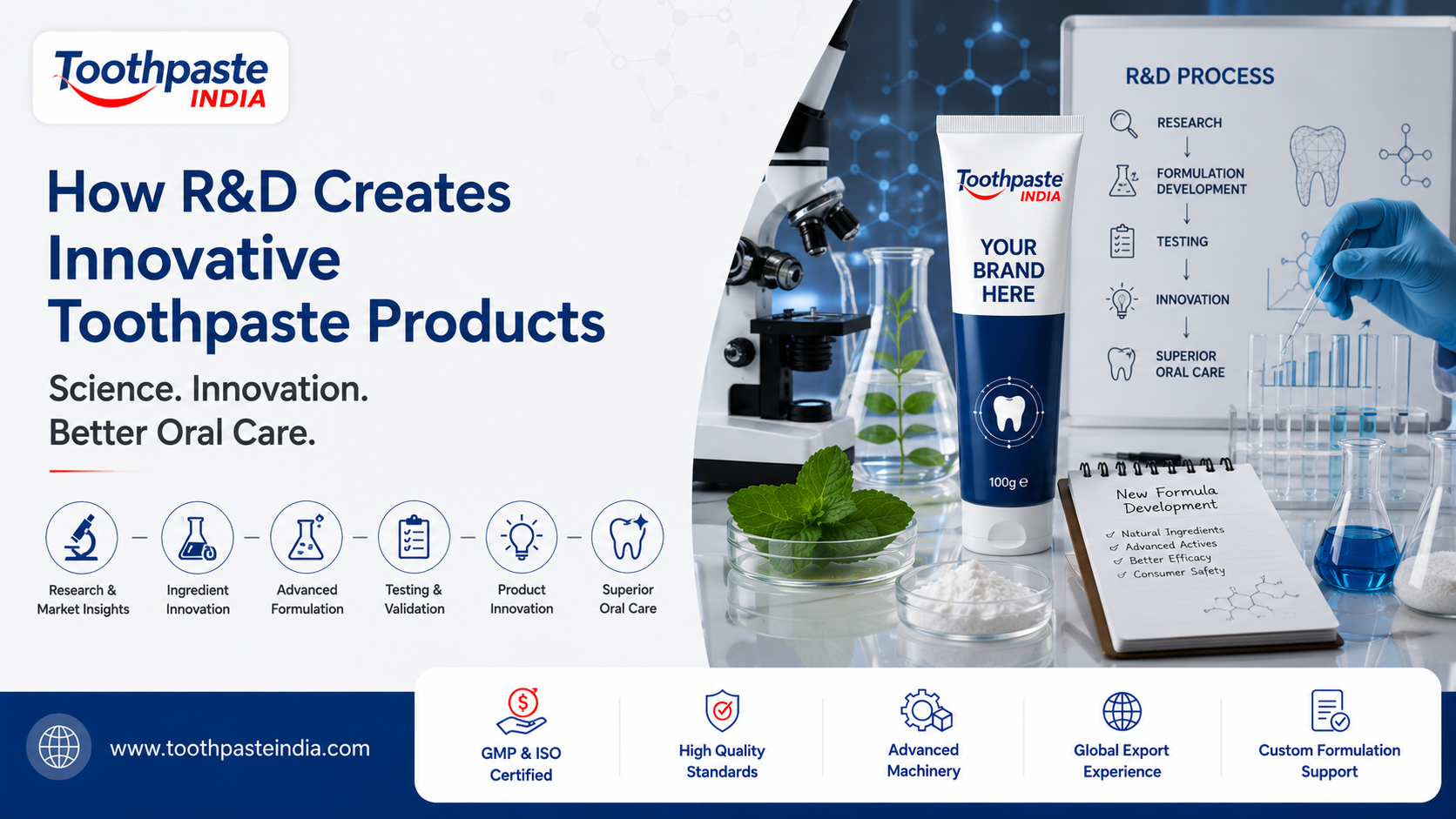

A successful toothpaste rarely begins on a production line. It starts with a consumer problem, a brand idea and a carefully written technical brief.
Toothpaste research and development converts that initial concept into a repeatable formula with the required cleaning performance, flavour, texture, stability, safety and commercial positioning. For brand owners, distributors, D2C startups, exporters and pharmaceutical companies, this stage determines whether the finished product will be genuinely differentiated or simply another generic toothpaste.
Effective Toothpaste R&D also prevents expensive problems before bulk production. Poor ingredient compatibility, unstable viscosity, excessive abrasiveness, weak flavour retention or unsuitable tube packaging may not be obvious in the first laboratory sample. A structured development programme identifies these risks before the formula enters commercial manufacturing.
What Is Toothpaste Research and Development?
Toothpaste research and development is the scientific and commercial process used to design, test, refine and prepare a toothpaste formula for manufacturing.
It connects consumer expectations with formulation science, regulatory requirements, packaging performance and production capability. Toothpaste Product Development may involve creating a completely new formula, adapting an existing base or improving a product already available in the market.
A complete R&D programme normally covers:
- Product concept development
- Market and competitor review
- Ingredient research
- Toothpaste Formula Development
- Laboratory sample preparation
- Sensory evaluation
- Physicochemical testing
- Stability assessment
- Packaging compatibility
- Pilot production
- Commercial scale-up
- Final specification approval
Toothpaste R&D is therefore more than mixing ingredients. It is a controlled decision-making process that balances performance, compliance, user experience, manufacturing feasibility and target cost.
Why Is R&D Important in Toothpaste Manufacturing?
R&D is important because a toothpaste must remain safe, stable, appealing and consistent throughout its intended shelf life.
A formula that looks acceptable immediately after mixing may change during storage. It may become thinner, harder, separated, discoloured or less flavourful. Certain actives may also behave differently depending on the abrasive system, water content, pH and packaging material.
R&D in Toothpaste Manufacturing helps reduce these risks by defining measurable product standards before production begins. A structured R&D process also helps brands avoid common toothpaste brand mistakes, such as selecting incompatible ingredients, making unsupported claims, approving packaging too early or moving into bulk production without adequate testing.
How Does R&D Reduce Product-Launch Risk?
A controlled development process reduces the risk of:
- Formula separation
- Flavour loss
- Excessive or insufficient foaming
- Poor tube dispensing
- Unstable colour
- Unexpected pH changes
- Packaging interaction
- Microbiological contamination
- Inconsistent commercial batches
- Unsupported product claims
Under India’s Cosmetics Rules, 2020, cosmetic manufacturing and related compliance operate within a defined regulatory framework. Formula classification, licensing, labelling and testing requirements should be checked against current regulatory guidance before launch.
How Does Toothpaste Product Development Begin?
Toothpaste Product Development begins with a clear product brief describing the target consumer, intended benefits, ingredients, claims, price and packaging.
A vague brief often results in repeated sample rounds. A detailed brief helps the formulation team understand both the scientific requirements and the commercial objective.
What Should a Toothpaste Development Brief Include?
A practical development brief should define:
- Target consumer
- Target market or country
- Desired product category
- Fluoride or fluoride-free preference
- Expected claims
- Flavour and sweetness profile
- Foam level
- Colour and appearance
- Texture and dispensing preference
- Natural, herbal, vegan or clean-label positioning
- Tube size and packaging format
- Target product cost
- Expected order quantity
- Certification requirements
- Desired launch timeline
For Private Label Toothpaste Development, the brief should also explain how the new product will differ from existing market options.
How Are Ingredients Selected During Toothpaste Formulation Development?
Ingredients are selected according to their technical function, compatibility, safety, consumer appeal and regulatory suitability.
A toothpaste formula typically combines several functional ingredient groups. The exact combination depends on the required product benefits.
What Are the Main Functional Ingredients in Toothpaste?
Abrasives help clean tooth surfaces and remove deposits. Common systems may include hydrated silica, calcium carbonate or other approved materials selected according to the formula.
Humectants help retain moisture and prevent the paste from drying. Glycerine and sorbitol are commonly used examples.
Binders or thickeners help maintain structure and consistency. They influence how the toothpaste sits inside the tube and behaves on the toothbrush.
Surfactants assist dispersion and foaming. Sodium lauryl sulphate is widely recognised, while SLS-Free Toothpaste Formulation may use alternative surfactant systems.
Flavours and sweeteners shape the brushing experience and influence repeat purchase.
Toothpaste Active Ingredients may support specific positioning such as anticavity, whitening, sensitivity relief, freshness or remineralisation. The formula and claims must be reviewed according to the relevant market.
Why Must Ingredients Be Tested as a Complete System?
A technically suitable ingredient may still perform poorly when combined with other materials.
For example, changing the abrasive may affect viscosity and mouthfeel. Adding a botanical extract may change colour, odour or microbial risk. Increasing flavour may affect stability or compatibility with the tube material.
Toothpaste Ingredient Research therefore evaluates the complete formula rather than judging each ingredient independently.
How Does R&D Create Different Types of Innovative Toothpaste?
R&D creates differentiated products by combining consumer needs with suitable active ingredients, delivery systems and sensory properties.
The strongest Toothpaste Innovation is not simply based on adding a trending ingredient. It must deliver a clear benefit while remaining stable, manufacturable and legally supportable.
How Is Natural and Herbal Toothpaste Developed?
Natural Toothpaste Formulation and Herbal Toothpaste Development may include botanical extracts, essential oils, herbal powders or traditionally recognised ingredients. The growing interest in natural oral care ingredients has encouraged brands to explore plant extracts, essential oils, herbal powders and naturally positioned functional ingredients for modern toothpaste formulations.
The R&D team must consider:
- Ingredient standardisation
- Natural colour variation
- Odour and flavour intensity
- Microbial quality
- Abrasiveness
- Preservative strategy
- Compatibility with other ingredients
- Regulatory and claim limitations
A clean-label concept still requires technical preservation, stability and quality control. “Natural” should not be treated as an automatic indication of safety or effectiveness.
How Is Fluoride-Free Toothpaste Developed?
Fluoride-Free Toothpaste Development focuses on consumer demand for non-fluoridated oral care while maintaining acceptable cleaning, taste, texture and stability.
The absence of fluoride also changes which benefits can be claimed. A brand should not make anticavity claims unless the formulation, evidence and target-market regulations support them.
In the United States, anticaries toothpaste products are addressed under the FDA’s OTC anticaries framework, and formulation and labelling requirements depend on the product’s active ingredients and intended claims.
How Is Whitening Toothpaste Formulated?
Whitening Toothpaste Formulation is commonly designed to remove or reduce visible surface staining rather than change the natural internal colour of teeth.
R&D may evaluate:
- Abrasive cleaning system
- Stain-removal performance
- Enamel compatibility
- Sensory feel
- Foam level
- Colour and appearance
- Claim wording
- Long-term daily-use suitability
An overly aggressive cleaning system may create an unpleasant mouthfeel or raise concerns about abrasiveness. The development objective is balanced performance, not simply maximum abrasive power.
How Is Sensitive Toothpaste Developed?
Sensitive Toothpaste Formulation requires careful selection of active ingredients, base formulation and claims.
The R&D team must assess whether the chosen sensitivity ingredient remains compatible and available within the formula. Flavour intensity is also important because very strong flavours may feel uncomfortable to some sensitivity-focused consumers.
How Are Kids’ Toothpaste Products Developed?
Kids Toothpaste Development prioritises age-appropriate flavour, appearance, dispensing and label instructions.
The development process may include:
- Mild flavour selection
- Controlled sweetness
- Attractive colour
- Suitable foam level
- Child-friendly packaging
- Market-specific fluoride decisions
- Appropriate warnings and directions
Children’s product requirements and fluoride guidance vary by market and age group, so brands should verify current professional and regulatory recommendations.
What Are Emerging Toothpaste Technologies?
Emerging Toothpaste Technologies include remineralising systems, nano hydroxyapatite concepts, probiotic positioning and new ingredient-delivery approaches.
Examples include:
- Remineralizing Toothpaste Formulation
- Nano Hydroxyapatite Toothpaste Development
- Probiotic Toothpaste Development
- Advanced sensitivity systems
- Enzyme-based concepts
- Sustainable ingredient platforms
- Personalised oral care products
Novel ideas require additional scrutiny because a popular ingredient does not automatically guarantee proven performance. Claims should be based on suitable evidence and reviewed for the intended sales market.
How Are Laboratory Samples Developed and Refined?
Toothpaste Sample Development converts the written formulation into a physical product that can be reviewed and improved.
The first laboratory sample is rarely treated as the final commercial product. It provides a practical starting point for sensory, technical and commercial evaluation.
What Happens During Toothpaste Laboratory Testing?
A typical laboratory workflow includes:
- Raw-material verification
- Ingredient weighing
- Controlled mixing
- Hydration of thickening agents
- Addition of abrasives and functional ingredients
- Flavour incorporation
- Vacuum processing where required
- Sample filling
- Initial quality assessment
- Sample submission for review
The sequence of ingredient addition matters because it can affect hydration, aeration, texture and final uniformity.
What Does the Brand Evaluate in a Sample?
During review, the brand should assess:
- Appearance
- Colour
- Flavour intensity
- Aftertaste
- Freshness
- Sweetness
- Foam
- Mouthfeel
- Smoothness
- Dispensing
- Product positioning
Toothpaste Texture Development and Toothpaste Flavor Development often require more than one revision because small changes can significantly affect consumer perception.
Which Quality Tests Are Used During Toothpaste R&D?
Quality testing confirms whether the formula meets its agreed physical, chemical and microbiological specifications.
The exact testing plan depends on the product type, ingredients, claims and market requirements.
Why Is Toothpaste pH Testing Important?
Toothpaste pH Testing monitors the acid or alkaline character of the formula.
pH may affect ingredient stability, sensory experience, preservation and compatibility. The acceptable range should be defined according to the specific formula and applicable standards rather than using one universal target for every toothpaste.
Why Is Toothpaste Viscosity Testing Required?
Toothpaste Viscosity Testing evaluates how easily the product flows and whether it maintains the intended consistency.
A formula that is too thin may leak or dispense excessively. A formula that is too thick may be difficult to fill or squeeze from the tube.
Viscosity results can also vary according to temperature, test method, spindle, equipment and measurement conditions. Therefore, the specification should include a defined testing procedure.
What Does Microbiological Testing Check?
Toothpaste Microbiological Testing evaluates microbial quality and helps confirm that ingredients, processing and preservation controls are suitable.
Testing requirements may include total microbial counts and checks for specified organisms, depending on the product and applicable regulatory standard.
What Is Toothpaste Performance Testing?
Toothpaste Performance Testing assesses whether the product delivers its intended functional and sensory outcome.
Depending on the product, this may include:
- Cleaning assessment
- Foam evaluation
- Dispensing performance
- Sensory testing
- Stain-removal evaluation
- Active-ingredient testing
- Stability of claimed benefits
- Packaging functionality
Claims such as whitening, anticavity, sensitivity relief or remineralisation may require more specialised evidence than general laboratory quality testing.
Why Is Toothpaste Stability Testing Necessary?
Toothpaste Stability Testing evaluates how the formula changes over time under defined storage conditions.
The purpose is to identify potential changes before the product enters the market.
What Is Checked During Stability Evaluation?
R&D teams may monitor:
- Appearance
- Colour
- Odour
- Flavour
- pH
- Viscosity
- Separation
- Drying
- Tube swelling
- Leakage
- Seal integrity
- Microbiological quality
- Active-ingredient stability where relevant
Accelerated testing can help identify early warning signs, but it should not be treated as a perfect substitute for real-time stability data.
The product’s shelf-life decision should be supported by appropriate testing, product knowledge and current regulatory expectations.
Why Must the Formula Be Tested with Its Packaging?
Toothpaste Packaging Compatibility Testing confirms that the formula and tube remain suitable when stored together.
The packaging is part of the product system. Flavour oils, herbal extracts, moisture and other ingredients may interact with unsuitable tube or closure materials.
What Packaging Problems Can R&D Identify?
Compatibility studies may identify:
- Tube panel distortion
- Print deterioration
- Flavour migration
- Leakage
- Seal weakness
- Cap interaction
- Product drying
- Discolouration
- Changes in texture
- Difficulty dispensing
A stable formula in a laboratory container may behave differently inside a printed laminate tube. Packaging approval should therefore occur before large quantities of tubes and cartons are ordered.
How Does a Laboratory Formula Move into Commercial Production?
The Toothpaste Scale-Up Process adapts a successful laboratory formula to larger manufacturing equipment without losing product quality. Before the formula enters a full-scale toothpaste manufacturing plant, the R&D team must confirm that it can be mixed, transferred, filled and packed consistently using commercial production equipment.
A formula that works in a small beaker may not behave identically in a large vessel. Mixing speed, shear, vacuum level, batch temperature and ingredient-addition time can all change during scale-up.
What Is a Toothpaste Pilot Batch?
Toothpaste Pilot Batch Development is a controlled intermediate step between laboratory sampling and full production.
A pilot batch helps evaluate:
- Manufacturing sequence
- Equipment compatibility
- Mixing time
- Vacuum performance
- Batch uniformity
- Filling behaviour
- Tube sealing
- Product yield
- Final quality parameters
Why Is Scale-Up a Critical R&D Stage?
Scale-up confirms that the formula can be manufactured consistently, efficiently and economically.
It may reveal that the viscosity is suitable in the laboratory but difficult to pump, transfer or fill at commercial scale. Adjustments can then be made before the main production order.
How Does R&D Support Private Label and OEM Toothpaste Brands?
R&D allows private-label and OEM brands to create products that match their positioning without building an internal laboratory or factory. For international toothpaste buyers, the development process must also consider destination-country regulations, permitted ingredients, product claims, label requirements, packaging durability and export documentation.
Private Label Oral Care Products may use an existing validated base with selected customisation. A fully customised project may involve New Toothpaste Product Development from the initial concept onward.
What Is the Difference Between Private Label and Custom Development?
A private-label project may use a proven formula with changes to flavour, colour, packaging or branding.
Custom Toothpaste Formulation may involve more extensive work, including:
- New ingredient combinations
- Unique active systems
- Specific sensory requirements
- Target-market compliance
- Custom claims
- Special certification requirements
- Exclusive positioning
OEM Toothpaste Development and Contract Manufacturing Toothpaste can follow either model depending on the buyer’s product brief, budget, volume and launch schedule.
How Do GMP and ISO Systems Support Toothpaste Innovation?
GMP and quality-management systems help transfer innovation into controlled, repeatable manufacturing.
ISO 22716 provides guidelines for the production, control, storage and shipment of cosmetic products. ISO also clarifies that the standard focuses on manufacturing quality and does not itself apply to research and development activities; R&D must therefore be supported by separate technical controls before the formula is transferred into production.
Important controls include:
- Approved raw-material specifications
- Supplier qualification
- Controlled formulation documents
- Batch manufacturing records
- Equipment cleaning
- In-process checks
- Laboratory testing
- Packaging controls
- Traceability
- Change control
- Complaint handling
- Retention samples
ISO develops standards, while certification is normally performed by independent certification bodies rather than ISO itself. Brands should verify a certificate’s scope, issuing body, site and validity.
How Does Toothpaste India Support Oral Care Product Innovation?
Toothpaste India supports brand owners seeking research, Custom Oral Care Formulation, private-label production and oral care manufacturing services in India.
Toothpaste India is positioned as an Ahmedabad-based B2B platform for toothpaste formulation, private-label manufacturing, contract manufacturing, packaging support and product development. Its website describes turnkey oral care support from research and development through formulation and packaging.
A structured development project may include:
- Product-brief review
- Formula selection or customisation
- Toothpaste R&D
- Laboratory sample development
- Sample revisions
- Packaging guidance
- Quality specification
- Pilot or scale-up assessment
- Commercial manufacturing
- Tube filling and secondary packaging
Brands should share their intended market, desired claims, formula preferences, certification needs, MOQ and packaging expectations at the beginning of the project.
Conclusion
Toothpaste research and development matters because it converts an attractive product idea into a stable, testable and commercially manufacturable oral care product.
The process connects Toothpaste Manufacturing Research, formulation science, consumer experience, quality testing, packaging and production scale-up. It is particularly important for private-label brands that want to create meaningful differentiation without investing in their own R&D laboratory or toothpaste plant. Understanding how to build a successful oral care brand also requires more than an attractive logo or packaging; brands need a reliable formula, clear positioning, compliant claims, consistent manufacturing and a product experience that encourages repeat purchases.
A reliable Toothpaste R&D Manufacturer India should not rush directly from an ingredient list to bulk production. The project should move through a documented brief, laboratory trials, sample approval, stability review, packaging compatibility and controlled commercialisation.
To develop herbal, fluoride-free, whitening, sensitive, kids’, SLS-free, vegan, clean-label, remineralising or other Innovative Toothpaste Products, contact Toothpaste India with your product concept, target market, pack size, expected quantity and desired launch timeline.
Frequently Asked Questions
Toothpaste research and development is the process of designing, testing and preparing a toothpaste formula for commercial manufacturing. It includes ingredient selection, laboratory trials, flavour and texture refinement, quality testing, stability studies, packaging compatibility, pilot production and final specification approval.
The development timeline depends on formula complexity, ingredient availability, sample revisions, testing requirements and packaging. A simple private-label modification may move faster than a fully customised formulation. Stability studies and regulatory reviews can extend the timeline, so brands should agree on realistic milestones with the manufacturer.
Common tests include appearance, odour, colour, pH, viscosity, dispensing behaviour, microbiological quality and stability. Depending on the formula and claims, the development programme may also include active-ingredient testing, performance studies, packaging compatibility and specialised safety or efficacy assessments.
Yes. A capable custom toothpaste manufacturer can develop a formula around a brand’s target consumer, preferred ingredients, flavour, texture, foam, claims and price point. The final scope depends on technical feasibility, regulatory compliance, testing requirements, MOQ and the intended country of sale.
A laboratory sample is a small development batch used to refine the formula and sensory experience. A pilot batch is produced using larger or production-relevant equipment to confirm manufacturing sequence, mixing behaviour, filling performance, product consistency and commercial-scale feasibility.
Stability testing helps identify changes in appearance, flavour, pH, viscosity, separation, microbiological quality and packaging performance over time. It supports shelf-life evaluation and reduces the risk of product complaints after launch. Testing conditions should be selected according to the formula and target market.
Yes. SLS-free toothpaste can be developed using suitable alternative surfactants or lower-foaming systems. However, changing the surfactant affects foam, flavour perception, viscosity and consumer expectations, so the entire formulation must be balanced rather than simply removing SLS from an existing formula.
The approved formula is stored in the intended tube and closure under defined conditions. The R&D team checks for leakage, swelling, print damage, flavour loss, discolouration, texture change, seal failure and dispensing problems before commercial packaging is ordered.
ISO 22716 provides cosmetic GMP guidance for production, control, storage and shipment. ISO states that the guideline does not apply directly to R&D activities. However, the standard becomes highly relevant when an approved toothpaste formula is transferred into controlled manufacturing.
A startup should prepare a product brief covering the target customer, formula type, desired claims, flavour, packaging, budget, quantity and sales market. The manufacturer can then recommend an existing base formula or a custom development programme, followed by samples, testing and production planning.