
Building an oral care business requires more than placing a logo on a toothpaste tube. Founders must connect a genuine consumer need with the right formulation, positioning, manufacturing system, packaging and distribution strategy.
Understanding how to build a successful oral care brand is especially important for D2C startups, distributors, exporters, dental professionals and pharmaceutical companies entering a competitive category. A brand may begin with an interesting idea, but trust is created through consistent product quality, realistic claims, transparent communication and reliable customer experiences.
India offers opportunities across herbal, Ayurvedic, fluoride, fluoride-free, sensitivity, whitening, kids’ and premium oral care categories. However, the strongest brands do not attempt to serve every consumer at once. They select a clear audience, solve a defined problem and build a focused product around it.
What Does It Take to Build a Successful Oral Care Brand?
A successful oral care brand combines a relevant consumer proposition with a safe, stable product and a dependable route to market.
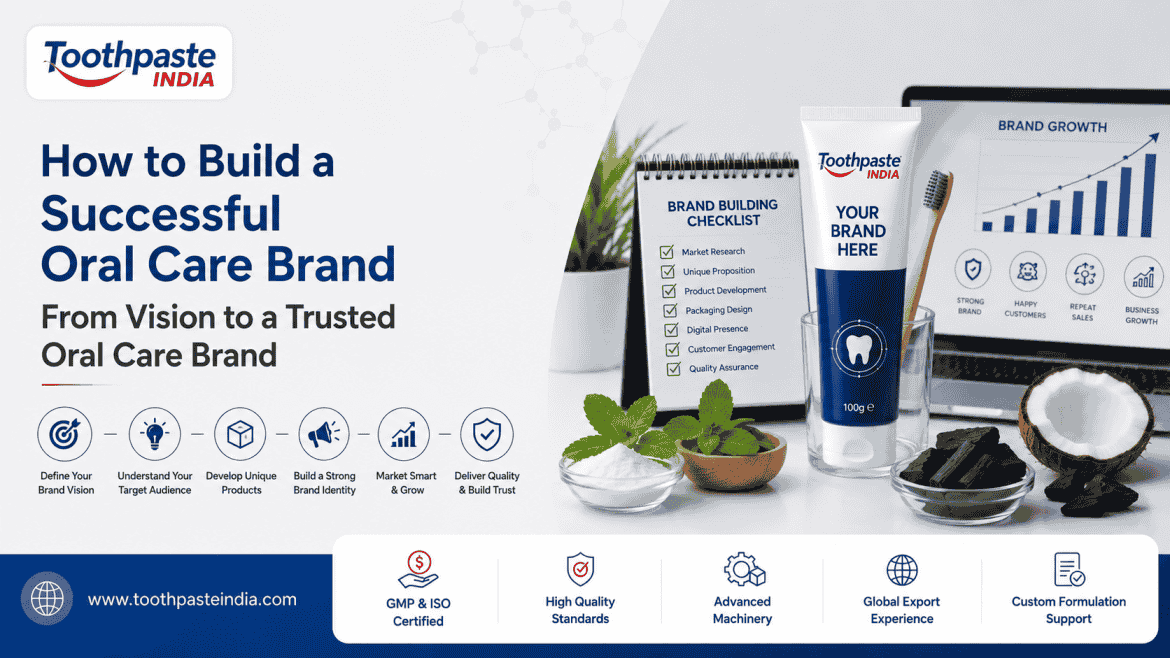
The process normally includes:
- Identifying a target consumer and oral care concern
- Studying competitors, prices and demand patterns
- Selecting a clear brand position
- Developing or choosing an appropriate formulation
- Testing samples before commercial production
- Finalising compliant packaging and product communication
- Launching through suitable sales channels
- Tracking repeat purchase, reviews and customer feedback
- Scaling production without reducing quality
These steps form the foundation of a practical oral care business plan. Skipping formulation testing, compliance review or audience research may reduce the initial launch time, but it can create costly problems later.
How Should You Define Your Oral Care Brand Vision?
Your brand vision should clearly explain whom you serve, what problem you solve and why consumers should trust your solution.
Instead of beginning with broad oral care business ideas, start with three questions:
- Who is the primary consumer?
- What specific oral care concern are they trying to address?
- What meaningful difference can the product offer?
A brand could focus on herbal gum care, everyday cavity protection, sensitivity support, children’s brushing, premium whitening or clean-label oral care. Each direction requires a different formula, flavour, claim strategy, packaging style and price point.
For example, a natural oral care brand may emphasise botanical ingredients and ingredient transparency. A premium oral care brand may compete through advanced actives, sophisticated flavours and elevated toothpaste packaging design. A children’s brand must prioritise age suitability, flavour acceptance and parent-friendly communication.
Strong oral care brand positioning creates focus. It also prevents the product development team from adding unnecessary ingredients, claims or packaging elements that do not support the main proposition.
Why Is Oral Care Market Research Important Before Launch?
Oral care market trends helps founders determine whether a product idea addresses real demand rather than personal assumptions.
Research should examine:
- Search queries and frequently asked consumer questions
- Marketplace reviews and recurring complaints
- Competitor ingredients, claims, sizes and prices
- Retail and distributor feedback
- Consumer preferences across regions
- Product formats gaining visibility
- Gaps in flavour, packaging or benefit communication
Current toothpaste industry trends include interest in herbal ingredients, sensitivity care, whitening, SLS-free products, fluoride alternatives, sustainable packaging and premium formulations. These signals may influence the future of the toothpaste market, but not every trend is suitable for every brand.
A founder should separate short-lived attention from sustainable demand. A category becomes more attractive when consumers understand the benefit, competitors are not addressing it effectively and the product can generate repeat purchases.
How Do You Identify the Right Oral Care Target Audience?
An oral care target audience is a clearly defined group with similar needs, buying behaviours and product expectations.
Useful audience segments may include:
- Parents purchasing toothpaste for children
- Consumers experiencing sensitive teeth
- Buyers seeking herbal or Ayurvedic oral care products
- Premium consumers interested in advanced ingredients
- Environmentally conscious buyers
- Dental clinics creating private label dental care products
- Exporters targeting a particular international market
- Pharmacies or distributors building exclusive product ranges
Avoid describing the audience only as “everyone who uses toothpaste.” A broad audience makes oral care product marketing expensive and weakens the product message.
Create a customer profile covering age, concern, preferred benefits, spending capacity, buying channel and objections. This profile should influence formulation, tube size, carton design, price and communication.
Should You Choose Private Label or Custom Oral Care Formulation?
Private label manufacturing is usually suitable for brands that want a faster route to market, while custom oral care formulation is appropriate when stronger product differentiation is required.
What Are Private Label Oral Care Products?
Private label oral care products are manufactured by an external producer and sold under the buyer’s brand name.
A private label toothpaste manufacturer may offer an existing base formula that can be customised through flavour, colour, packaging or selected ingredients. This approach can reduce development time and is useful for startups testing demand.
What Is Custom Toothpaste Formulation?
Custom toothpaste formulation is the process of developing or significantly modifying a formula according to a brand’s audience, ingredient preferences, texture, flavour and intended positioning.
A typical toothpaste formula may contain:
- Abrasives, such as hydrated silica or calcium carbonate, to support cleaning
- Humectants, such as glycerin or sorbitol, to retain moisture
- Binders or thickeners to maintain texture
- Surfactants, such as SLS or suitable alternatives, to support dispersion and foaming
- Flavours and sweeteners to improve the brushing experience
- Active or functional ingredients selected according to the product concept
Fluoride toothpastes are widely used for cavity-prevention positioning, while fluoride-free products target a different consumer preference. Scientific and regulatory support should be reviewed before making therapeutic, anticavity, remineralisation, whitening or sensitivity claims. The American Dental Association notes that toothpastes carrying its cavity-protection acceptance claim must contain fluoride, illustrating the need to align claims with evidence and applicable market requirements.
How Should Oral Care Product Development Be Managed?
Oral care product development should move through controlled stages instead of going directly from an idea to bulk production.
A practical development sequence is:
- Product brief and target consumer definition
- Ingredient and claim review
- Laboratory formulation
- Initial sample evaluation
- Flavour, texture and foam adjustments
- Packaging compatibility assessment
- Stability and quality testing
- Final sample approval
- Pilot or commercial batch
- Filling, coding, packing and batch documentation
Oral care product sampling is essential because a formula that appears attractive on paper may feel too abrasive, taste too strong, foam poorly or separate during storage. Samples should be evaluated against an agreed brief rather than personal preference alone.
A written approval process also prevents confusion when several flavour, colour or texture versions are being tested.
How Do You Select an Oral Care Product Manufacturer?
The right oral care product manufacturer should provide transparent information about formulation, testing, production, packaging, documentation and scalability.
Ask prospective manufacturers about:
- Manufacturing licences and quality systems
- GMP and relevant ISO certifications
- Toothpaste formulation capabilities
- Minimum order quantity
- Sample-development process
- Ingredient and packaging sourcing
- Batch testing and traceability
- Tube filling and carton packing
- Production capacity and repeat-order planning
- Export documentation support, where required
- Ownership and confidentiality of custom formulas
A low MOQ oral care manufacturer may help a startup limit early inventory risk. However, MOQ should not be the only selection criterion. Extremely low pricing or unrealistic launch promises can indicate compromises in formulation, packaging or service.
Toothpaste India is an Ahmedabad-based oral care manufacturing platform that supports private label toothpaste, custom formulation, OEM production and packaging for brands. Its published manufacturing resources describe support for fluoride, gel, herbal and kids’ toothpaste concepts, as well as formula, flavour, texture and packaging customisation.
What Is the Difference Between OEM, Third-Party and Contract Manufacturing?
OEM, third-party and contract manufacturing all allow a brand to outsource production, although the commercial scope and level of customisation can vary.
An OEM oral care manufacturer develops or manufactures products according to agreed specifications. Third party oral care manufacturing allows another company to produce goods that are marketed under the brand owner’s name. Contract manufacturing oral care products may involve a detailed agreement covering formulation, sourcing, manufacturing, filling and documentation.
Before signing an agreement, confirm:
- Formula ownership
- Confidentiality obligations
- Approved specifications
- MOQ and pricing conditions
- Packaging responsibilities
- Rejection and replacement procedures
- Lead times
- Payment terms
- Regulatory documentation
- Territory or exclusivity conditions
Clear written responsibilities protect both the brand and the manufacturing company.
What Compliance Is Required to Start an Oral Care Business in India?
Compliance depends on the formula, ingredients, claims, manufacturing arrangement and market in which the product will be sold.
India’s Cosmetics Rules, 2020 establish requirements for cosmetic manufacturing, import, labelling, quality and regulatory administration. Brand owners should review the current rules with their manufacturer and relevant licensing authority before launch.
Depending on the product and business model, compliance planning may involve:
- Manufacturing through an appropriately licensed facility
- Reviewing applicable BIS standards
- Ingredient and safety documentation
- Batch coding and traceability
- Net quantity, MRP and manufacturer or marketer declarations
- Legal Metrology requirements for packaged goods
- Trademark protection
- GST and business registrations
- Export-market documentation
- Substantiation for product claims
A toothpaste manufacturing licence should not be confused with food licensing. Do not automatically assume that FSSAI applies simply because toothpaste is used in the mouth. The product classification, composition and claims should be verified with the current regulatory guidelines and the appropriate authority.
Certifications such as GMP, ISO, Halal, Vegan or cruelty-free may support particular market or buyer requirements, but they must be genuine, current and applicable to the product or facility. They should never be displayed merely as marketing graphics.
How Can Packaging Build Trust in a New Oral Care Brand?
Oral care product packaging builds trust by communicating the product’s purpose, usage, ingredients and manufacturer details clearly.
Good packaging should:
- Make the main benefit easy to understand
- Use readable text and a clear visual hierarchy
- Avoid unsupported clinical or therapeutic claims
- Display mandatory declarations accurately
- Protect the formula during storage and transport
- Remain visually consistent across the range
- Differentiate the product without copying competitors
The tube, cap, laminate structure, seal, carton and printing method should be assessed for compatibility with the formulation. Packaging should be approved using the final dimensions and artwork template supplied by the selected oral care packaging supplier.
For an oral care ecommerce business, packaging must also photograph well on mobile screens. Consumers should understand the category, benefit and size without zooming into the image.
How Should You Launch and Market an Oral Care Brand?
A strong launch begins with one hero product and a focused customer-acquisition plan.
An effective toothpaste marketing strategy may combine:
- Educational SEO content
- Marketplace listings
- Demonstration and explainer videos
- Dentist or professional education, where appropriate
- Distributor and pharmacy outreach
- Sampling campaigns
- Customer reviews and user-generated content
- Email and repeat-purchase communication
- Search and social advertising
- Export or B2B outreach
Oral care digital marketing should answer practical questions rather than relying only on promotional claims. Explain what the product is, whom it is for, how it should be used and what makes the formulation different.
To sell oral care products online, create clear product pages with ingredient information, usage directions, FAQs, authentic images and realistic benefit descriptions. Avoid promising instant whitening, permanent sensitivity relief or treatment of dental disease without valid evidence and regulatory support.
How Can You Scale From an Oral Care Startup to a Trusted Brand?
A brand should scale when repeat demand and operational consistency are visible—not simply when its first production batch sells.
Track indicators such as:
- Repeat-purchase rate
- Customer complaints and return reasons
- Product ratings and review themes
- Cost of customer acquisition
- Distributor reorder frequency
- Gross margin after fulfilment and marketing
- Stock availability
- Manufacturing rejection or leakage rate
- Batch-to-batch sensory consistency
A practical oral care brand growth strategy improves the core product before adding multiple variants. A successful toothpaste brand may eventually expand into mouthwash, tooth powder, tooth gel, kids’ products or dental accessories, but each extension should serve the same audience and brand promise.
Long-term trust comes from consistency. Consumers should receive the expected flavour, texture, packaging quality and performance every time they reorder.
Conclusion
The best answer to how to build a successful oral care brand is to combine a focused consumer need with differentiated product development, compliant manufacturing, clear packaging and disciplined market testing.
Do not begin with twenty products or exaggerated claims. Begin with one relevant proposition, test it thoroughly and build repeat demand before moving into bulk oral care manufacturing.
Toothpaste India supports startups, distributors, exporters, D2C companies and established businesses with private label toothpaste manufacturing company, custom toothpaste formulation, sampling, tube filling, packaging and scalable production in Ahmedabad, Gujarat.
Contact Toothpaste India to discuss your toothpaste concept, target market, formulation requirements, packaging preferences and expected order quantity.
Frequently Asked Questions
Start by selecting a target consumer, identifying a specific oral care need and preparing a basic business plan. Next, choose a suitable private label or contract manufacturer, develop samples, review packaging and compliance requirements, approve the final product and launch through selected online, retail or distributor channels.
The cost depends on formulation complexity, MOQ, tube size, packaging, testing, artwork, registrations, marketing and distribution. A ready private label formula normally requires less initial development than a fully custom product. Request an itemised quotation rather than comparing only the per-tube manufacturing price.
Yes. You can launch toothpaste through a private label, OEM or third-party manufacturing arrangement. The manufacturer handles production using its facility, while you manage brand ownership, positioning, distribution and marketing. Verify the manufacturer’s licensing, quality systems, documentation and production capabilities before placing an order.
The best first product solves a clearly defined consumer need and matches your sales channel. Herbal, sensitivity, whitening, kids’, fluoride and fluoride-free products can all be viable. The right choice should be based on market research, competition, formula feasibility, claims and repeat-purchase potential.
MOQ varies according to the manufacturer, formulation, tube size, printed laminate, carton type and raw-material availability. Standard formulas and packaging may allow lower quantities than completely custom products. Ask whether the quoted MOQ applies to manufacturing, tubes, cartons or the complete finished product.
Development time depends on whether the brand selects a ready formula or requests custom formulation. Sampling, revisions, stability work, packaging development and compliance review can extend the timeline. Brands should not approve commercial production until the formula, flavour, texture, claims and final packaging are confirmed in writing.
You need custom formulation when your brand requires a distinctive ingredient combination, flavour, texture, active system or market position. A standard private label formula may be sufficient when speed and lower development costs are the main priorities. The decision should support your commercial strategy rather than complexity alone.
The required licences and certifications depend on the product and market. Review the facility’s manufacturing authorisation, GMP system, relevant ISO credentials, quality documentation and applicable regulatory compliance. Halal, Vegan or cruelty-free certification should be requested only when relevant and verified through valid documentation.
A new brand can compete by focusing on a narrow consumer need, communicating transparently and providing a strong customer experience. Instead of matching large brands across every category, build authority in one segment, collect authentic feedback, improve the product and use educational content to earn consumer trust.
Many Indian manufacturers support export-oriented production, but capabilities differ. Confirm whether the manufacturer can provide ingredient documents, certificates of analysis, batch records, free-sale documents, packaging adaptation and other destination-specific information. The importer should verify all product, label and registration requirements in the target country.