
India offers international toothpaste buyers access to custom formulations, scalable production, private-label services and competitive manufacturing costs. However, choosing a dependable supplier requires more than comparing quotations.
A buyer must evaluate the toothpaste manufacturing company’s legal credentials, quality systems, formulation expertise, packaging capabilities, production capacity and knowledge of the destination market.
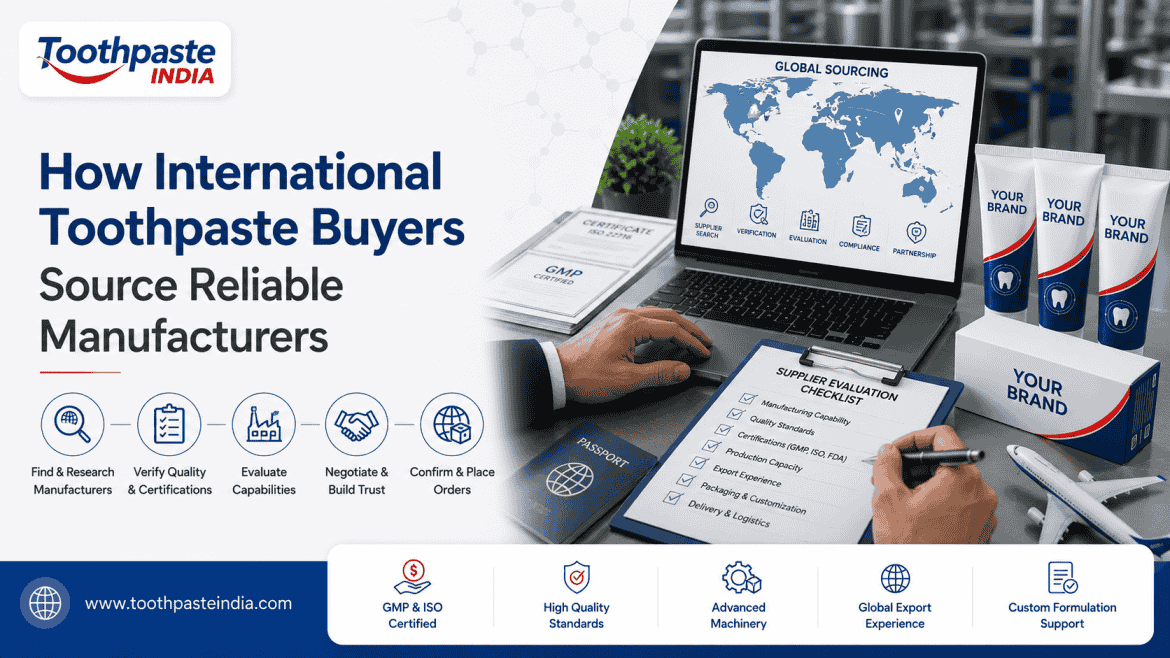
The most reliable sourcing process moves through defined stages: supplier discovery, document verification, technical discussion, sample development, factory assessment, commercial negotiation, packaging approval and pre-shipment quality control. This approach reduces regulatory, quality and supply-chain risks before bulk production begins.
Why Do International Toothpaste Buyers Source Products from India?
International toothpaste buyers source from India because the country has an established pharmaceutical, cosmetic and personal-care manufacturing ecosystem.
Flexible Manufacturing Models for International Brands
Indian manufacturers can support several commercial models, including:
- Private label toothpaste export
- OEM toothpaste manufacturing for global brands
- Contract manufacturing toothpaste for export
- White label toothpaste production
- Custom toothpaste formulation
- Bulk toothpaste supply
- Third-party toothpaste manufacturing
- Finished toothpaste with export-ready packaging
This flexibility is valuable for distributors, D2C startups, pharmacy brands, dental-care companies, retailers and international FMCG businesses.
Access to Custom and Speciality Formulations
A capable toothpaste manufacturer for international markets may support fluoride, fluoride-free, herbal, Ayurvedic, charcoal, whitening, sensitive-teeth, children’s, SLS-free, vegan and speciality formulations.
India is also attractive to brands that require a low MOQ toothpaste manufacturer for initial market testing. Nevertheless, a low minimum order quantity should not be the only selection criterion. Quality consistency, documentation and regulatory suitability are more important than the lowest unit price.
How Do International Toothpaste Buyers Find Manufacturers?
International toothpaste buyers usually find manufacturers through targeted online research, industry directories, trade fairs, professional referrals and direct factory inquiries.
Search Using High-Intent Manufacturing Keywords
Useful search phrases include:
- Toothpaste manufacturers for export
- Toothpaste export manufacturer India
- Private label toothpaste manufacturer India
- OEM toothpaste manufacturer
- Toothpaste supplier for overseas markets
- Export-ready toothpaste manufacturer in India
- Toothpaste manufacturer Ahmedabad
- Toothpaste manufacturer Gujarat
- Reliable toothpaste manufacturers in India
- Build a Shortlist Before Choosing a Supplier
The initial search should produce a shortlist rather than an immediate supplier decision. A polished website or attractive quotation does not prove that a company operates its own toothpaste manufacturing plant.
Buyers should determine whether the supplier is an actual manufacturer, a marketing intermediary, a trader or an exporter working with an unrelated third-party facility.
What Should Buyers Check During Toothpaste Supplier Selection?
A reliable manufacturer should provide verifiable legal, technical and commercial information.
Legal and Business Credentials
International buyers should request:
- Company registration details
- Manufacturing licence covering the product category
- GST and export-related business information
- Importer Exporter Code details where applicable
- Factory address and manufacturing-site information
- GMP or relevant quality-system documentation
- ISO certificates, including their scope and validity
- Product specifications and test methods
- Certificate of Analysis format
- Stability-testing information
- Microbiological and physicochemical test reports
- Packaging specifications
- Batch coding and traceability procedures
- Export-market experience
- References or evidence of completed export orders
The Indian Trade Portal identifies an Importer Exporter Code as an important step in establishing an Indian export operation. International buyers should therefore verify that their proposed toothpaste export company is properly prepared to transact internationally.
Certificate Scope and Validity
Certificate validity should be confirmed directly with the issuing or certification body whenever possible. Buyers should check the certificate number, certified site, scope, issue date and expiry date rather than accepting a logo displayed on a website.
Which Indian Standards and Regulations Apply to Toothpaste?
Toothpaste manufactured in India falls within the Indian cosmetics regulatory framework, but requirements can vary according to composition, claims and destination market.
Indian Standards Applicable to Toothpaste
The Bureau of Indian Standards identifies IS 6356 as the Indian Standard referenced for toothpaste. BIS also lists IS 4707 Parts 1 and 2 in relation to cosmetic ingredients and materials.
India’s Cosmetics Rules, 2020 provide the wider regulatory framework for cosmetics. Manufacturers and buyers should review the current rules and applicable state licensing requirements before commercial production.
Understand the Role of BIS and FSSAI
A buyer should not automatically assume that every toothpaste requires “BIS certification” in the same manner as a product covered by a mandatory certification order. The manufacturer should explain which standard, licence, test method or certification applies to the specific formulation.
FSSAI approval is also frequently misunderstood. FSSAI primarily governs food products, so it should not be presented as a standard toothpaste manufacturing certification unless a specific product or ingredient legally falls within its scope.
Verify Destination-Market Regulations
The safest approach is to verify current requirements with the manufacturer’s regulatory team and the relevant authority in both India and the importing country.
What Certifications Should an Export-Quality Toothpaste Manufacturer Have?
There is no single certificate that makes a manufacturer suitable for every international market.
GMP and Quality-System Documentation
A GMP certified toothpaste manufacturer should demonstrate controlled production, hygiene, batch documentation, material traceability, equipment cleaning, quality testing and complaint handling.
Depending on the product and target country, buyers may also ask about:
- Valid cosmetic manufacturing licence
- GMP compliance
- ISO 9001 quality management
- ISO 22716 cosmetic GMP
- Halal certification
- Vegan certification
- Cruelty-free documentation
- Ingredient-origin declarations
- Allergen or restricted-substance statements
- Free Sale Certificate where required
- Market-specific product registration support
Check the Exact Scope of ISO Certification
ISO standards are internationally developed frameworks intended to improve consistency in products and processes. However, buyers should check the exact scope of an ISO certificate because a general certificate does not automatically confirm that every toothpaste formulation meets the importing country’s requirements.
Registration Is Not the Same as Product Approval
Claims such as “USFDA registered toothpaste manufacturer” must be examined carefully. Registration is not the same as product approval, certification or endorsement.
For the United States, regulatory classification may depend on the formula and claims. Fluoride anticavity toothpaste can be regulated as an over-the-counter drug as well as a cosmetic, and FDA requirements differ accordingly.
Therefore, international toothpaste importers should have the final formula, claims and label reviewed by a regulatory specialist familiar with the intended sales market.
How Should Buyers Evaluate Toothpaste Formulation Capabilities?
A custom toothpaste manufacturer should be able to explain how the formula will be developed, tested and transferred into commercial production.
Define the Product and Formulation Brief
During toothpaste formulation development, discuss:
- Product positioning and target customer
- Fluoride or fluoride-free requirements
- Abrasive system
- Humectants such as sorbitol or glycerine
- Surfactant choice, including SLS-free options
- Flavour and sweetness profile
- Active and botanical ingredients
- Product pH
- Colour, texture and foaming preference
- Preservative strategy
- Vegan or Halal requirements
- Destination-country ingredient restrictions
- Target shelf life
- Packaging compatibility
Understand the Function of Key Ingredients
Abrasives help remove surface deposits, while humectants help prevent the paste from drying. Surfactants contribute to dispersion and foaming. These materials must be balanced carefully because changing one component may affect taste, viscosity, stability or cleaning performance.
Evaluate Product Claims Carefully
The manufacturer should also distinguish between marketing concepts and scientifically supportable claims. Whitening, sensitivity, enamel repair, anticavity and antibacterial claims may require specific active ingredients, testing and regulatory treatment.
Why Is the Toothpaste Sampling Process Important?
The toothpaste sampling process is the most practical way to determine whether a manufacturer can translate a brand concept into a stable and commercially acceptable product.
Standard Toothpaste Sample Development Process
A typical process includes:
- Product brief submission
- Ingredient and claim review
- Laboratory formulation
- Initial sample preparation
- Buyer evaluation
- Taste, texture or flavour revision
- Packaging compatibility testing
- Final sample approval
- Pilot or production-scale validation
- Bulk manufacturing approval
What Should Buyers Evaluate in a Sample?
Buyers should assess the toothpaste’s appearance, flavour, aftertaste, foaming, mouthfeel, consistency and dispensing behaviour.
The approved sample should be linked to a controlled specification. Verbal approval or approval based only on a courier sample can create disputes during bulk production.
Establish Measurable Product Specifications
A final specification should define measurable parameters such as colour, odour, appearance, pH, viscosity or consistency, net content and microbiological limits where applicable.
How Can Buyers Audit a Toothpaste Factory in India?
A toothpaste factory audit verifies whether the manufacturer’s actual systems match its sales presentation.
The audit may be performed in person or through an independent inspection company. A virtual tour can support preliminary evaluation, but it is less reliable than an on-site assessment.
What Should Be Included in a Factory Audit?
The buyer or auditor should inspect:
- Raw-material receipt and quarantine
- Supplier approval procedures
- Material identification and labelling
- Storage conditions
- Water-treatment system
- Weighing and dispensing controls
- Manufacturing vessels
- Vacuum mixing or homogenisation equipment
- Tube-filling and sealing machinery
- Line-clearance procedures
- Cleaning and sanitation records
- In-process quality checks
- Finished-product testing
- Retention sample storage
- Batch record completion
- Rejected-material controls
- Pest-control systems
- Employee hygiene and training
- Complaint and recall procedures
Review Quality-Control and Calibration Systems
A toothpaste quality-control audit should also review whether laboratory instruments are calibrated and whether test records can be traced to specific batches.
Assess Production Capacity and Supply Continuity
Production capacity must be assessed realistically. Buyers should ask about vessel size, output per shift, filling-line speed, current capacity utilisation, maintenance plans and contingency arrangements.
A manufacturer that can produce a trial order may not necessarily be able to supply large monthly volumes reliably.
How Should Buyers Conduct a Manufacturer Background Check?
Due diligence protects the buyer from false credentials, unstable suppliers and unauthorised subcontracting.
Verify the Manufacturer’s Identity and Reputation
A toothpaste manufacturer background check should include:
- Verification of the legal company name
- Confirmation of the manufacturing address
- Licence and certificate validation
- Export-history review where available
- Reference checks
- Litigation or regulatory issue searches
- Online reputation review
- Ownership of manufacturing equipment
- Financial and commercial stability
- Confirmation of authorised signatories
- Review of subcontracting policies
Clarify Formula and Artwork Ownership
Buyers should also ask who owns the formula, packaging artwork, moulds, cylinders, printing plates and product documentation.
Use a Detailed Manufacturing Agreement
A written manufacturing agreement should address confidentiality, formula ownership, quality specifications, rejected goods, delivery delays, product recalls, market complaints and dispute resolution.
How Should Toothpaste Packaging for Export Be Evaluated?
Export packaging must protect the toothpaste throughout filling, storage, container loading and international transport.
Select the Right Toothpaste Tube Structure
Common primary packs include laminated tubes, aluminium-barrier laminate tubes and plastic laminate tubes. The correct structure depends on the formula, target shelf life, filling process and destination requirements.
Buyers should confirm:
- Tube material and barrier properties
- Tube dimensions
- Cap type
- Seal quality
- Crimp or end-seal strength
- Print durability
- Carton specifications
- Master-carton strength
- Batch coding area
- Barcode requirements
- Pallet configuration
- Shipping marks
- Temperature and storage conditions
Complete Packaging Compatibility Testing
The formula should undergo packaging compatibility evaluation. Essential oils, flavours and other formulation components may interact with unsuitable packaging materials.
Review Export Label and Artwork Compliance
Labels should be reviewed for ingredient declaration, warnings, directions, net quantity, batch information, manufacturer details, importer information, country of origin and required language.
Packaging compliance depends on the destination country. Artwork should therefore receive regulatory approval before printing begins.
What Documents Are Commonly Required for Toothpaste Export?
The exact documentation depends on the importing country, shipment terms and customer requirements.
Commercial and Shipping Documents
A toothpaste export documentation file may include:
- Commercial invoice
- Packing list
- Shipping bill
- Bill of lading or airway bill
- Certificate of origin
- Certificate of Analysis
- Safety Data Sheet where requested
- Product specification
- Ingredient declaration
- Free Sale Certificate where applicable
- Manufacturing licence copy
- Insurance documents
- Fumigation certificate for wooden packaging where required
- Halal or vegan documentation where applicable
- Market-specific registration documents
Confirm Product Classification and Incoterms
The Indian Trade Portal provides export guidance covering business establishment, taxation, IEC and trade procedures. Buyers and exporters should verify the latest documentation and tariff requirements for the product’s HS classification and destination.
Incoterms should also be agreed clearly. EXW, FOB, CIF and DDP place different obligations on the manufacturer and buyer.
How Can Buyers Compare Toothpaste Manufacturer Quotations?
The best toothpaste manufacturer for export is not necessarily the supplier offering the lowest price.
Compare the Complete Cost Structure
A proper quotation comparison should examine:
- Formula cost
- Active-ingredient concentration
- Tube and carton specifications
- Minimum order quantity
- Sample-development charges
- Artwork or printing costs
- Testing costs
- Certification expenses
- Product-registration support
- Freight and insurance
- Payment terms
- Production lead time
- Reorder lead time
- Wastage allowance
- Currency validity
- Ownership of unused packaging
- Cost of formula changes
Compare Like-for-Like Specifications
Two quotations may appear similar while using different ingredient grades, tube structures or testing standards.
A reliable toothpaste manufacturing partner should provide a detailed cost breakdown and clearly state what is excluded.
What Are the Most Common Sourcing Mistakes?
International buyers often increase risk by moving too quickly from quotation to bulk order.
Common Supplier-Selection and Compliance Errors
Common mistakes include:
- Selecting a supplier only by price
- Failing to verify the factory address
- Accepting expired certificates
- Skipping sample approval
- Printing packaging before regulatory review
- Making unsupported product claims
- Ignoring packaging compatibility
- Paying for bulk production without agreed specifications
- Assuming Indian compliance guarantees overseas compliance
- Failing to arrange pre-shipment inspection
- Not defining rejection or replacement procedures
- Allowing undisclosed subcontracting
Cross-border toothpaste sourcing works best when technical, regulatory and commercial responsibilities are documented before production.
Why Work with an Ahmedabad-Based Toothpaste Manufacturing Partner?
Ahmedabad and Gujarat have developed strong manufacturing ecosystems for pharmaceuticals, cosmetics, packaging materials and personal-care products.
Access to a Connected Manufacturing Ecosystem
This gives global oral care procurement teams access to formulation specialists, packaging vendors, testing services and export logistics support within a connected industrial region.
Private Label and OEM Toothpaste Manufacturing Support
Toothpaste India is an Ahmedabad-based B2B manufacturing platform focused on private label, OEM and contract manufacturing solutions for toothpaste brands, distributors and international buyers.
Services can be structured around:
- Custom toothpaste formulation
- Private label oral care manufacturing
- OEM toothpaste manufacturing India
- White label toothpaste India
- Product sampling
- Tube and carton packaging
- Commercial-scale production
- Export documentation coordination
Before engagement, buyers should confirm the certifications, formulation suitability and export documentation required for their specific target country.
Conclusion
International toothpaste buyers should select an Indian manufacturer only after completing document verification, formula evaluation, sampling, factory assessment, regulatory review and commercial due diligence.
The right toothpaste production partner India offers more than manufacturing capacity. It provides transparent communication, controlled quality, traceable documentation, realistic lead times and support for export-ready packaging.
To discuss private-label toothpaste, OEM production, custom toothpaste formulation or contract toothpaste manufacturing for international markets, contact Toothpaste India with your target country, desired formulation, pack size, expected order quantity and certification requirements.
Frequently Asked Questions
Find reliable manufacturers through targeted online research, trade directories, exhibitions and industry referrals. Shortlist companies that operate verifiable manufacturing facilities and can provide valid licences, quality certificates, product specifications, test reports, samples and export references. Complete a factory audit before approving a significant order.
Look for regulatory compliance, GMP systems, formula-development expertise, testing capabilities, packaging support, production capacity, batch traceability and export experience. The supplier should communicate clearly, provide transparent quotations and agree to written quality specifications, delivery timelines and complaint-resolution procedures.
Request copies of the manufacturing licence, company registration, IEC, GMP documents and ISO certificates. Verify certificate numbers with their issuing bodies and ensure the factory address and certification scope match the proposed production site. An on-site or independent third-party audit provides additional confirmation.
Buyers source toothpaste from India for custom formulations, private-label flexibility, scalable manufacturing, packaging options and comparatively cost-effective production. India also has established pharmaceutical, cosmetic and packaging supply networks that support oral care contract manufacturing and international distribution.
First verify the product’s classification, ingredients, claims, labelling and registration requirements in the destination country. Then finalise the supplier, approved sample, packaging, commercial agreement, Incoterms and export documents. Work with an experienced freight forwarder and customs professional to manage shipment and import clearance.
The manufacturer generally requires a valid licence for cosmetic manufacturing and should operate under appropriate GMP and quality-control systems. ISO, Halal, vegan or cruelty-free documentation may be requested depending on the buyer and market. The exact requirements must be verified for the formula and destination country.
Compare manufacturers using product quality, technical expertise, compliance, production capacity, communication, lead times, export experience and total landed cost. Approve a sample and written product specification before ordering, and avoid choosing a partner solely because it offers the lowest price or MOQ.
Review material storage, water treatment, weighing, mixing, filling, cleaning, quality testing, calibration, batch records, traceability and complaint procedures. Confirm that the facility has sufficient equipment and production capacity. A specialist third-party inspection agency can conduct the audit when an in-person visit is not possible.
Export toothpaste should comply with applicable Indian manufacturing rules, the destination country’s ingredient and labelling regulations and the buyer’s approved specification. IS 6356 is the Indian Standard referenced for toothpaste, but overseas markets may impose additional requirements based on ingredients, fluoride content and product claims.
Yes. Sampling allows the buyer to evaluate taste, colour, texture, foaming, consistency, packaging compatibility and overall consumer suitability. The approved sample should be supported by a signed specification so the bulk batch can be tested against objective quality parameters rather than subjective expectations.