
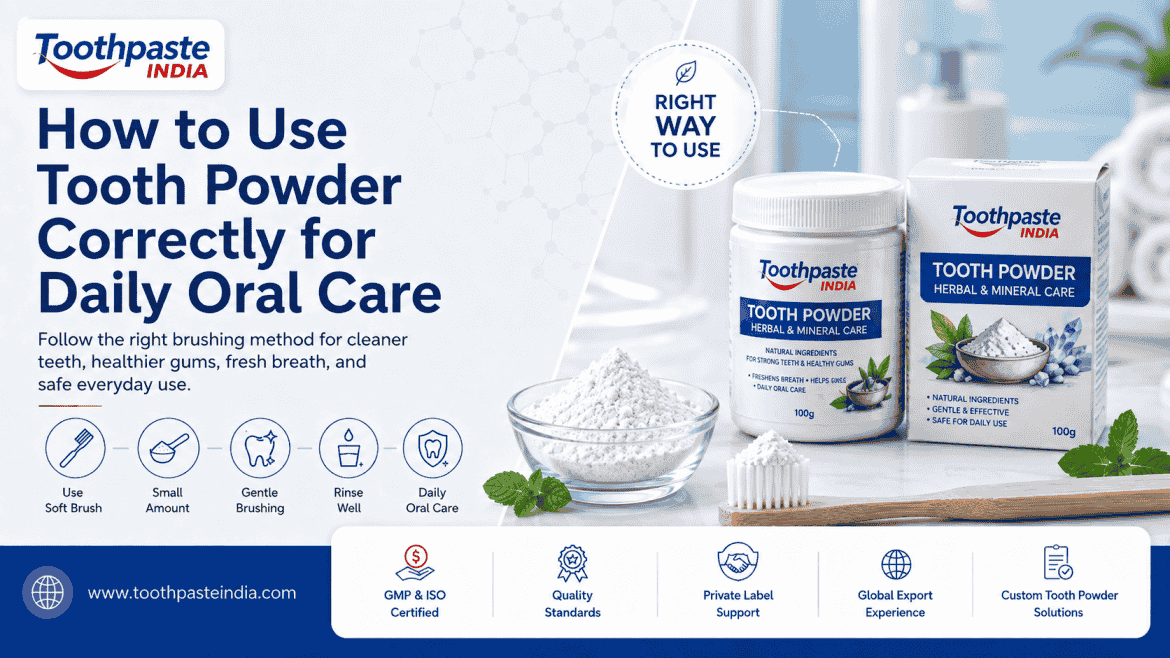

Tooth powder is a dry oral care product that cleans teeth using mild abrasives, functional actives, and sometimes herbal or ayurvedic ingredients designed to support gums and fresh breath. In India, consumers and brands are increasingly exploring tooth powder benefits as part of natural and traditional oral care routines.
However, many users still want to understand how to use tooth powder correctly for daily oral care and how tooth powder vs toothpaste compares for regular brushing. For businesses planning to launch their own oral care range, choosing an experienced tooth powder manufacturer is equally important for achieving the right formulation, quality, safety, and consumer experience.
What is tooth powder and how does it work in daily oral care?
Tooth powder is a powdered dentifrice designed to clean teeth and support oral hygiene through gentle abrasives, cleansing agents, and targeted functional ingredients. It works by mechanically removing plaque and surface stains while delivering actives to teeth and gums as part of a daily oral care routine.
Typical tooth powder formulations may include:
- Mild abrasives (e.g., calcium carbonate, hydrated silica, or herbal powders) to polish teeth and remove plaque
- Flavoring agents and natural sweeteners to improve taste and compliance
- Functional ingredients such as herbal extracts, mineral salts, or fluoride, depending on the product positioning
- Optional anti-bacterial or anti-plaque agents to support gum health and fresh breath
From a manufacturing perspective, tooth powder allows flexible positioning, including 100% herbal, ayurvedic, mineral-rich, sensitive-teeth-friendly, and SLS-free formulations. Businesses can work with a reliable private Label tooth powder manufacturer to customize ingredients, abrasivity levels, flavours, packaging, and functional actives according to their target market. An experienced tooth powder supplier can also support bulk production, private labeling, regulatory requirements, and scalable supply for startups, distributors, established brands, and export buyers.
How to use tooth powder correctly: step-by-step brushing method
The correct tooth powder brushing method is to use a small amount of powder on a damp toothbrush, brush in gentle circular motions for 2–3 minutes, and then spit and rinse thoroughly. This approach ensures effective cleaning while minimizing abrasion and product wastage.
Here is a simple tooth powder step-by-step guide:
1. Prepare your toothbrush
- Use a soft-bristled toothbrush to reduce abrasion on enamel and gums.
- Lightly wet the bristles with clean water; they should be damp, not dripping.
2. Apply the tooth powder
- Option 1: Sprinkle a small pinch of tooth powder (about 0.25–0.5 g) onto the damp bristles.
- Option 2: Tap a small amount into a clean cap or dish, then dip the damp bristles into the powder.
- Avoid dipping multiple wet brushes directly into a common jar for hygiene reasons; this is especially important in family or shared-use scenarios.
3. How to brush with tooth powder
- Place the brush at a 45-degree angle to the gum line.
- Use gentle circular motions, covering outer, inner, and chewing surfaces of all teeth.
- Brush for approximately 2–3 minutes, as you would with toothpaste.
- Avoid vigorous scrubbing, which can increase abrasion and gum recession risk over time.
4. Rinsing and finishing
- Spit out the powder and saliva mixture.
- Rinse your mouth with water until no gritty feeling remains.
- Rinse the toothbrush thoroughly and allow it to air-dry.
This routine covers how to use tooth powder for teeth cleaning, plaque removal, and fresh breath in a practical daily setting.
How much tooth powder to use and how often to use it?
The ideal tooth powder usage per brushing is a small pinch roughly 0.25–0.5 grams enough to lightly coat the bristles without forming a heavy paste. This quantity balances cleaning efficacy with controlled abrasivity and product economy.
For most adults with normal oral health, tooth powder daily use can be set at:
- Frequency: 1–2 times per day
- Duration per brushing: 2–3 minutes
- Consistency: Same timing as regular brushing (morning and/or night)
When brand owners design labels, clear directions like “use a pea-sized pinch of powder” or “use 0.25–0.5 g per brushing” can help manage consumer expectations and reduce overuse. For specific segments such as children, elderly users, or those with sensitive teeth, professional guidance on frequency and quantity is recommended.
Can you use tooth powder every day and is it safe for daily use?
Tooth powder can be safe for daily use when it is formulated with controlled abrasivity, appropriate actives, and used with correct brushing technique. Safety depends on factors like the abrasiveness index (RDA), particle size, and presence or absence of fluoride or other actives, which should align with regulatory and dentist recommendations.
Key safety considerations for daily tooth powder usage include:
- Abrasivity: Excessive abrasiveness can erode enamel; manufacturers often design powders to meet acceptable abrasion limits. Brands should verify with current regulatory guidelines and in-vitro testing.
- Sensitive teeth or gums: For users with sensitivity, powders with gentler abrasives and desensitizing ingredients may be needed.
- Herbal and ayurvedic powders: Natural does not automatically mean mild; some herbal ingredients can be quite abrasive if not controlled.
Communication on-pack should clearly address: “Is tooth powder safe for daily use?” and “Can you use tooth powder every day?” with references to laboratory data or regulatory guidance where available.
How to use tooth powder daily as part of an oral care routine?
The best way to use tooth powder daily is to integrate it into a structured tooth powder oral care routine that may include brushing, flossing, and optional mouthwash. Tooth powder can be used as a complete replacement for toothpaste or as a complementary product, depending on consumer goals and dental advice.
A sample daily routine could look like:
Morning:
- Brush with tooth powder for 2–3 minutes
- Floss or use interdental cleaners
- Optional: Use a mouthwash if recommended by a dentist
Night:
- Brush again with tooth powder or rotate with toothpaste if preferred
- Focus on thorough plaque removal and gum line cleaning
Brands can offer both toothpaste and tooth powder in their portfolio, providing guidance on “tooth powder vs toothpaste for daily use” and positioning each for specific needs (e.g., tooth powder for herbal/ayurvedic consumers, toothpaste for fluoride or specific sensitivity benefits).
How to use herbal, ayurvedic, and natural tooth powders correctly?
Herbal tooth powder is a tooth-cleaning powder formulated with plant-based ingredients like neem, clove, babool, triphala, or other traditional botanicals. Ayurvedic tooth powder follows ayurvedic principles and often includes classical herb combinations tailored for gum health, fresh breath, or kapha/pitta-balancing properties.
For herbal tooth powder how to use and ayurvedic tooth powder how to use, the basic brushing method remains the same, but brands should highlight:
- Contact time: Consumers may be advised to let the powder sit for 30–60 seconds on gums after brushing to support herbal action, if clinically justified.
- Gum massage: Some traditional routines involve gently massaging gums with a small amount of powder using a finger before brushing.
- Taste and compliance: Herbal and ayurvedic formulations may have stronger taste profiles; clear guidance and taste-optimized flavours can improve user compliance.
Natural tooth powder how to use guidelines should also emphasize that “natural” does not imply free use for all; users with specific conditions should still consult dental professionals.
Tooth powder benefits for teeth, gums, and fresh breath
Tooth powder benefits for teeth and gums come from a combination of mechanical cleaning and targeted functional ingredients. When correctly formulated and used with the proper brushing technique, tooth powder can support plaque removal, gum health, fresh breath, and surface stain removal. The specific benefits depend on the ingredients, particle size, abrasivity, and active components selected by the tooth powder manufacturer. Therefore, brands should work with a qualified manufacturing partner when developing products for specific consumer needs or benefit claims.
Typical benefit claims (subject to regulatory approval and evidence) may include:
- Tooth powder for teeth cleaning: Mild abrasives help remove plaque and extrinsic stains.
- Tooth powder for plaque removal: Consistent use with proper brushing technique supports plaque control.
- Tooth powder for gum health: Herbal or mineral ingredients may help support gingival health; claims should be evidence-based.
- Tooth powder for fresh breath: Flavours, herbal oils, and anti-microbial agents can help reduce malodour-causing bacteria.
- Tooth powder for teeth whitening: Surface stain removal can create a whitening effect; brands should avoid overstated “bleaching” claims without data.
- Tooth powder for sensitive teeth: Specialized formulations can include desensitizing agents, but these must be carefully developed and validated.
For B2B buyers, it is important to work with a manufacturer capable of tailoring particle size, abrasivity, pH balance, and actives to match the desired benefit claims and target markets.
Tooth powder vs toothpaste for daily oral care: can tooth powder replace toothpaste?
Tooth powder vs toothpaste is an important comparison for consumers as well as oral care brands. Tooth powder can appeal to consumers looking for herbal, ayurvedic, low-foaming, traditional, or SLS-free oral care options, while toothpaste remains widely preferred for convenience, fluoride-based cavity protection, and mass-market familiarity. Brands working with a private Label tooth powder manufacturer can develop customized powder formulations alongside toothpaste products to target different consumer preferences and price segments.
Key comparison dimensions for brands:
- Format: Tooth powder (dry, jar or sachet) vs toothpaste (paste, tube)
- Fluoride: Many toothpastes provide fluoride; tooth powders may be fluoride-free or fluoride-containing depending on formulation and regulations
- Consumer perception: Powders may be perceived as more “traditional”, “herbal”, or “eco-friendly”
- Shelf-life and stability: Powders are typically more stable and require fewer preservatives than pastes
For brand owners, offering both formats can capture different segments. Claims such as “can tooth powder replace toothpaste” should be made cautiously and align with dental professional guidance and relevant regulations.
Practical tips: common mistakes when using tooth powder
Common mistakes when using tooth powder often relate to quantity, technique, and hygiene. Avoiding these issues helps protect enamel and maintain consumer satisfaction.
Some frequent errors and how to correct them:
- Using too much powder: Leads to excessive abrasivity and messy usage; instruct consumers to use just a pinch.
- Hard-bristled brushes: Combined with abrasive powders, these can contribute to enamel wear; recommend soft-bristled brushes.
- Aggressive scrubbing: Emphasize gentle circular motion instead of back-and-forth scrubbing.
- Shared jars with wet brushes: This can introduce moisture and contamination; suggest using a dry spoon or cap to portion powder.
- Skipping rinsing: Users should rinse thoroughly after brushing to remove residues and prevent grittiness.
By addressing these points in product literature and packaging, brands can reduce complaints and improve long-term loyalty.
Should you rinse after using tooth powder and how long to brush?
Users should rinse after using tooth powder to remove excess abrasives and flavouring residues while leaving teeth and gums clean. Thorough rinsing reduces the risk of discomfort and makes the experience more acceptable for everyday use.
For how long to brush with tooth powder, the recommended duration remains 2–3 minutes per session, similar to toothpaste. For how many times a day to use tooth powder, most brands and professionals align with once or twice daily, but any special instructions (e.g., for sensitive teeth or specific actives) should be stated clearly on pack and aligned with dentist guidance.
Conclusion
Tooth powder for daily oral care is a versatile category that can cater to herbal, ayurvedic, natural, and specialty segments when formulated and used correctly. The key is to provide clear guidance on how to use tooth powder daily, including quantity, brushing technique, and safety considerations, so consumers feel confident and informed.
Toothpaste India an Ahmedabad-based private label and contract manufacturer works with brands, exporters, and D2C startups to develop customized tooth powder and toothpaste solutions that meet Indian and international quality expectations. If you are exploring tooth powder usage claims, herbal or ayurvedic formulations, or tooth powder vs toothpaste positioning, contact our team to discuss tailored formulations, compliance support, and scalable manufacturing options.
Frequently Asked Questions
To use tooth powder for teeth cleaning, dampen a soft-bristled toothbrush, apply a small pinch of powder to the bristles, and brush gently in circular motions for 2–3 minutes before spitting and rinsing thoroughly. This ensures effective plaque removal while minimizing abrasion and product wastage.
A small pinch, around 0.25–0.5 grams, is usually enough for one brushing session. The bristles should be lightly coated rather than heavily loaded. Using more does not necessarily improve cleaning and can increase abrasivity, especially if combined with hard brushing.
Yes, many tooth powders are designed for daily use, provided they have controlled abrasivity and appropriate actives. However, users with sensitive teeth, existing enamel wear, or gum issues should consult a dentist and follow professional guidance on frequency and product choice.
Tooth powder can be safe for sensitive teeth and gums if formulated with gentle abrasives and possibly desensitizing ingredients. Not all powders are suitable for sensitivity, so brands should clearly label their products and consumers should consult dental professionals before using a new powder regularly.
Tooth powder can replace toothpaste for some users, especially those who prefer herbal or SLS-free products. However, if fluoride-based caries protection is a priority, many consumers and professionals still rely on toothpaste. Any replacement decision should be made with dental guidance and regulatory compliance in mind.
Use herbal or ayurvedic tooth powder like any other powder: dampen the brush, apply a small amount, and brush gently for 2–3 minutes. Some traditional practices also include gentle gum massage with a small amount of powder; such usage should be supported by product directions and, ideally, clinical or traditional evidence.
Most users should rinse thoroughly after using tooth powder to remove abrasive particles and flavouring residues. If a brand suggests leaving a thin film for specific benefits, this should be clearly indicated on-pack and aligned with safety data and regulatory guidance.
The best way is to use a soft-bristled toothbrush, lightly dampen it, apply a small amount of powder, and brush using gentle circular motions at a 45-degree angle to the gum line. This method balances cleaning efficacy with gum and enamel protection.
Most users can safely use tooth powder once or twice per day as part of their routine, similar to toothpaste. For specialized formulations—such as whitening or desensitizing powders—brands should provide clear usage frequency guidance based on testing and regulatory norms.
Brands should warn against using too much powder, brushing too hard, using hard-bristled brushes, dipping multiple wet brushes into a shared jar, and skipping thorough rinsing. Packaging and educational content that address these points can significantly improve user experience and product perception.