
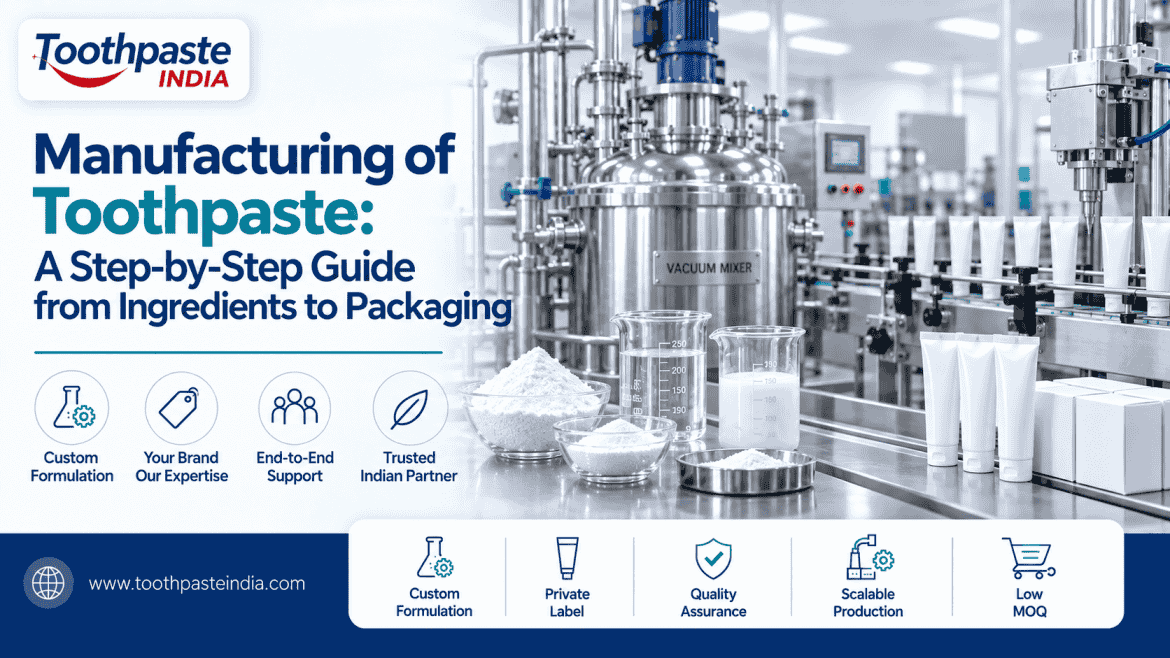

Manufacturing of toothpaste turns a product concept into a stable, consistently filled oral care product. For brand owners, distributors, D2C startups, and exporters, understanding this process helps prevent costly problems: gritty texture, inconsistent flavour, leaking tubes, or claims unsupported by testing.
A successful launch requires more than selecting attractive ingredients. The formula must work with the manufacturing equipment, remain compatible with its packaging, and meet the requirements of its destination market.
This guide explains how toothpaste is made, which production controls matter, and what to discuss with a manufacturing partner before approving commercial production. It also covers the practical decisions behind formulation, quality checks, and packaging that influence both product performance and project cost.
What ingredients are used in toothpaste manufacturing?
Toothpaste is a formulated mixture of cleaning agents, moisture-retaining ingredients, binders, and other components selected for its intended purpose.
The main constituents of toothpaste include:
- Abrasives: Hydrated silica or calcium carbonate help remove deposits and surface stains during brushing.
- Humectants: Sorbitol and glycerin help retain moisture and prevent drying.
- Binders: Cellulose gums or similar thickeners help maintain consistency.
- Surfactants: SLS or suitable alternatives support dispersion and foaming.
- Functional ingredients: Fluoride compounds may support cavity prevention where permitted.
- Supporting ingredients: Water, flavours, sweeteners, and preservatives, where needed, complete the formula.
The composition of toothpaste varies by product. A gel, herbal paste, and sensitivity-focused formula need different ingredient systems. The American Dental Association’s toothpaste overview explains these ingredient functions and fluoride’s anticaries role.
There is no single toothpaste chemical formula: toothpaste is a mixture, not one chemical compound. Its toothpaste ingredients list identifies the components, while the manufacturing formula specifies their quantities and processing requirements.
How does manufacturing of toothpaste work step by step?
The toothpaste production process moves from an approved product brief through formulation, material control, mixing, testing, and packaging.
Step 1: Define the product and develop the formulation
Toothpaste formulation development begins with the target customer, destination market, intended claims, pack size, and commercial budget.
A custom toothpaste formulation should specify flavour, texture, cleaning system, active ingredients, and packaging requirements. Ingredient compatibility matters: selecting an abrasive and fluoride system independently can compromise the finished product’s performance.
Laboratory samples establish the preferred toothpaste formulation. Pilot production then checks whether that formula transfers successfully to larger equipment.
Step 2: Approve and weigh raw materials
Raw materials for toothpaste manufacturing should be accepted against documented specifications before use.
Checks typically address material identity, supplier documentation, condition, and relevant chemical or microbiological requirements. Ingredients are then weighed against the approved batch instructions, with lot numbers recorded for traceability.
A supplier certificate supports material approval; it should not automatically replace an appropriate incoming-control programme.
Step 3: Prepare the base and disperse powders
The toothpaste mixing process typically starts with water and humectants, followed by controlled incorporation of other ingredients.
Binders need adequate dispersion and hydration to avoid lumps. Abrasives must be incorporated evenly, while the addition sequence depends on the formula and equipment.
Step 4: Control aeration and finish mixing
Vacuum mixing helps remove trapped air, improving paste uniformity.
Flavour and other finishing ingredients are incorporated under suitable conditions. Surfactants are commonly added late with gentler agitation to limit foaming.
Step 5: Test the bulk batch
The bulk paste must satisfy approved acceptance criteria before release for filling.
Record sampling results, investigate deviations, and document any authorised adjustments. A batch that looks smooth can still have an incorrect active level or fail microbiological requirements.
Step 6: Fill, seal, inspect, and pack
Toothpaste filling and packaging place the approved paste into compatible tubes, followed by sealing or crimping, coding, inspection, and secondary packing.
Check fill quantity, closure integrity, tube appearance, and code readability. Finished goods should remain under controlled status until the required release checks are complete.
Which toothpaste manufacturing equipment is needed?
A toothpaste manufacturing plant needs equipment matched to product viscosity, abrasiveness, batch size, and packaging format.
Typical toothpaste manufacturing equipment includes:
- Water-treatment systems and calibrated weighing equipment.
- Premix vessels and suitable vacuum mixers.
- Transfer pumps designed for viscous products.
- Tube-filling and sealing machines.
- Coding, inspection, and cartoning equipment.
- Laboratory instruments for the specified quality tests.
A practical scale-up consideration is that laboratory mixing speed cannot simply be copied into a larger vessel. Mixing geometry, circulation, powder addition, and heat generation all change with scale.
What does quality control in toothpaste manufacturing include?
Quality control in toothpaste manufacturing checks whether materials, bulk paste, and finished packs meet defined requirements.
Relevant toothpaste testing methods include:
- Physical checks: Appearance, homogeneity, pH, consistency, and extrusion behaviour.
- Chemical checks: Relevant active content and specified contaminants.
- Microbiological checks: Compliance with applicable microbial requirements.
- Performance assessments: Abrasivity and evidence supporting intended claims.
- Stability studies: Changes during storage in the proposed packaging.
- Packaging checks: Leakage, sealing, fill quantity, and compatibility.
Development tests and routine batch-release tests serve different purposes; not every assessment belongs on every batch certificate.
For buyers, a useful question is: “Which results are supplied for each batch, and which studies support the formulation?” This reveals more than a general promise of “quality tested.”
What regulations apply to toothpaste manufacturing in India?
Toothpaste manufacturing in India requires the appropriate licensing, product standards, and labelling compliance for the product’s classification.
For cosmetic toothpaste, review the Cosmetics Rules, 2020. BIS lists IS 6356:2021 as the toothpaste specification; confirm the applicable amendments and requirements before finalising specifications.
GMP concerns controlled manufacturing practices. ISO certificates should be checked for their actual scope, site, and validity. Neither a general ISO certificate nor an FSSAI licence substitutes for applicable toothpaste manufacturing requirements.
Herbal ingredients alone do not establish an Ayurvedic medicinal classification. Halal, vegan, and cruelty-free claims require appropriate supporting evidence. Verify classification and current regulatory guidelines with the relevant authority, especially for therapeutic claims and exports.
What affects toothpaste production cost?
Toothpaste production cost depends on the formula, order volume, packaging, testing requirements, and manufacturing complexity.
Key cost drivers include:
- Specialist ingredients, flavours, and custom development.
- Tube material, printing, caps, cartons, and pack size.
- Batch size, changeovers, process losses, and filling efficiency.
- Stability work, claim substantiation, and export documentation.
Bulk toothpaste manufacturing can spread setup costs across more units, but larger orders also increase inventory exposure.
When comparing toothpaste manufacturers in India, request quotations against the same specifications. Confirm whether development, packaging, testing, freight, and taxes are included.
How can brands move from formulation to a finished product?
A clear brief and documented approvals help turn manufacturing of toothpaste into a repeatable commercial process.
Toothpaste India, based in Ahmedabad, Gujarat, offers private label oral care and custom manufacturing support. Its published workflow covers product requirements, samples, packaging, production, and final inspection.
For private label toothpaste manufacturing or contract toothpaste manufacturing, share your target market, formulation preferences, pack size, expected quantity, and intended claims. Contact Toothpaste India to discuss samples, specifications, packaging options, and a project-specific quotation.
Frequently Asked Questions
The main steps are product briefing, formulation development, raw-material approval, weighing, controlled mixing, deaeration, bulk testing, filling, sealing, and finished-product release. Each stage should follow documented instructions. The precise sequence and operating conditions vary with the formula, equipment, packaging format, and applicable market requirements.
There is no universal main ingredient in toothpaste because formulations differ. Water, humectants, and abrasives commonly make up much of the product, while functional ingredients may appear at lower levels. Ingredient quantity alone does not determine importance: a low-dose active can provide a key benefit.
The chemistry of toothpaste involves balancing cleaning ingredients, moisture retention, texture, flavour, preservation, and functional activity. Chemical composition in toothpaste must also account for interactions between ingredients. A formula can contain individually suitable materials yet perform poorly if their combined stability or compatibility has not been assessed.
Colgate’s exact formulations and factory operating parameters vary by product and are not established by a general manufacturing guide. Broadly, commercial toothpaste production involves ingredient preparation, mixing, quality testing, and tube filling. Any claim about a specific Colgate product should rely on the company’s published information.
Herbal toothpaste manufacturing adds botanical-material controls to the usual formulation and production requirements. Extract identity, consistency, microbial quality, colour, and flavour need attention. Herbal ingredients can also affect stability and preservation. Their presence does not automatically prove safety, therapeutic effectiveness, or eligibility for Ayurvedic medicinal claims.
Yes, fluoride free toothpaste manufacturing and SLS free toothpaste manufacturing are possible, but each requires a properly developed formula. Removing SLS changes foaming and sensory properties; removing fluoride changes the basis for anticaries claims. Replacement ingredients and finished-product claims need suitable evidence and market-specific regulatory review.
Third party toothpaste manufacturing is an arrangement in which a manufacturer produces toothpaste for another company’s brand. The agreement should define specifications, testing, packaging responsibilities, release procedures, and change control. Buyers should also clarify formula ownership, confidentiality, minimum quantities, and the documents supplied with each batch.
The timeline depends on whether the project uses an established formula or requires new development. Sampling, testing, artwork approval, packaging procurement, and production scheduling all contribute. Ask for separate milestones rather than one unsupported delivery promise, especially when custom tubes or export requirements are involved.
Shelf life is established through an appropriate stability programme using the proposed formulation and packaging. Manufacturers assess relevant physical, chemical, microbiological, and packaging changes during storage. Accelerated studies can support evaluation, but shelf-life decisions should consider suitable real-time evidence and the requirements of the intended market.
Buyers should approve the formula specification, reference sample, artwork, packaging, testing plan, and commercial terms before production. Confirm that toothpaste contents match the agreed specification and declared ingredients. Also establish how deviations, rejected goods, supplier changes, complaints, and repeat-order consistency will be handled in writing.