
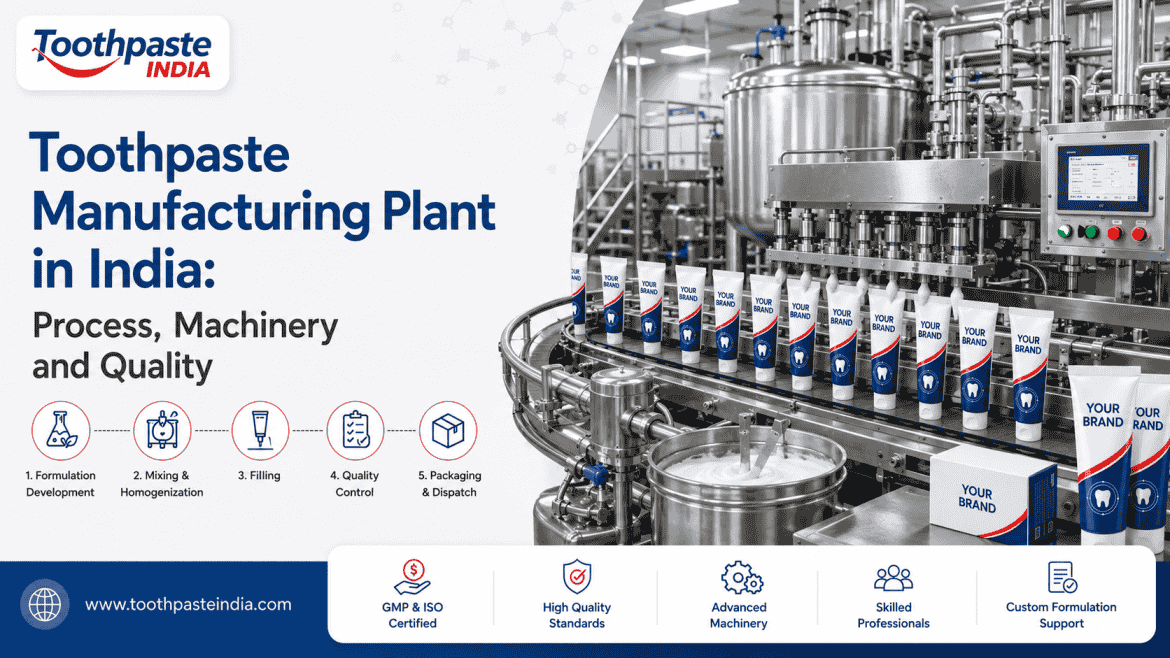

A Toothpaste Manufacturing Plant converts approved ingredients into a stable, hygienic and consistently packaged toothpaste through controlled mixing, vacuum homogenisation, quality testing, tube filling and batch documentation.
For startups and oral care brands, understanding this system helps them evaluate manufacturing partners, estimate production requirements and prevent formulation, packaging or compliance problems before launch. A modern manufacturing facility can produce conventional, herbal, fluoride-free and natural oral care ingredients based toothpaste according to the approved formula, target audience and brand positioning.
What Is a Toothpaste Manufacturing Plant?
A toothpaste plant is a controlled manufacturing facility designed to produce paste or gel dentifrices at commercial scale. It normally includes raw-material storage, weighing areas, formulation vessels, vacuum-processing equipment, holding tanks, filling machines, packaging lines, laboratories and finished-goods storage.
A modern Toothpaste Manufacturing Facility must manage more than mixing. It must control material identity, batch accuracy, texture, flavour, pH, microbiological quality, filling weight, tube sealing, coding and traceability.
In India, domestic cosmetic manufacturing is licensed and inspected by the relevant State Licensing Authority, while CDSCO regulates imported cosmetics. Cosmetic products must comply with applicable quality and safety requirements, and false or misleading claims are prohibited under the Cosmetics Rules, 2020.
Toothpaste Manufacturing Process: Step by Step
The exact Toothpaste Production Process depends on the formula, batch size, equipment and packaging format. However, most commercial plants follow the stages below.
1. Formula and Raw-Material Approval
Production begins only after Toothpaste Formulation Development, laboratory trials and sample approval are complete. Professional custom toothpaste formulation helps brands select suitable abrasives, humectants, active ingredients, botanical extracts, flavours and texture profiles before commercial production begins.
Typical Toothpaste Raw Materials include:
- Abrasives such as hydrated silica or calcium carbonate
- Humectants such as sorbitol and glycerine
- Binders or thickeners
- Surfactants
- Flavours and sweeteners
- Preservatives
- Botanical extracts
- Approved functional or active ingredients
Each incoming material should be checked against its approved specification, supplier documents and internal quality requirements.
2. Weighing and Dispensing
Raw materials are weighed according to the approved batch manufacturing record. Accurate dispensing is essential because small differences in flavour, binder, active ingredient or surfactant levels can affect taste, viscosity, foaming and product performance.
Controlled weighing also improves batch traceability and reduces formulation errors.
3. Liquid-Phase Preparation
Water, humectants and soluble ingredients are added to the processing vessel in a defined sequence. Some ingredients may require separate premixing to prevent lumps or uneven dispersion.
Temperature, mixing speed and addition order must be controlled according to the formula.
4. Abrasive and Powder Addition
Abrasives, binders and other powders are gradually introduced into the liquid base. Poor powder addition can create agglomerates, trapped air or inconsistent texture.
A suitable Toothpaste Mixing Machine should provide controlled agitation without creating excessive aeration.
5. Vacuum Homogenisation
The batch is processed using a Toothpaste Homogenizer Machine, often under vacuum. Homogenisation helps distribute ingredients evenly, while vacuum removes trapped air.
This stage supports a smoother appearance, better tube filling and more uniform texture. The equipment must be selected according to batch viscosity, vessel size and production capacity.
6. Flavour and Sensitive Ingredient Addition
Flavours, essential oils, botanical extracts and heat-sensitive materials are generally added under controlled conditions. The manufacturer must ensure that these ingredients disperse uniformly without excessive flavour loss or unwanted interaction.
7. In-Process Quality Testing
Before filling, the quality team may evaluate appearance, colour, odour, taste profile, pH, viscosity, homogeneity and other formula-specific parameters.
The batch is released for packaging only when it meets approved specifications.
8. Tube Filling, Sealing and Coding
The finished bulk is transferred to a holding tank and then to a Toothpaste Tube Filling Machine.
Depending on the tube material, the machine fills, seals, trims and codes each pack. Filling weight, seal integrity, batch number and manufacturing details must be monitored throughout the run. The selected toothpaste packaging format must be compatible with the formulation, filling equipment, sealing method, storage conditions and requirements of the intended market.
9. Secondary Packaging
Filled tubes move through the Toothpaste Packaging Process, which may include cartoning, leaflet insertion, label inspection, shrink wrapping and shipper packing.
A suitable Toothpaste Filling and Packaging Machine improves output consistency, but trained operators and line inspections remain essential.
Essential Toothpaste Manufacturing Machinery
A typical Toothpaste Manufacturing Plant Machinery List may include:
Core Processing Equipment
- Stainless-steel manufacturing vessel
- Vacuum homogeniser
- Planetary or anchor-type mixer
- Powder charging system
- Premixing vessel
- Storage and holding tanks
- Transfer pumps and pipelines
- Water-treatment system
Filling and Packaging Equipment
- Automatic or semi-automatic tube-filling machine
- Tube-sealing and trimming unit
- Batch-coding machine
- Cartoning machine
- Check-weighing system
- Label or print inspection equipment
- Shrink-wrapping and shipper-sealing equipment
An Automatic Toothpaste Manufacturing Plant can increase speed and repeatability, but automation should match realistic order volumes. A highly automated line may not be economical for brands requiring frequent formula, flavour or pack-size changes.
Toothpaste Quality Control and Testing
Effective Toothpaste Quality Control begins with raw materials and continues through processing, packaging and finished-product release.
Raw-Material Controls
The manufacturer should verify material identity, appearance, supplier documentation, microbial limits and other relevant specifications. Every toothpaste ingredient should be evaluated for quality, purity, microbial limits, regulatory suitability, supplier documentation and compatibility with the complete formulation.
In-Process Controls
Important checks may include:
- Mixing time and speed
- Processing temperature
- Vacuum level
- Product pH
- Viscosity and texture
- Colour and odour
- Batch yield
- Filling weight
Finished-Product Controls
Finished toothpaste may be evaluated for physical, chemical and microbiological specifications, packaging integrity and formula-specific requirements.
India’s BIS page identifies toothpaste under IS 6356 among the Indian Standards referenced for finished cosmetics. BIS also lists standards addressing cosmetic colourants and raw materials that are not generally recognised as safe for cosmetic use.
Stability and Packaging Compatibility
Toothpaste Stability Testing evaluates how the product behaves under defined storage conditions. Brands should monitor separation, drying, colour change, flavour loss, viscosity drift and packaging interaction.
The tube should also be tested for leakage, panel distortion, seal failure and compatibility with the formula.
GMP, Licensing and Manufacturing Standards
A GMP Toothpaste Manufacturing Plant should operate through documented procedures covering personnel hygiene, cleaning, material handling, equipment use, production control, testing, deviations and traceability.
For domestic cosmetic manufacturing in India, the applicable manufacturing licence is handled by the State Licensing Authority. The facility, technical staff, product category and documentation must meet the requirements relevant to the proposed operation.
Businesses should also verify:
- Applicable Cosmetics Rules, 2020 requirements
- Relevant BIS specifications
- Approved ingredient restrictions
- Label declarations
- Batch and manufacturing records
- Product-claim substantiation
- State pollution and local factory approvals
- Export-market requirements, where applicable
The exact Toothpaste Manufacturing License in India depends on product classification, claims and operational circumstances. Regulatory advice should be obtained before finalising the formula or artwork.
Own Plant vs Contract Toothpaste Manufacturing
Building a Toothpaste Production Plant offers direct control over equipment, scheduling and manufacturing systems. However, it also requires capital, technical staff, licensing, utilities, laboratory systems, maintenance and ongoing compliance.
Contract Toothpaste Manufacturing allows brands to manufacture through an established facility. This is usually more practical for startups, D2C companies, dental brands, exporters and businesses testing new concepts.
Related models include:
- Private Label Toothpaste Manufacturing: The manufacturer develops or supplies products under the client’s brand.
- Third Party Toothpaste Manufacturing: Production is outsourced to a licensed facility.
- Custom manufacturing: The formula, flavour, active system and packaging are developed around a specific brief.
Toothpaste Plant Setup Cost and Capacity
The Toothpaste Plant Setup Cost cannot be estimated accurately from equipment price alone.
Major cost factors include:
- Premises and clean production layout
- Batch size and automation level
- Water-treatment and utility systems
- Processing and filling equipment
- Laboratory setup
- Licensing and professional support
- Packaging-line requirements
- Warehousing and working capital
- Cleaning, maintenance and trained manpower
Toothpaste Manufacturing Capacity should be calculated from realistic demand, batch turnaround, cleaning time, filling speed and pack-size mix—not only the rated speed of one machine.
Expert Buyer Checklist
Before selecting a Toothpaste Factory in India, ask for evidence of:
- Valid manufacturing permissions
- Relevant GMP and quality systems
- Separate production and quality-control responsibilities
- Raw-material and finished-product specifications
- Batch documentation and traceability
- Laboratory and stability-testing capabilities
- Formula customisation support
- Tube and carton compatibility testing
- Realistic minimum order quantity
- Capacity and delivery timeline
- Export documentation experience
- Clear ownership of formula and artwork
Avoid choosing a manufacturer only because it offers the lowest quotation. Poor documentation, weak testing or inconsistent production can cost far more than the initial saving.
Conclusion
A toothpaste manufacturing plant requires coordinated formulation, machinery, trained personnel, hygiene controls, quality testing, compliant packaging and detailed documentation.
New brands do not always need to invest in their own facility. Working with an experienced manufacturing partner can provide access to formulation support, production infrastructure, quality systems and scalable capacity without the full cost of plant ownership.
Toothpaste India supports private-label and contract-manufacturing projects for startups, established oral care brands, dental businesses, distributors and international buyers seeking commercial toothpaste production in India.
Frequently Asked Questions
Core machinery generally includes a vacuum homogeniser, mixing vessel, premixing tank, storage tank, transfer system, tube-filling machine, sealing unit, coding machine and packaging equipment.
Ingredients are weighed, mixed in a controlled sequence, homogenised under vacuum, tested, transferred to filling equipment, packed and released after quality approval.
Vacuum helps remove trapped air from the paste. This creates a smoother product and improves filling accuracy, appearance and texture consistency.
Yes. Domestic cosmetic manufacturing is regulated through State Licensing Authorities under the applicable legal framework. Product classification and claims should be reviewed before applying.
Cost depends on facility size, batch capacity, automation, utilities, laboratory infrastructure, machinery, compliance requirements and working capital. A technical project estimate is required.
Common controls include appearance, odour, pH, viscosity, homogeneity, filling weight, microbiological quality, stability and packaging integrity.
Capacity should match expected monthly sales, MOQ, product variety and working capital. Outsourcing small initial batches is often more practical than installing a large line.
Private label often uses a manufacturer-supported formula under the buyer’s brand. Contract manufacturing may involve a more customised formula, process and packaging brief.
It helps identify separation, flavour loss, viscosity change, colour variation, microbial risk and packaging interaction before the product reaches the market.
Review licences, GMP systems, equipment, testing facilities, formulation experience, batch traceability, MOQ, capacity, packaging support and regulatory knowledge before making a decision.