
Nano hydroxyapatite toothpaste has moved from a niche oral-care concept to a serious formulation option for sensitivity, enamel-care and premium fluoride-free products. However, the performance of a toothpaste depends on far more than simply adding hydroxyapatite.
Understanding nano hydroxyapatite toothpaste ingredients is particularly important for toothpaste brand owners, D2C startups, dental brands, pharma companies and exporters. The active mineral, abrasive system, humectants, surfactants, sweeteners, flavors and pH all interact with each other.
For private-label buyers, the better question is therefore not just “Does this toothpaste contain nHAp?” but “Is the entire formula designed to support the intended claim?” For D2C startups, dental brands and established oral-care companies, investing in nano hydroxyapatite toothpaste can create opportunities in premium enamel-care, sensitivity and biomimetic oral-care segments when the product is backed by a well-designed formulation and responsible claims.
What Is the Main Active Ingredient in Nano Hydroxyapatite Toothpaste?
The main nano hydroxyapatite active ingredient is a calcium-phosphate material designed to resemble the mineral structure found naturally in enamel and dentin.
Hydroxyapatite can deposit on tooth surfaces and help fill microscopic irregularities. On exposed dentin, it can also help occlude open dentinal tubules, which is one reason nano hydroxyapatite for sensitive teeth has attracted clinical interest. The growing interest in nano hydroxyapatite for teeth comes from this biomimetic mechanism, which allows the mineral to interact directly with enamel and exposed dentin rather than functioning only as a conventional cleaning ingredient.
Randomized clinical studies have evaluated toothpaste containing different nHAp concentrations, including 10% and 15%, and reported reductions in dentin hypersensitivity. However, this does not mean one percentage is automatically ideal for every commercial formulation.
Nano hydroxyapatite for enamel is better described as supporting remineralization of early mineral loss rather than literally regrowing missing enamel.
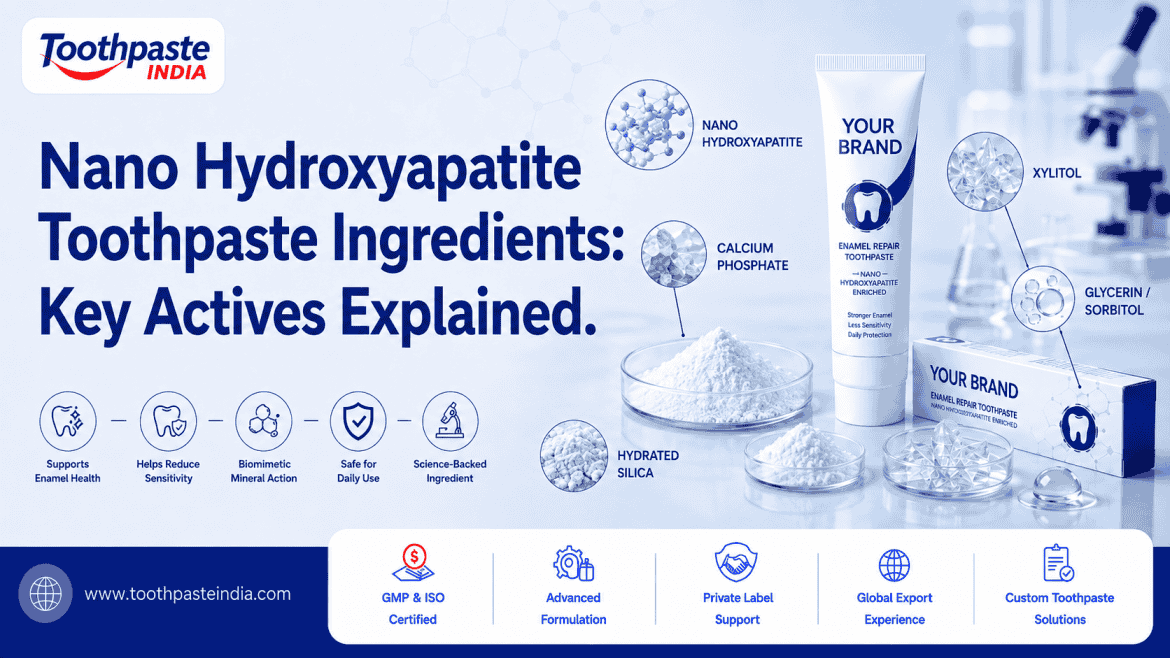
Which Nano Hydroxyapatite Toothpaste Ingredients Support the Formula?
A successful nano hydroxyapatite toothpaste formulation needs supporting ingredients with clearly defined functions.
Hydroxyapatite
Among hydroxyapatite toothpaste ingredients, HAp provides the biomimetic mineral component. Nano-scale particles are used because of their ability to interact closely with enamel and dentin surfaces.
Clinical and in-situ evidence suggests hydroxyapatite-containing oral-care products may support enamel remineralization and caries prevention, although formulation, study design and product characteristics vary. For consumers and brand owners, the benefits of nano hydroxyapatite toothpaste are linked not only to the nHAp active itself but also to how well it works with the abrasive system, humectants, surfactants and other ingredients in the finished formula.
Humectants: Sorbitol and Glycerin
Toothpaste humectants keep the paste from drying out and help maintain a smooth texture.
Sorbitol in toothpaste commonly serves as both a humectant and sweetness contributor, while glycerin in toothpaste helps retain moisture and improves mouthfeel.
The American Dental Association lists glycerol and sorbitol among common toothpaste humectants.
Abrasives: Hydrated Silica and Calcium Carbonate
Toothpaste abrasives physically assist in removing surface deposits and stains during brushing.
Silica in toothpaste is widely used because manufacturers can select grades with different cleaning and polishing characteristics. Calcium carbonate may also be used, depending on the formulation.
With biomimetic toothpaste ingredients, abrasive selection deserves particular attention because excessive abrasivity can work against a product positioned around gentle enamel or sensitivity care.
Surfactants
Toothpaste surfactants help disperse ingredients and create the foaming consumers associate with brushing.
Sodium lauryl sulfate, or SLS, is commonly used, but brands targeting sensitive or premium niches increasingly request SLS-free toothpaste ingredients and alternative surfactant systems.
SLS itself is primarily a detergent and foaming ingredient; its presence or absence should be considered alongside the complete formulation rather than treated as a measure of toothpaste quality.
Xylitol and Other Sweeteners
Xylitol toothpaste ingredients can improve taste without adding fermentable sugar.
Xylitol is also widely discussed in preventive oral care, although evidence for its independent caries-prevention benefit is mixed. A 2024 systematic review concluded that existing studies did not establish the preventive effect conclusively, so brands should avoid exaggerated claims.
How Do These Ingredients Support Enamel Remineralization?
Remineralizing toothpaste ingredients work best when the complete system supports mineral interaction with the tooth surface.
Nano hydroxyapatite enamel remineralization involves calcium-phosphate mineral depositing on or interacting with demineralized enamel. This is why nHAp is frequently used in enamel repair toothpaste ingredients and calcium phosphate toothpaste concepts.
Hydroxyapatite for teeth is particularly relevant to products positioned for:
- Early enamel mineral loss
- Sensitive teeth
- Post-whitening care
- Low-abrasive daily care
- Biomimetic oral care
- Premium fluoride-free positioning
“Enamel repair” still needs careful wording. A toothpaste may support remineralization of early demineralized areas, but it cannot reconstruct a physically broken tooth or restore an established cavity.
Nano Hydroxyapatite vs Fluoride Toothpaste: Do Brands Need to Choose One?
Nano hydroxyapatite vs fluoride toothpaste is not necessarily an either-or formulation decision.
Fluoride has extensive established evidence for preventing tooth decay. Hydroxyapatite research is growing, with recent systematic reviews reporting promising results for caries prevention and remineralization in studied fluoride-free products.
A brand may therefore consider:
- Fluoride free hydroxyapatite toothpaste for a specific consumer positioning
- nHAp combined with fluoride where formulation and market regulations allow
- Sensitivity-focused hydroxyapatite formulations
- Kids or family concepts developed according to applicable regulatory requirements
The claim strategy should be decided before finalizing the active system.
Is Nano Hydroxyapatite Safe in Toothpaste?
Safety depends on the specification of the nano-hydroxyapatite being used, not simply the ingredient name.
In its 2025 opinion, the EU Scientific Committee on Consumer Safety considered a specifically characterized form of nano-hydroxyapatite safe at up to 29.5% in toothpaste. Importantly, that conclusion applied to defined, uncoated, predominantly rod-shaped particles and did not apply to needle-shaped hydroxyapatite.
For B2B buyers, nano hydroxyapatite toothpaste raw materials should therefore be supported by appropriate documentation covering factors such as:
- Raw-material identity
- Particle characteristics
- Purity
- Heavy-metal specifications
- Certificate of Analysis
- Supplier documentation
- Intended use level
- Stability and compatibility
A percentage quoted from a research paper should never automatically become a commercial formulation specification.
What Does the Nano Hydroxyapatite Toothpaste Manufacturing Process Involve?
The nano hydroxyapatite toothpaste manufacturing process must distribute the active consistently while maintaining acceptable texture, cleaning ability, stability and consumer experience.
A typical development approach may involve:
- Preparing the water and toothpaste humectant phase.
- Hydrating binders or rheology modifiers.
- Incorporating abrasives and functional actives under controlled mixing.
- Dispersing the nHAp appropriately within the base.
- Adding toothpaste surfactants with attention to unnecessary aeration.
- Incorporating flavors and other sensitive components at the appropriate stage.
- De-aerating, conducting quality checks and filling into final packaging.
The exact order, temperature and mixing conditions depend on the raw materials and plant equipment.
For nano hydroxyapatite toothpaste manufacturing, pilot batches are particularly useful before scale-up because changing the mineral loading may affect viscosity, mouthfeel, dispersion and filling behavior. Current nano hydroxyapatite toothpaste manufacturing trends include fluoride-free enamel-care formulas, low-abrasive sensitive-tooth products, SLS-free concepts, premium biomimetic positioning and customized formulas for dental, D2C and export-focused brands.
How Should Brands Choose a Nano Hydroxyapatite Toothpaste Manufacturer?
A nano hydroxyapatite toothpaste manufacturer should understand both the active ingredient and the complete dentifrice system.
When choosing a private label nano hydroxyapatite toothpaste manufacturer, buyers should evaluate formulation expertise, nHAp raw-material specifications, testing support, customization capabilities and experience with the regulatory requirements of their intended market.
- nHAp specification and supplier documentation
- Formula customization
- Fluoride and fluoride-free options
- Abrasive and sensitivity strategy
- pH and stability testing
- Microbiological and finished-product quality testing
- Pilot-batch capabilities
- Packaging compatibility
- Regulatory documentation
- Export-market requirements
Toothpaste India is an Ahmedabad, Gujarat-based B2B toothpaste manufacturing business serving brand owners seeking private-label and contract manufacturing solutions. For nHAp projects, formulation decisions should begin with the target market and intended claims rather than copying a competitor’s ingredient list.
What Regulations Should Indian Toothpaste Brands Check?
In India, toothpaste is covered by the Cosmetics Rules, 2020. The Ninth Schedule specifically lists toothpaste against BIS standard IS 6356, and BIS currently lists IS 6356:2021 for tooth paste specifications.
Brands should therefore verify the latest requirements covering ingredient suitability, manufacturing licensing, labelling, safety, finished-product specifications and claims before launch.
FSSAI should not be assumed to be the primary regulatory framework simply because some toothpaste ingredients are also food-grade ingredients. Product classification and applicable requirements should be checked under current cosmetic and other relevant regulations.
Conclusion: What Makes a Strong nHAp Formula?
The best nano hydroxyapatite toothpaste ingredients work as a system rather than as isolated marketing actives. Hydroxyapatite provides the biomimetic mineral component, while carefully chosen humectants, toothpaste abrasives, surfactants, binders, flavors and supporting ingredients determine stability and everyday performance.
For brands planning a customized enamel-care, sensitive-teeth or fluoride-free formula, Toothpaste India can support formulation development, private-label production and contract manufacturing based on your target market and positioning.
Contact the Toothpaste India team to discuss your nano hydroxyapatite toothpaste concept, ingredient strategy and manufacturing requirements.
Frequently Asked Questions
Nano hydroxyapatite toothpaste commonly contains nHAp as the functional mineral plus humectants such as sorbitol or glycerin, abrasives such as hydrated silica, binders, surfactants, flavors and sweeteners. Some formulas may additionally contain fluoride, xylitol or sensitivity-focused ingredients.
Nano hydroxyapatite is used to provide tooth-like calcium-phosphate mineral that can interact with enamel and dentin. Research suggests it may support remineralization of early enamel mineral loss and help reduce sensitivity by occluding exposed dentinal tubules.
There is no universal percentage that is best for every formulation. Clinical studies have tested concentrations such as 10% and 15%, while regulatory safety limits can depend on precise particle specifications. Finished-product performance should be validated rather than selecting concentration from marketing claims alone.
Neither ingredient should automatically be described as universally better. Fluoride has long-established anticaries evidence, while hydroxyapatite has growing clinical evidence for remineralization, caries prevention and sensitivity applications. Product choice should consider age, caries risk, formulation and professional dental advice.
Nano-hydroxyapatite may support remineralization of early demineralized enamel, but “repair” should not be interpreted as regrowing a physically lost part of a tooth. Cavities, fractures and significant enamel loss require professional dental assessment.
Hydrated silica can function as a cleaning and polishing abrasive. Different silica grades provide different levels of cleaning, thickening and mouthfeel, making abrasive selection particularly important when formulating an enamel-care or sensitivity-focused nHAp toothpaste.
Glycerin and sorbitol are primarily toothpaste humectants. They help prevent water loss, maintain a smooth paste consistency and contribute to mouthfeel. Sorbitol can also provide sweetness without using conventional cariogenic sugar.
Yes. An SLS-free nano hydroxyapatite toothpaste can be formulated using a suitable alternative surfactant system. The choice depends on desired foaming, sensory profile, ingredient compatibility and the intended sensitive-care or premium positioning.
A 2025 SCCS assessment found specifically characterized nano-hydroxyapatite safe in toothpaste up to 29.5%, but the conclusion applies only to particles meeting defined specifications and excludes needle-shaped HAp. Brands should therefore evaluate the actual raw material rather than relying only on the ingredient name.
Yes, brands can explore private-label nHAp toothpaste, but the finished product, claims, ingredients, manufacturing and labelling need to meet applicable Indian requirements. Toothpaste is covered under India’s Cosmetics Rules and the relevant BIS toothpaste specification, so current regulatory requirements should be verified before launch.