
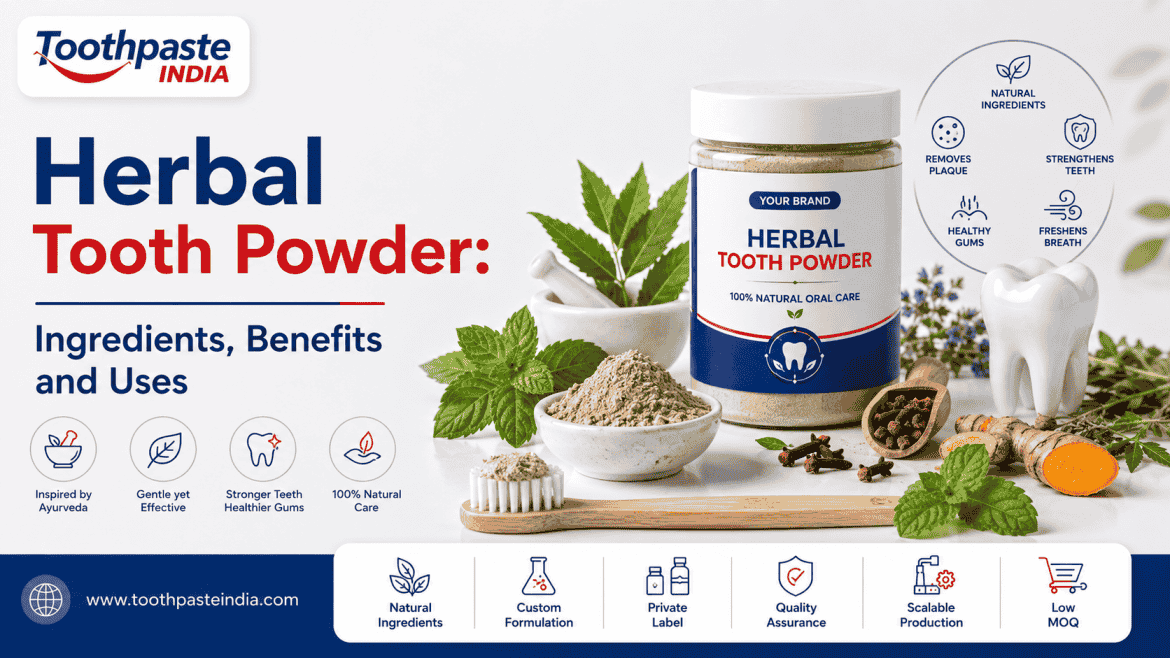

Herbal tooth powder combines the traditional idea of dant manjan with modern oral-care formulation and manufacturing standards. Instead of a paste base containing water, humectants and thickeners, herbal tooth powder is supplied as a dry blend that is applied to a wet toothbrush or used according to the product directions.
Interest in herbal dental powder has increased alongside demand for Ayurvedic, natural, fluoride-free, charcoal, botanical and minimalist oral-care products. For brand owners, distributors, D2C startups and exporters, however, developing the best herbal tooth powder requires more than combining a few herbs.
Ingredient particle size, abrasivity, flavour, moisture control, microbiological quality, packaging compatibility, product claims and regulatory classification all influence whether a formulation can become a commercially viable oral-care product.
What Is Herbal Tooth Powder?
Herbal tooth powder is a powdered dentifrice containing botanical ingredients together with cleansing, polishing, flavouring or other functional components for oral hygiene.
Traditional products may also be described as herbal dant manjan, herbal manjan, Ayurvedic dental powder, herbal tooth & gum powder or Ayurvedic powder for teeth.
A modern commercial formulation may contain:
- Botanical powders or extracts
- Mild cleaning or polishing agents
- Natural flavours or essential oils
- Sweeteners such as xylitol
- Mineral ingredients
- Flow-control ingredients
- Functional actives permitted for the intended regulatory category
Unlike toothpaste, tooth powder does not require the same water-based paste structure. For consumers and brands comparing tooth powder vs toothpaste, one of the biggest differences is product format: toothpaste is typically a semi-solid formulation, while tooth powder is a dry blend that depends heavily on controlled particle size, powder flow and moisture protection.
What Are the Main Herbal Tooth Powder Ingredients?
Herbal tooth powder ingredients should be selected according to the intended benefit, regulatory positioning and required sensory profile rather than simply adding as many herbs as possible. When developing a commercial formula, the choice of tooth powder ingredients influences cleaning performance, taste, texture, abrasivity, stability and final product positioning.
Neem
Neem is widely associated with Indian herbal dental care and is commonly used in herbal and Ayurvedic oral-care formulations. Depending on the formulation, neem powder or suitable extracts can contribute to a botanical oral-care positioning.
Clove
Clove has a strong traditional association with oral care and gives formulations a distinctive warm flavour. Because concentrated clove components can be powerful, dosage should be controlled by a qualified formulator rather than added arbitrarily.
Turmeric
Turmeric is increasingly used in botanical oral-care concepts. Research on curcumin-based oral-care products suggests potential plaque- and gingival-care applications, although stronger and longer-term clinical evidence is still required.
A turmeric powder toothpaste or tooth powder therefore needs responsible claims rather than promises to cure gum disease.
Miswak and Other Botanicals
Miswak, babool, tulsi, amla, fennel, cinnamon, cardamom and other botanical ingredients may be incorporated according to formulation objectives.
Herbal oral-care products studied in the scientific literature have included ingredients such as neem, clove, miswak, turmeric, charcoal and green tea. A 2024 overview of systematic reviews found potentially useful effects for some herbal oral-care products but also highlighted short study duration and inconsistent evidence.
Calcium-Based Cleaning Agents
A commercial herbal dental powder may require a suitable polishing or cleaning system to physically remove surface deposits.
The concentration and particle characteristics matter. A formulation that is unnecessarily abrasive may clean aggressively while being unsuitable for frequent use.
Xylitol
Xylitol powder for teeth products is attractive because xylitol is non-fermentable by many oral bacteria and provides sweetness without conventional sugar.
However, brands should avoid presenting xylitol as a guaranteed cavity cure. A recent systematic review concluded that evidence for its anticaries effect remains inconclusive because clinical studies vary considerably.
Charcoal
Charcoal powder for teeth remains commercially popular, particularly in whitening-focused formulations. Activated charcoal can support a strong visual and natural-product concept, but whitening and safety claims require caution.
The American Dental Association notes that evidence is insufficient to demonstrate reliable whitening benefits from charcoal oral-care products with adequate safety and effectiveness.
What Are the Main Herbal Tooth Powder Benefits?
Herbal tooth powder benefits depend entirely on the formula; the word “herbal” alone does not guarantee better oral-health performance.
Some of the commonly expected tooth powder benefits include surface cleaning, removal of certain superficial deposits, fresher breath and support for routine oral hygiene when the product is properly formulated and used correctly.
A properly formulated product may offer:
- Mechanical cleaning of tooth surfaces
- Removal of some superficial deposits
- Fresh-breath positioning
- Herbal or Ayurvedic product positioning
- Support for routine gum hygiene
- Dry, water-light product format
- Convenient formulation for selected natural-product concepts
- Fluoride-free or specialty positioning when legally and scientifically appropriate
Some consumers search for herbal powder for teeth cavity concerns. Brands should be especially careful here. A herbal powder should not automatically be promoted as preventing or treating cavities unless its composition, regulatory status and supporting evidence justify that claim.
Scientific reviews suggest some herbal toothpastes and mouthrinses may reduce plaque and gingival inflammation, but the quality and consistency of evidence varies, and herbal formulations should be considered part of good daily oral hygiene rather than a replacement for necessary dental treatment.
Can Herbal Tooth Powder Whiten Teeth?
Herbal tooth powder may help remove certain superficial stains through brushing and polishing, but it should not automatically be considered a true bleaching treatment.
Products marketed as whitening toothpaste powder may contain polishing ingredients, charcoal or other components designed for surface stain removal.
It is important to distinguish surface stain removal from changing the intrinsic colour of teeth.
The same caution applies to purple teeth whitening powder and purple tooth powder. Purple pigments can create a temporary optical colour-correcting effect, but that is different from chemically bleaching tooth structure.
Consumers also search phrases such as “baking powder can whiten teeth.” Baking powder and baking soda are not the same ingredient, and household DIY powders should not be recommended simply because they appear in online whitening remedies. Poorly controlled abrasiveness can increase the risk of unwanted tooth wear.
What Is a Remineralising Tooth Powder?
A remineralising tooth powder is a formulation designed around ingredients intended to support the mineral environment of tooth enamel, but the term should only be used when the formulation and evidence support the claim.
The effectiveness depends on the actual active ingredient, its concentration, availability during use and the product’s regulatory positioning.
For B2B brands, “remineralising” should therefore be treated as a technical formulation claim rather than merely a marketing keyword.
How Should Herbal Tooth Powder Be Used?
For consumers wondering how to use tooth powder, the simplest method is to apply a small quantity to a wet, soft-bristled toothbrush and brush gently according to the finished product’s directions.
A practical routine is:
- Wet a soft-bristled toothbrush.
- Dispense a small quantity of powder without contaminating the container.
- Brush gently across all tooth surfaces.
- Avoid aggressive scrubbing.
- Spit out the product after brushing.
- Follow the instructions provided on the finished product label.
Consumers should avoid excessive use simply because a product is labelled natural or herbal.
People with persistent bleeding gums, dental pain, sensitivity, cavities or other oral-health problems should seek professional dental advice rather than relying solely on a tooth and gum powder.
How Is Herbal Tooth Powder Manufactured Commercially?
Commercial herbal tooth powder manufacturing requires controlled weighing, sieving, dry blending, quality checks and hygienic filling rather than simple household-style mixing.
An experienced tooth powder manufacturer must control raw material quality, botanical identity, particle size, blend uniformity, moisture exposure, filling accuracy and packaging compatibility to achieve reliable batch-to-batch quality.
India’s Cosmetics Rules, 2020 specifically list weighing and measuring devices, a dry mixer or powder blender, stainless-steel sieves, and powder filling and sealing equipment for general tooth-powder manufacture.
A typical industrial workflow includes:
1. Raw Material Qualification
Botanicals, minerals, flavours and other ingredients are evaluated against approved specifications.
For herbal raw materials, identity, cleanliness and supplier documentation are especially important because natural materials can vary from batch to batch.
2. Sieving and Particle Control
Powders are sieved to achieve a more consistent particle profile and remove unwanted agglomerates.
Particle control directly affects texture, powder flow and the consumer’s brushing experience.
3. Controlled Dry Blending
Ingredients are blended in an appropriate powder mixer until the batch reaches the required uniformity.
Strong flavours and low-dose functional ingredients need careful dispersion to prevent concentration differences within the batch.
4. In-Process and Finished Product Checks
Depending on formulation and specification, checks may cover appearance, odour, moisture, flow characteristics, fill weight, microbiological quality and other relevant quality parameters.
A manufacturer should also evaluate the finished product against applicable regulatory and product-standard requirements.
5. Moisture-Protective Filling
The finished herbal tooth and gum powder is filled into a suitable jar, bottle, shaker or other compatible pack.
For dry powders, closure integrity and protection from humidity are critical because moisture can affect flow, stability and consumer experience.
Which Regulations Apply to Tooth Powder in India?
Commercial tooth powder must be evaluated under the regulatory framework applicable to the specific product classification, ingredients and claims.
For cosmetic tooth powders, the Cosmetics Rules, 2020 are directly relevant. CDSCO states that cosmetics manufactured or imported in India must comply with applicable quality and safety standards and must not carry false or misleading claims.
The Bureau of Indian Standards lists IS 5383 for tooth powder among Indian standards referenced for cosmetics.
If a product is positioned and licensed as an Ayurvedic medicine rather than a cosmetic oral-care product, a different regulatory route under the applicable Ayurvedic, Siddha and Unani drug framework may become relevant.
FSSAI should not automatically be assumed to be the primary regulator merely because some ingredients are edible.
Before launch, brands should verify:
- Product classification
- Manufacturing licence requirements
- Applicable BIS specifications
- Ingredient restrictions
- Label declarations
- Claims
- Stability and safety requirements
- Export-country regulations
GMP, ISO, Halal, Vegan or Cruelty-Free claims should only be printed when the applicable facility, product, certification or documented process genuinely supports them.
Why Is Herbal Tooth Powder an Opportunity for Private Label Brands?
Herbal tooth powder gives oral-care brands an opportunity to combine familiar Indian Ayurvedic positioning with differentiated modern formats.
Working with an experienced private label tooth powder manufacturer can help brand owners move from product concept to formulation, testing, packaging and commercial production while maintaining greater consistency and regulatory control.
Potential product concepts include:
- Ayurvedic herbal tooth powder
- Neem and clove herbal dental powder
- Herbal tooth & gum powder
- Charcoal powder for teeth
- Herbal dant manjan
- Fresh-breath botanical powder
- Xylitol-based tooth powder
- Whitening tooth powder
- Modern Ayurvedic dental powder
- Export-oriented herbal oral-care powder
The best Ayurvedic powder for teeth is not necessarily the product with the longest ingredient list. For a commercial brand, a focused formula with an understandable benefit, controlled taste, appropriate abrasivity, strong packaging and compliant claims often creates a clearer market proposition.
How Can Toothpaste India Help Develop a Private Label Herbal Tooth Powder?
Toothpaste India is an Ahmedabad-based oral-care manufacturer offering tooth powder, herbal toothpaste, Ayurvedic toothpaste, private label and contract manufacturing solutions for Indian and international brands. The company’s existing tooth-powder offering includes herbal, Ayurvedic, charcoal and private-label product concepts.
For companies looking for a reliable tooth powder manufacturer, the development process can include ingredient selection, formulation planning, flavour development, packaging selection, product positioning and commercial manufacturing based on the requirements of the target market.
As a private label tooth powder manufacturer, Toothpaste India can work with brand owners, distributors, D2C startups and exporters to develop herbal, Ayurvedic, charcoal, whitening and other customised tooth powder concepts.
For a B2B project, formulation discussions can include the target consumer, ingredient concept, herbal positioning, flavour profile, pack type, product claims, target market and commercial requirements.
Instead of simply asking for the “best herbal tooth powder,” brand owners should develop a clear product brief: Who will buy it? What problem or preference does it address? Which claims can be supported? How will it differ from existing dant manjan or whitening powders?
That approach creates a stronger foundation for private label development and long-term brand growth.
Conclusion
Herbal tooth powder combines traditional herbal teeth-cleaning concepts with modern oral-care formulation, manufacturing and branding opportunities. Neem, clove, turmeric, miswak, xylitol, charcoal and other ingredients can support differentiated concepts, but performance depends on the complete formulation not on a single trendy ingredient.
For brand owners, the priority should be a balanced herbal tooth powder with suitable cleaning performance, acceptable abrasivity, controlled flavour, quality raw materials, appropriate packaging and compliant claims.
If you are planning to launch a herbal dental powder, Ayurvedic tooth powder, herbal manjan or private label tooth and gum powder, contact Toothpaste India to discuss formulation development, custom branding, packaging and contract manufacturing for your target market.
Frequently Asked Questions
Herbal tooth powder is a dry dentifrice containing botanical ingredients together with cleaning, polishing, flavouring or other functional ingredients. It is generally used with a toothbrush for routine oral hygiene and may be marketed as herbal dental powder, Ayurvedic tooth powder or herbal dant manjan depending on its composition and regulatory positioning.
Common herbal tooth powder ingredients may include neem, clove, turmeric, miswak, babool, tulsi, fennel, cinnamon, mineral cleaning agents, flavours and sweeteners such as xylitol. The exact combination should be determined by product objectives, safety, abrasivity, regulatory requirements and intended consumer claims.
A properly formulated herbal tooth powder may help clean tooth surfaces, remove some superficial deposits, freshen breath and support daily oral hygiene. Benefits depend on the complete formula. Herbal ingredients should not automatically be assumed to prevent cavities, cure gum disease or outperform clinically established oral-care treatments.
An Ayurvedic herbal tooth powder may be suitable for regular use when it has been professionally formulated, manufactured and tested for its intended use. Frequency should follow the product directions. Highly abrasive powders or aggressive brushing techniques may not be appropriate for frequent use.
No tooth powder should be marketed as physically removing an established dental cavity. Consumers searching for herbal powder for teeth cavity treatment should understand that a cavity may require professional dental assessment and treatment. Appropriate oral-care products can form part of prevention and daily hygiene but do not replace restorative dentistry.
Charcoal powder may remove some surface deposits through abrasive action, but evidence for meaningful and safe tooth whitening remains limited. The ADA reports insufficient evidence to demonstrate reliable whitening benefit with adequate safety and effectiveness for charcoal oral-care products.
Xylitol is a non-sugar sweetener widely used in oral-care formulations, but its cavity-prevention benefits should not be overstated. Recent systematic-review evidence found that the anticaries effect of xylitol could not be confirmed with certainty because available clinical studies are heterogeneous.
Baking powder should not be confused with baking soda, and DIY whitening powders are not automatically safe simply because they are household ingredients. Tooth-whitening products require controlled formulation and abrasivity. Repeated aggressive use of abrasive DIY preparations may damage tooth surfaces instead of producing healthy whitening.
Not necessarily. A purple tooth powder may use colour-correcting pigments designed to make yellow tones appear temporarily less noticeable, whereas whitening products may rely on polishing or validated bleaching mechanisms. Brands should accurately describe the mechanism and avoid implying permanent whitening when the effect is primarily optical.
Yes. Brand owners can work with an experienced oral-care manufacturer to develop private label herbal tooth powder, select ingredients, create packaging and manufacture commercial batches. Before launch, the product’s classification, claims, labelling and applicable Indian or export-market regulatory requirements should be verified.