
Launching a new oral care product or expanding an existing dental line requires making a fundamental supply chain decision: should you choose Contract Manufacturing vs Private Label? For startups, e-commerce brand owners, and pharmaceutical companies, selecting the wrong production model can lead to wasted capital, inventory bottlenecks, or product quality failures. At Toothpaste India a premier oral care manufacturer in India based in Ahmedabad, Gujarat we guide brands through this selection daily. Whether you are launching a therapeutic toothpaste or a Travel Size Mouthwash, choosing your brand manufacturing partner is a critical step that shapes your product development cycle, initial capital expenditure, and time-to-market speed.
What is the Difference Between Contract Manufacturing and Private Label?
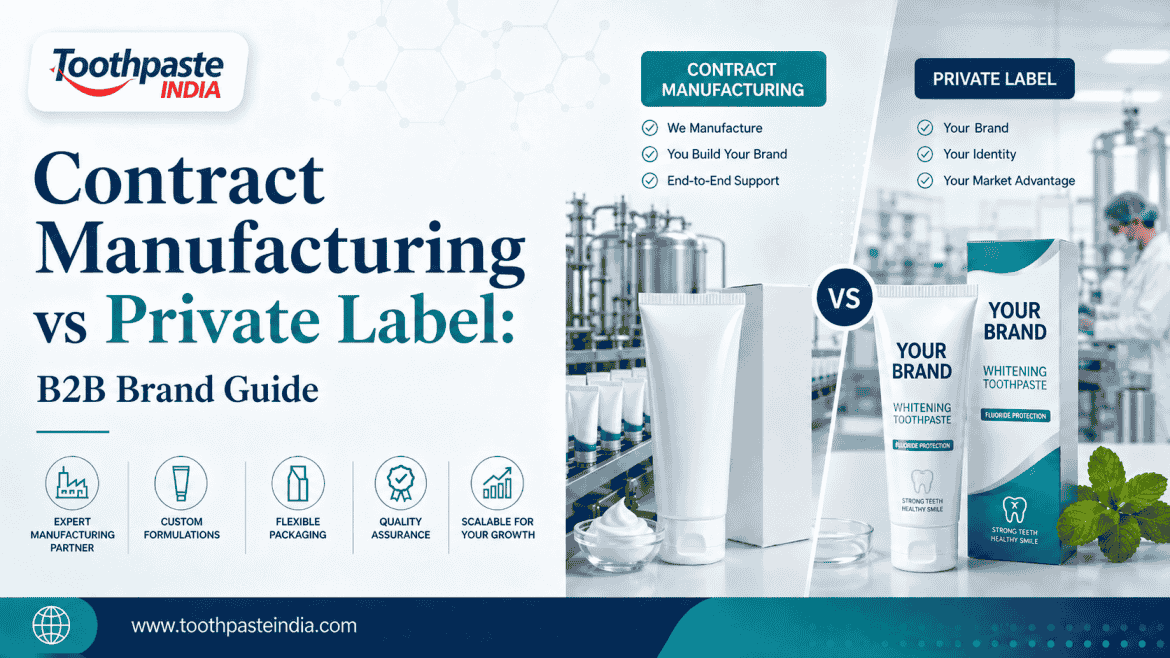
The difference between contract manufacturing and private label lies primarily in formulation ownership, control over the manufacturing process, and initial capital requirements. Both are B2B manufacturing models designed to help brands scale without building physical factories, but they serve different business strategies.
Contract manufacturing is a B2B model where a brand hires a manufacturer to produce a completely custom product according to the brand’s proprietary specifications. Under this model, the brand provides or funds the custom formulation manufacturing, specifies the raw materials, and defines the toothpaste packaging requirements. The manufacturer acts as the execution partner, utilizing their facility, workforce, and machinery to mix, fill, and pack the products.
Private label manufacturing is a B2B model where a brand selects an existing, pre-formulated product from a manufacturer’s library and sells it under their own brand name. The private label manufacturer owns the formulation, handles the raw material sourcing, and offers standardized private label packaging options. This model is often referred to as ready formula manufacturing because it requires zero formulation R&D from the brand.
What is the Meaning of Contract Manufacturing for Brands?
To fully evaluate contract manufacturing vs private label manufacturing, we must first look at the contract manufacturing meaning and its specific applications for growing brands. Contract product manufacturing is an outsourced manufacturing arrangement where the brand maintains intellectual property (IP) control.
This model is ideal for established brands and pharmaceutical companies that require high degrees of product differentiation. For example, if a brand wants to manufacture a clinically active sensitivity toothpaste utilizing a custom toothpaste formulation (such as a specific percentage of potassium nitrate paired with an SLS-free foaming system), they require contract manufacturing.
Key benefits of contract manufacturing for brands include:
Intellectual Property Ownership: Your brand owns the proprietary chemical recipe, giving you long-term asset value.
Custom Toothpaste Formulation: In our Ahmedabad facility, our R&D chemists can modify viscosity, pH balance, and abrasive levels (RDA) to match your exact performance criteria.
Packaging Flexibility: You can choose custom toothpaste packaging shapes, special laminate barriers (like ABL or PBL), and unique retail boxes.
Bulk Manufacturing Efficiencies: This model is optimized for high-volume runs, offering a lower cost-per-unit for bulk toothpaste manufacturing.
However, contract manufacturing for startups can be challenging due to higher initial research costs and higher minimum order quantities (MOQs) required to offset machine setup times.
What is the Meaning of Private Label for Brands?
Understanding the private label meaning is crucial for brands that want to minimize initial investment and fast-track their launch. Private label for brands is a commercial arrangement where a manufacturer licenses their pre-developed, regulatory-approved formulations to a brand.
For example, at Toothpaste India, we have a library of stable, pre-tested formulations, including herbal toothpaste, fresh breath gel, and charcoal whitening pastes. A brand can choose one of these ready formula toothpaste options, supply their artwork, and start selling within a few weeks.
Key benefits of private label manufacturing benefits for brands include:
Faster Time-to-Market: Because the formulation is already developed and stability-tested, you skip the 3-to-6-month R&D phase.
Low MOQ Toothpaste Manufacturing: Private label allows for smaller production runs (often starting at 10,000 tubes), making it the preferred private label manufacturing for startups.
Reduced Financial Risk: No upfront formulation development fees or regulatory testing costs are required.
Simplified Compliance: The formulation is already registered with state licensing bodies, such as the Food and Drug Control Administration (FDCA) in Gujarat.
The primary limitation of private label is product differentiation. Since the formulation is owned by the manufacturer, other brands may sell a very similar toothpaste formulation under different labels.
OEM vs Private Label: Clearing Up the Terminology
In the B2B manufacturing sector, terms like OEM manufacturing, third party manufacturing, and white label toothpaste manufacturing are often used interchangeably, leading to confusion.
OEM manufacturing (Original Equipment Manufacturer) is the technical equivalent of contract manufacturing. An OEM toothpaste manufacturer in India produces toothpaste based on the client’s design, formulation, and engineering specifications. The client owns the product design and formula IP.
White label manufacturing is similar to private label, but the customization is even more restricted. In white label vs private label, white label products are completely identical across all buyers, with only the brand sticker changed. Private label allows for minor modifications, such as choosing a custom flavor, adjusting the color, or selecting different toothpaste packaging support options.
Third party manufacturing in India is a broad term that encompasses both contract toothpaste manufacturing vs private label toothpaste manufacturing. When a brand hires a third party manufacturer in India, they are outsourcing the physical production to a specialized facility, whether they use a custom or a ready formula.
How to Choose Between Contract Manufacturing and Private Label?
Choosing contract manufacturing or private label which is right for your brand depends on your business stage, budget, and competitive positioning. If your brand relies on a unique selling proposition (USP) that requires a proprietary ingredient or a patented delivery system, contract manufacturing is the only viable option.
When comparing contract manufacturing vs private label for startups, private label is almost always the recommended starting point. Startups typically have limited capital and need to validate their product-market fit quickly. Launching with private label toothpaste vs contract toothpaste manufacturing allows a new brand to preserve capital for digital marketing and customer acquisition.
Conversely, established brands with stable distribution channels should choose contract manufacturing. When your volume reaches bulk manufacturing scale (typically 50,000 tubes or more per batch), contract manufacturing provides better unit economics, absolute control over raw ingredients, and a defensible IP barrier against competitors.
What are the Regulatory and Quality Standards in India?
Regardless of whether you choose contract toothpaste manufacturing vs private label toothpaste manufacturing, your product must comply with Indian and international regulatory standards. In India, oral care products are regulated under the Drugs and Cosmetics Act, 1940, and must adhere to the Bureau of Indian Standards (BIS IS 6356) for toothpaste.
At our state-of-the-art toothpaste manufacturing company in India based in Ahmedabad, we ensure that both custom and ready-formula products meet these rigorous requirements:
ISO 22716 (GMP for Cosmetics/Oral Care): Guides our sanitary design, manufacturing steps, and hygienic procedures.
WHO-GMP: Required for pharmaceutical-grade medicated toothpastes (such as potassium nitrate or chlorhexidine formulations).
Ayush Manufacturing License: Necessary for manufacturing authentic Ayurvedic toothpaste and herbal toothpaste formulations.
Our quality assurance laboratory tests every batch for critical parameters including viscosity, pH levels, active ingredient assay (such as fluoride levels), and microbial contamination before the paste is transferred to the toothpaste tube filling station.
Why Choose a Toothpaste Manufacturing Partner in Gujarat?
Gujarat has emerged as the premier hub for chemical and pharmaceutical manufacturing in India. Partnering with a toothpaste manufacturer in Gujarat, particularly a toothpaste manufacturer in Ahmedabad, offers unique logistics and sourcing advantages.
Ahmedabad is home to major raw material suppliers for essential toothpaste ingredients, including hydrated silica, calcium carbonate, sorbitol, and high-quality packaging materials. This localized supply chain reduces transport costs and lead times. Furthermore, Ahmedabad’s proximity to major shipping ports like Mundra and Kandla makes it an ideal location for export-oriented brands searching for a bulk toothpaste supplier India partner.
At Toothpaste India, we combine these regional advantages with state-of-the-art automation. Whether you require a low MOQ toothpaste manufacturer for an e-commerce pilot or a high-volume third party toothpaste manufacturer in India for a global export contract, our facility is equipped to scale with your brand.
Partner with Toothpaste India for Your Next Launch
Choosing your brand manufacturing partner is one of the most critical decisions you will make. At Toothpaste India, we offer both advanced contract manufacturing company services and highly profitable private label toothpaste manufacturer options.
From custom toothpaste formulation development to high-speed toothpaste tube filling and custom packaging support, we handle the technical complexities so you can focus on building your brand.
Contact our B2B team in Ahmedabad today to discuss your project requirements, request sample formulations, or schedule a tour of our certified manufacturing facility.
Frequently Asked Questions
The main difference is formulation ownership. Under contract manufacturing, the brand owns the custom formula and product IP, whereas under private label, the manufacturer owns the ready-made formula and licenses it to the brand.
Private label is generally better for startups because it offers lower minimum order quantities (MOQs), faster time-to-market, and eliminates upfront formulation development and stability testing costs.
Yes, while you use a ready formula toothpaste, you can fully customize the external artwork on the tube laminate and retail carton. Many private label manufacturers also offer a choice of cap styles and box finishes.
OEM (Original Equipment Manufacturer) manufacturing refers to a contract manufacturing arrangement where the manufacturer produces toothpaste according to the exact formulation, design, and raw material specifications provided by the brand.
In contract manufacturing, the brand typically owns the product license, but the manufacturing partner assists in preparing the technical dossiers and securing manufacturing approvals from regulatory bodies like the state FDCA or Ayush department.
A reliable toothpaste manufacturing partner should hold ISO 22716 (GMP for Cosmetics/Oral Care), WHO-GMP, state FDCA manufacturing licenses, and specialized certifications like Halal, Vegan, or Cruelty-Free depending on your target market.
Yes, as your brand grows and sales volumes increase, you can work with your manufacturing partner to transition the product to a custom contract manufacturing model to optimize unit costs and secure exclusive formulation rights.
Our quality control lab tests key raw materials including abrasives (silica, calcium carbonate), humectants (sorbitol, glycerin), active ingredients (fluoride, desensitizers), and flavor oils for purity, heavy metals, and microbial load.
Ahmedabad is a preferred location due to its established pharmaceutical industrial corridor, easy access to key raw chemical suppliers, lower manufacturing overheads, and close proximity to major export ports in Gujarat.